

Why web-to-print projects stall, and how to tell early
Web-to-print projects usually stall because three decisions were never made before the build started: who owns the pricing rules, what exact file production will accept, and how orders reach the production system. Code written ahead of those decisions is rewritten each time one is settled, so the schedule moves while the scope looks the same.
Start a project brief Explore servicesReviewed by CEO, Netbase JSC · Published 28 Sep 2026 · Updated 3 Oct 2026 · 10 min read

Why do web-to-print projects stall?
A web-to-print project stalls when the build starts before three business decisions are made: who owns the pricing rules, what file production will accept, and how an order reaches the production system. Each of those decisions changes the data model underneath the storefront. When one is settled halfway through the build, the code already written around a guess has to be reworked, and the project appears to slow down for no visible reason.
This article sets out that thesis as of September 2026, the signs that show a project is heading that way, and what a print business can check before more budget is committed. It is an insight: a dated, arguable position, not a service description and not a survey. It does not estimate how often projects stall, because no published measurement supports a number.
Where do stalled projects usually sit?
-
Pricing rule owner
- What it looks like when missing
- Staff check web quotes against a spreadsheet or the MIS before accepting an order
- Where to start
- Print pricing engine
-
Output specification
- What it looks like when missing
- Prepress repairs web orders after payment: wrong colour space, missing bleed, unembedded fonts
- Where to start
- Print-ready PDF and prepress automation
-
Production interface
- What it looks like when missing
- The launch date depends on a vendor answer nobody has requested in writing
- Where to start
- Web-to-print architecture discovery
What does a stalled project look like from the inside?
A stalled web-to-print project rarely looks stopped. Work continues, demos happen and tickets close. The signs are in the shape of the work rather than its volume.
- The same feature is rebuilt. The product configurator was finished, then reopened when finishing options changed the price, then reopened again when production asked for a different file.
- Acceptance keeps moving. Nobody can say which products, prices and files the platform must handle correctly before launch, so every review adds a condition.
- Prices are corrected by hand. Staff check web quotes against a spreadsheet or the MIS before accepting an order, which means the storefront price is not yet the price.
- Prepress repairs web orders. Files from the online designer arrive in RGB, without bleed or with missing fonts, and someone fixes them after payment.
- The launch date depends on another party. A connector to the production system waits on credentials, documentation or a vendor answer that nobody has requested in writing.
One of these signs is normal in any build. Three or more together usually mean the project is spending money on consequences rather than causes.
Which decisions are usually missing?
The pricing rule set. Print pricing is a calculation, not a list: stock, size, quantity breaks, sheet yield, finishing sequence, turnaround and customer terms all interact. When the rules live in one estimator's head or in a spreadsheet with exceptions, developers encode what they are told this week. The fix is to write the rules down and test them against real quotes the business already trusts, which is the core of a print pricing engine engagement.
The output specification. Production accepts a particular file: often a PDF/X variant with a defined trim box and bleed, CMYK or named spot colours converted through a chosen ICC profile, fonts embedded and images at adequate resolution. If that specification is not written before the design tool is built, the tool is built to produce something else. Print-ready PDF and prepress automation starts from that written specification.
The production interface. An order has to reach the MIS, ERP, job ticketing or hot folder with the right product codes, quantities, artwork references and due dates. Some production systems offer a documented API or a JDF/JMF interface; others offer only a manual import or none at all. The interface decides the scope, and it can only be known by inspecting it.
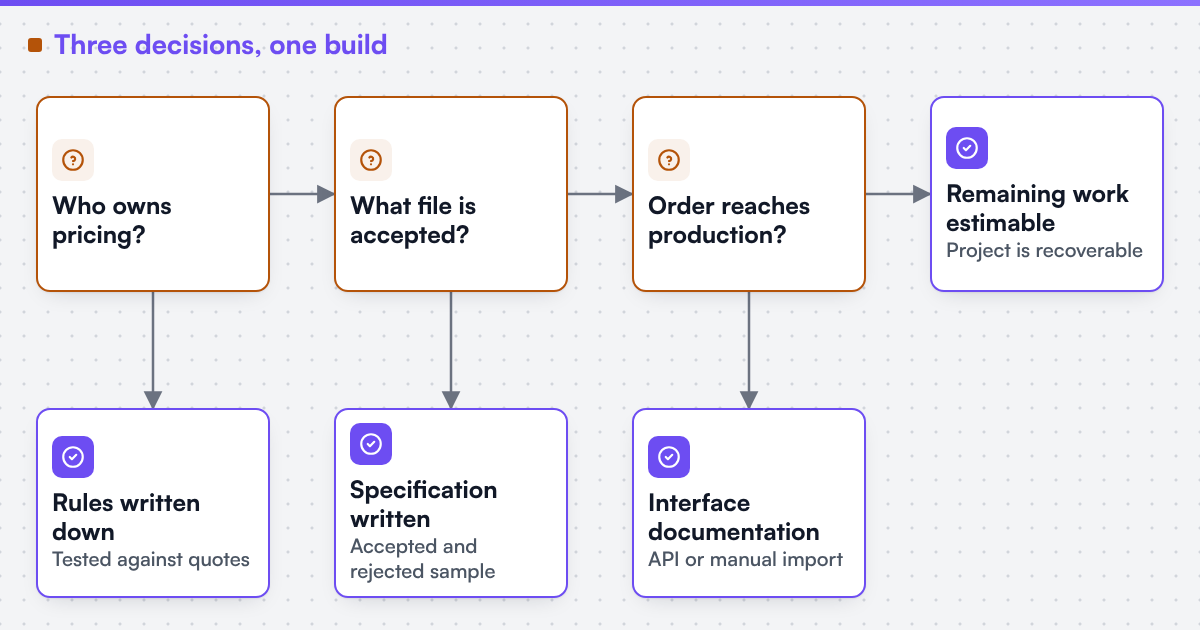 (opens the full-size diagram in a new tab)
Why does the platform itself move during the build?
Commerce platforms change under long projects. Shopify publishes a new API version every quarter and supports each stable version for at least twelve months, so a slow build can find its first integration code near the end of its support window before launch. WooCommerce moved order storage to dedicated tables with High-Performance Order Storage, and code that wrote order data as post meta had to be updated. Neither change is a failure of the platform; both are documented. They become a stall only when a project runs long enough to meet them without a plan.
This is a secondary cause. It turns a delay into a larger one, but it rarely starts the delay.
What is the counter-argument?
The fair objection is that some projects stall for reasons no decision would fix: the supplier lacks the skill, the budget was unrealistic, or the business changed direction. Those cases exist. The thesis here is narrower. When a competent team, a reasonable budget and a stable goal still produce a stalled web-to-print project, the cause is usually one of the three missing decisions. The test is simple: if the pricing rules, output specification and production interface were written down today, would the remaining work be estimable? If yes, the project is recoverable. If no, more development will not help until they are.
A second objection is that packaged products avoid all of this. Sometimes they do. A packaged web-to-print product already embodies a pricing model, an output path and a set of connectors. If the business fits those, choosing one is often the right decision, and the page on when not to hire us says so plainly. The stall pattern appears when a business outgrows the packaged model; outgrown web-to-print SaaS describes that situation.
Turn this into a scoped brief
If your project shows three or more of the signs above, send a project brief that names one product, the price your team would quote for it, the file production expects and the system the order must reach. That one worked example shows more than a feature list, and it is enough to judge whether the next step is an assessment or a discovery engagement.
What can a print business do before spending more?
Write the three decisions down. A pricing rule document with ten real quotes the business trusts, an output specification with one accepted and one rejected sample file, and a description of the production interface with its documentation or its absence. None of this needs a developer.
Separate completion from replacement. A stalled build can be completed, replaced, migrated to another platform or stopped. We can assess a stalled, inherited or failing web-to-print build and report plainly whether it should be completed, replaced, migrated or stopped. That is what the web-to-print migration and rescue service scopes, and the answer can be to stop.
Make the next phase fixed. The default engagement is fixed-scope with written acceptance criteria and priced change control. Managed operations is a separate, opt-in agreement. A fixed scope is only possible once the three decisions exist, which is why a paid architecture discovery often comes first. We can run a paid discovery engagement that produces an architecture, an explicit pricing-rule specification, an integration inventory and a phased plan you could hand to another supplier. The output of a discovery engagement is written so that a supplier other than us can execute it.
How we reached this
The thesis comes from the engineering boundaries this service scopes: storefront, design tool, pricing, output and production handoff. Netbase JSC, which operates Web2Print Solutions, has delivered 50+ web-to-print platforms; that group experience is the background to the patterns described here. Web2Print Solutions is the web-to-print engineering service of Netbase JSC. Delivery records cited on this site belong to Netbase JSC; where no delivered example of a capability is published, the page says so rather than implying a record. No rescue engagement by this property is published, and no failure rate or recovery figure is claimed. Platform facts are cited below with the date they were checked.
Limitations
This is an engineering view. It does not cover contract disputes, supplier selection or budgeting practice, and it does not name or assess any previous supplier. The platform changes described are examples, dated September 2026, and should be rechecked against current documentation before a build.
Discuss your web-to-print project
Frequently asked questions
No. If the missing decisions show that the chosen platform cannot hold the pricing model or the output specification, finishing it spends more money on the wrong foundation. An assessment should be free to recommend replacing the build or stopping, and should explain why in terms the business can check.
It depends on access, documentation and the number of integrations, so no fixed duration is promised here. The useful measure is what the assessment produces: an inventory of what works, what is missing, which of the three decisions are open and a recommendation with its reasons.
Yes, and it is usually better that way. The people who quote every day know the exceptions. A developer turns the written rules and the trusted sample quotes into tests later; the business owns the rules either way.
References (4)
- Shopify developer documentation, API versioning, accessed 2026-09-28.
- WooCommerce developer docs, High-Performance Order Storage, accessed 2026-09-28.
- CIP4, JDF print automation specification overview, accessed 2026-09-28.
- Ghent Workgroup, PDF/X workflow: the GWG 2015 specification is based on the ISO PDF/X-4 standard, accessed 2026-09-30.