

Ecommerce platform integration for print
Web-to-print ecommerce integration connects a storefront such as Shopify, WooCommerce or a custom build to print pricing, an online designer and production. Web2Print Solutions decides which print options become variants and which travel as line-item data, validates every price on the server, and proves that one configured product becomes one complete production job.
Start a project brief Explore servicesReviewed by CEO, Netbase JSC · Published 28 Sep 2026 · Updated 3 Oct 2026

At a glance
- Engagement type
- Integration build
- What you provide
- One real product or workflow, plus your acceptance criteria
- What you receive
- Connect a Shopify, WooCommerce or custom store to print pricing, an online designer and production so each order arrives complete.
- Who accepts
- The system owner on each side of the integration
What you need to provide
- One real product or workflow to scope against
- What correct looks like for it
- Any system that must stay in place
- Who in your organisation confirms the result
Ready to scope this service?
What does web-to-print ecommerce integration involve?
A general-purpose store sells a product with a few variants and a fixed price. A print product has a custom size, a stock, a finish, a quantity break, artwork and a production route, and the price is a function of all of them. Ecommerce integration is the engineering that lets the store keep doing what it does well, catalogue, cart, payment and customer accounts, while print pricing, the online designer and the production handoff do their part without drift. Among the web-to-print engineering services, it is the one that owns the storefront boundary.
We can scope and build web-to-print integrations for Shopify, WooCommerce, Magento / Adobe Commerce, BigCommerce, Wix and headless storefronts, and we state each platform's constraints before the work is priced. The deciding question is always the same: after cart edits, checkout and order events, do the selected configuration, the charged amount, the artwork version and the production instruction still describe the same job?
Key takeaways
- Web-to-print ecommerce integration keeps the store's catalogue, cart, payment and accounts in place and adds pricing, a designer and a production handoff around them.
- The test that matters after cart edits, checkout and order events is whether the configuration, the charged price, the artwork version and the production instruction still describe the same job.
- Custom dimensions usually travel as cart line-item data rather than product variants, because Shopify's own documentation caps a product at 2048 variants.
- WooCommerce's High-Performance Order Storage moved order data into dedicated tables, so an integration reads and writes through WooCommerce's order objects, not raw post meta.
- A saved design identifier, not a preview image, is what the production file is generated from, so a reorder recalculates the current price against the same accepted design.
Who is this for, and when does another route fit better?
Good fit
- A print business that wants to keep its Shopify or WooCommerce store and add configurable print products
- A brand or publisher whose store must pass personalised items to a print partner with the right file
- A team replacing an app that cannot express its option rules or output specification
Another route fits better
- A catalogue of fixed products with fixed prices, which a standard product setup already handles
- A buyer who has not yet decided which system owns price, where architecture discovery comes first
- A store whose platform plan cannot run the price mechanism the product needs, where a different surface is the honest answer
What outcomes is the engagement accepted against?
-
Prices that survive checkout
The amount shown in the configurator equals the amount charged, because the server recalculates it from the same rule version before the order is accepted.
-
Designs that reach production
A saved design identifier travels with the cart line, and the production file is generated from that exact version, not from a preview the customer saw earlier.
-
Orders that become jobs once
A retried or duplicated order webhook produces one job, and a rejected job is visible to a named operator instead of disappearing.
What is in scope?
| Module | Input | Deliverable |
|---|---|---|
| Product model | Your options, constraints and production routes | A variant and option strategy that respects platform limits, with invalid combinations blocked |
| Price path | Your pricing rules or an existing print pricing engine | A server-side price call, cart validation and a documented behaviour when price cannot be computed |
| Online designer | Templates, fonts, image rules and output specification | Designer integration with saved-design identifiers, proof images and print-ready output for each order line |
| Order handoff | Receiving MIS, prepress hot folder or fulfilment API | An idempotent order-to-job adapter with acknowledgement, retry and a visible failure queue |
| Accounts and reorders | Customer tiers, trade accounts, saved designs | Reorder that reopens the accepted design and recalculates the current price |
| Test suite | Representative products and awkward orders | Automated tests for configuration, cart edits, checkout, duplicate events and rejected artwork |
What is not included?
-
No commercial pricing policy
The engagement implements the rules you decide; it does not set margins or advise on price levels.
-
No vendor partnership or listed app
Integrations use each platform's public extension points under your store's own accounts and plan.
-
No marketing or store design
Theme work is limited to what the configurator and cart need to function and stay accessible.
How does the work run?
-
Boundary check
Map one representative product through store, price, designer, order and job
- Evidence you receive
- A written data map and the platform constraints that apply to your plan
-
Build and wire
Implement the product model, price path, designer and order adapter
- Evidence you receive
- Working flow on a staging store with test data
-
Acceptance and handover
Run the agreed product, edge and failure cases; hand over configuration and runbook
- Evidence you receive
- Signed acceptance per case, open issues listed by owner
The default engagement is fixed-scope with written acceptance criteria and priced change control. Managed operations is a separate, opt-in agreement.
Which platform constraints change the design?
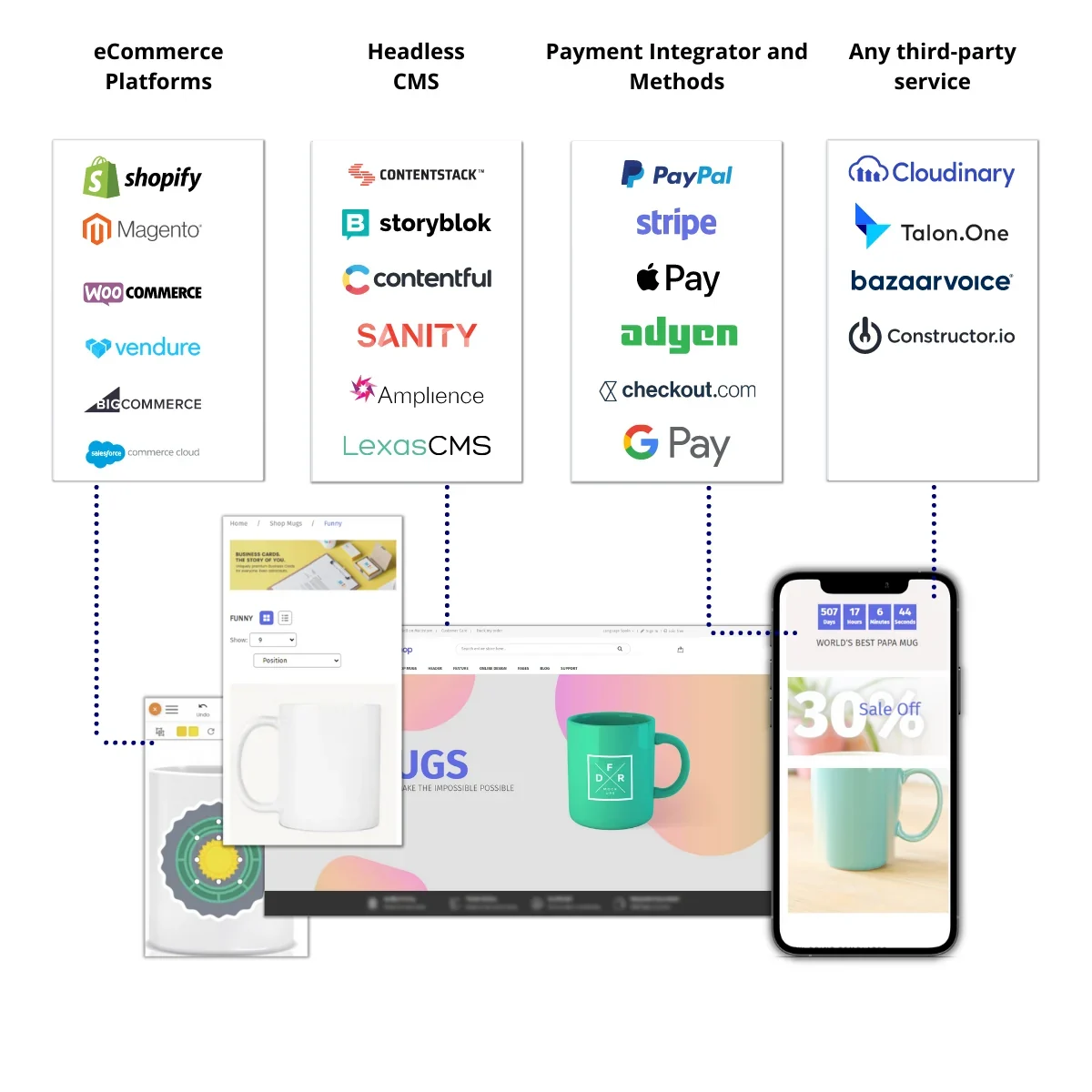
Illustration only: example platform categories around a print storefront. The logos show kinds of systems a project may connect, not a list of supported connectors or partnerships.
Platform facts decide the architecture, so they are checked against vendor documentation at the start of every engagement.
On Shopify, the GraphQL Admin API documentation (version 2026-07, accessed 28 September 2026) sets a maximum of 2048 variants per product. Stock, size, finish and quantity multiply fast, so custom dimensions usually travel as line-item properties rather than variants. Shopify's Cart Transform function can override a cart line's price with a lineUpdate operation, but the documentation limits that operation to stores on a Shopify Plus plan or development stores. A price design that relies on it must confirm the merchant's plan first. The Shopify web-to-print page covers those limits in detail.
On WooCommerce, the hooks woocommerce_add_cart_item_data, woocommerce_before_calculate_totals and woocommerce_checkout_create_order_line_item let an integration attach configuration to a cart item, recalculate its price and persist it on the order line. With High-Performance Order Storage (HPOS), order data lives in dedicated order tables, so an integration reads and writes order meta through the WooCommerce order objects rather than raw post meta. Code that assumes the old storage model breaks silently when HPOS is enabled.
Magento / Adobe Commerce, BigCommerce, Wix and headless builds each have their own option, price and extension model. The integrations directory explains which surfaces have their own page and why.
What does Netbase JSC bring to the integration?
Netbase JSC, which operates Web2Print Solutions, has delivered 50+ web-to-print platforms. The group maintains storefront connectors for WooCommerce, Shopify, Wix and custom stores, a browser-based online designer, rule-based pricing templates and print-ready PDF output with CMYK conversion. Where one of those components meets the requirement, the engagement integrates it rather than rebuilding it, and says so in the scope.
We can build custom product configurators and browser design tools that emit print-ready artwork to an agreed specification when the reusable components do not fit the product.
Client-specific deliverables, access and handover are defined in the engagement contract. Pre-existing software, products, APIs and third-party components remain subject to their respective ownership and licence terms.
Scope this work with a project brief
Web2Print Solutions has not yet published a case study for this service, so the fastest evidence is a test on your own store. Send a project brief with your platform and plan, one configurable product, how its price is calculated today, and the system that should receive the job.
See it live
Live stores operated by their owners. Each link opens the store in a new tab.

Ale Upominek
What it shows
A personalisation step on an IdoSell store, where the customer adds their own design to a glass clock before ordering.
Live store using web-to-print components delivered by Netbase JSC, which operates Web2Print Solutions.

Mama Design
What it shows
A Korean-language business card page that offers a choice between designing online and starting from a template.
Live store using web-to-print components delivered by Netbase JSC, which operates Web2Print Solutions.

CharmingPrint
What it shows
A multi-page photobook editor that opens with a template loaded, on a Chinese-language storefront.
Live store using web-to-print components delivered by Netbase JSC, which operates Web2Print Solutions.
Frequently asked questions
Usually not. Most print products can be sold on the existing store once options, price validation and the order handoff are designed around the platform's extension points. A move is justified only when the store's plan or data model cannot express a rule the business depends on, and the outgrown web-to-print product page explains how to test that.
In most cases, yes. The designer loads on the product page, saves a design identifier to the cart line, and generates the production file after checkout. The integration work is making that identifier survive cart edits, reorders and order changes.
Client-specific deliverables, access and handover are set out in the engagement contract. The store, its customers and its orders stay in your accounts. Reused group components and third-party apps keep their own licence terms, which are listed in the scope before work starts.
The design decides that in advance. The usual rule is that checkout blocks the affected line with a clear message rather than charging a stale or guessed amount, and the failure is logged for an operator.
Yes. Web2Print Solutions delivers remote-first from Hanoi, Vietnam, and Netbase JSC has delivered web-to-print projects for clients in 80+ countries.
Send a project brief at /project-brief, email project@netbasejsc.com or message us on WhatsApp at +84 937 869 689. A senior engineer reads every brief and replies in writing.
References (4)
- Shopify, Product object, GraphQL Admin API 2026-07: variant limit of 2048 per product, accessed 2026-09-28.
- Shopify, Cart Transform Function API: lineUpdate limited to Shopify Plus and development stores, accessed 2026-09-28.
- WooCommerce Code Reference, hooks list, accessed 2026-09-28.
- WooCommerce developer docs, High Performance Order Storage, accessed 2026-09-28.