

Web-to-print on Shopify
Shopify can run the storefront for web-to-print, but configurable print needs design around its limits. Shopify allows at most 2048 variants per product, so custom sizes and finishes usually travel as line item properties, and its Cart Transform price override works only on Shopify Plus or development stores, which decides how a calculated print price reaches checkout.
Start a project brief Explore servicesReviewed by CEO, Netbase JSC · Published 27 Sep 2026 · Updated 2 Oct 2026

Where does Shopify fit a print catalogue?
Shopify is a strong home for the commercial side of print: catalogue, checkout, payments, customer accounts and marketing. It fits well when the store sells a bounded set of print products, such as business cards, photo prints, canvas, apparel or signage, and the business wants to keep its existing Shopify operations. It fits less well when every order is a custom quote, when B2B buyers need approval chains the store's plan does not provide, or when the price depends on a calculation the chosen plan cannot apply at checkout.
This page is one of the platform pages in the web-to-print integration directory. It records the Shopify facts that change the engineering, each checked against Shopify's developer documentation on 28 September 2026.
Key takeaways
- Shopify's GraphQL Admin API caps a product at 2048 variants, so custom sizes, finishes and quantity usually travel as line item properties rather than variants.
- A calculated print price can override the cart line only through the Cart Transform Function API, and Shopify restricts update operations to Shopify Plus or development stores.
- Checkout validation functions can block a cart line that is missing required print data, but they cannot inspect an artwork file, so preflight stays a separate step after payment.
-
An adapter must ignore repeated
X-Shopify-Webhook-Iddeliveries and key each production job on the order line, or a retried webhook creates a second job. - The plan tier, not the app chosen, usually decides which pricing behaviour is possible, which is why it is checked before any price logic is scoped.
How does print data cross a Shopify store?
-
Product options
Stable, purchasable choices such as a standard size or paper become variants. Open-ended choices, such as a custom width and height or a finishing combination, travel as line item properties: name and value pairs attached to the cart line that Shopify carries into the order.
-
Price
The configurator shows an estimate. The authoritative amount comes from a print pricing engine or pricing rules, and must reach the cart through a mechanism the store's plan supports.
-
Artwork and design
An online designer embedded through a theme app extension saves the design and writes its identifier to a line item property. After payment, the production file is generated from that identifier to the output contract in print-ready PDF and prepress automation.
-
Order to job
An order webhook triggers the job: the adapter reads the line item properties, maps them to production codes and submits one job for each order line to the MIS, prepress hot folder or fulfilment partner.
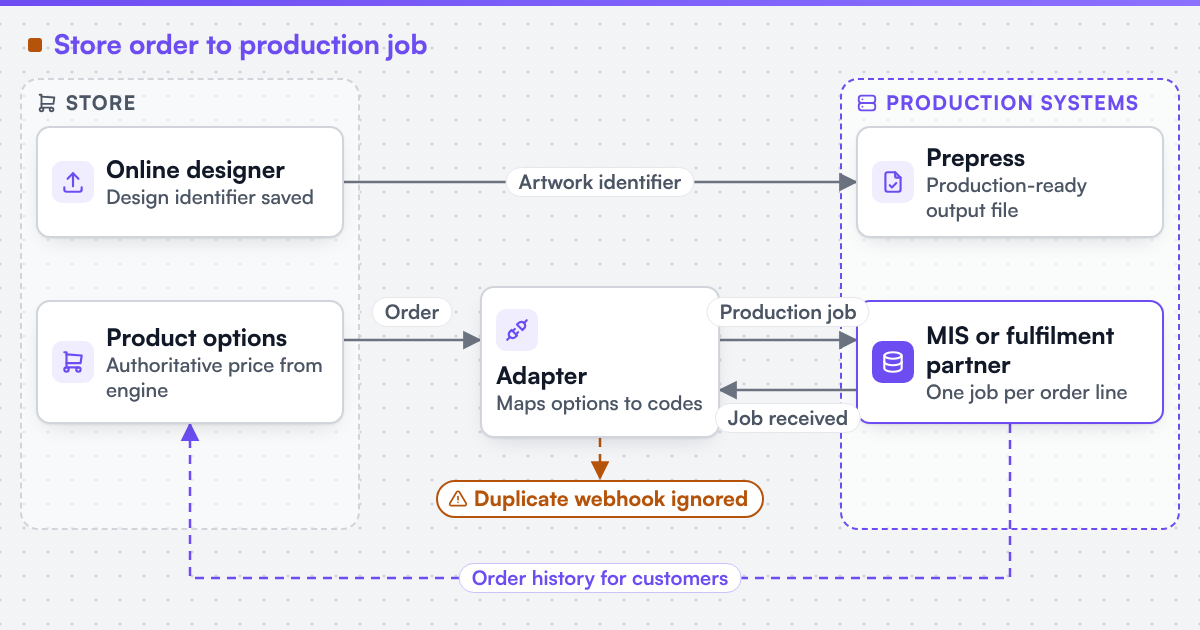 (opens the full-size diagram in a new tab)
Which Shopify constraints change the design?
| Constraint | Shopify's rule | Design response |
|---|---|---|
| Variant ceiling | Maximum 2048 variants per product (GraphQL Admin API, 2026-07) | Custom sizes and finishes travel as line item properties, not variants |
| Price override | Cart Transform lineUpdate works only on Shopify Plus or development stores |
Other plans use price bands, draft orders or a different surface |
| Checkout validation | A validation function can block an incomplete print line | Artwork files stay unchecked at checkout; preflight runs after payment |
| Duplicate webhooks | Retried deliveries repeat the same X-Shopify-Webhook-Id |
The adapter ignores repeats and keys each job on the order line |
Variant ceiling. Shopify's GraphQL Admin API documentation (version 2026-07) states a maximum of 2048 variants per product. Five sizes, eight stocks, four finishes and ten quantity tiers already make 1600 combinations, so modelling every print attribute as a variant fails fast. Custom dimensions and quantity usually belong in properties and price logic instead.
Price override eligibility. Shopify Functions' Cart Transform API can override a cart line's price, title and image with a lineUpdate operation, but Shopify documents that only stores on a Shopify Plus plan or development stores can use apps with update operations. On other plans, the design uses alternatives such as pre-priced variants for price bands, draft orders for quoted jobs, or a different surface. The plan is checked before the price path is promised.
Checkout validation. Cart and checkout validation functions run on Shopify's servers and can block checkout when a business rule is not met, for example a print line missing its design identifier or an invalid finish combination. They validate what is in the cart; they cannot inspect an artwork file stored elsewhere, so file checks stay in the preflight step.
Duplicate webhooks. Shopify's webhook documentation tells apps to ignore duplicate deliveries using the X-Shopify-Webhook-Id header. A print adapter must do exactly that, and also key the production job on the order line, so a retried delivery never creates a second job.
Which components and systems are involved?
A Shopify web-to-print build usually combines four parts: the Shopify store and its theme, an online designer loaded through a theme app extension, a pricing service, and an adapter from order webhooks to production. We can scope and build web-to-print integrations for Shopify, WooCommerce, Magento / Adobe Commerce, BigCommerce, Wix and headless storefronts, and we state each platform's constraints before the work is priced.
Netbase JSC, which operates Web2Print Solutions, has delivered 50+ web-to-print platforms, and the group maintains a Shopify storefront connector, a browser-based online designer and print-ready PDF output with CMYK conversion, bleed and trim. Where those components fit your products they are reused instead of rebuilt. Client-specific deliverables, access and handover are defined in the engagement contract. Pre-existing software, products, APIs and third-party components remain subject to their respective ownership and licence terms. No Shopify partnership or app-store status is implied.
The engagement that builds this is web-to-print ecommerce integration.
What must survive a move to or from Shopify?
Moving onto Shopify, or away from it, the same assets decide the risk: saved designs and templates in the designer, customer accounts, order history with its line item properties, product URLs and the production interface. Line item properties survive in order records, but a design identifier is only useful if the designer's data moves too. If Shopify's limits block a rule the business depends on, outgrown a web-to-print product explains how to test whether a contained component or a different platform is the smaller change.
Check the plan before anything else. Scope this work with a project brief that names your Shopify plan, one configurable product, how its price is calculated today, and the system that should receive the job.
Discuss your web-to-print project
Frequently asked questions
Not always. Plus matters when a calculated price must override the cart line through Cart Transform. Stores on other plans can still sell print using variant price bands, properties for custom data and draft orders for quoted work, with some limits on fully dynamic pricing.
Yes. An online designer can load on the product page through a theme app extension, save the design and write its identifier to the cart line, so the production file is generated after checkout from the approved version.
Up to 2048 variants per product, according to Shopify's GraphQL Admin API documentation for version 2026-07. Options beyond that are carried as line item properties and validated by your own price and configuration logic.
Not if the adapter ignores repeated X-Shopify-Webhook-Id values and keys each job on the order line. Both checks are part of acceptance testing.
References (6)
- Shopify, Product object, GraphQL Admin API 2026-07: maximum of 2048 variants per product, accessed 2026-09-28.
- Shopify, Liquid line_item object: line item properties as name and value pairs, accessed 2026-09-28.
- Shopify, Cart Transform Function API: update operations limited to Shopify Plus and development stores, accessed 2026-09-28.
- Shopify, About cart and checkout validation, accessed 2026-09-28.
- Shopify, About webhooks: ignoring duplicate deliveries with X-Shopify-Webhook-Id, accessed 2026-09-28.
- Shopify, App extensions, accessed 2026-09-28.