Web-to-print migration and rescue
A print platform migration starts with an independent assessment of the existing web-to-print code, data, interfaces and live order path. Web2Print Solutions reports whether to complete, replace, migrate or stop, and if migration is justified, delivers field mapping, parity tests on real orders, a cutover plan and a rollback point before production traffic moves.
Start a project brief Explore servicesReviewed by CEO, Netbase JSC · Published 27 Sep 2026 · Updated 1 Oct 2026

At a glance
- Engagement type
- Assessment, then operate
- What you provide
- One real product or workflow, plus your acceptance criteria
- What you receive
- A plain verdict on an inherited or stalled print platform, then a tested migration with parity checks, cutover and rollback.
- Who accepts
- The operator named in the engagement
What you need to provide
- One real product or workflow to scope against
- What correct looks like for it
- Any system that must stay in place
- Who in your organisation confirms the result
Ready to scope this service?
What does a web-to-print rescue start with?
A stalled web-to-print build is rarely described the same way twice. The previous supplier calls it almost finished. Estimators still price every job by hand. Production runs from the MIS while the storefront writes orders into a separate database nobody reconciles. A rescue starts by establishing which path actually works, using the code, data and running system you can lawfully give access to.
We can assess a stalled, inherited or failing web-to-print build and report plainly whether it should be completed, replaced, migrated or stopped. This service covers both halves of that job among the web-to-print engineering services: the verdict, and the migration when the verdict calls for one.
Key takeaways
- A migration or rescue engagement starts with an independent assessment, separating what is actually implemented from what was only intended.
- The verdict is one of four routes: complete, replace, migrate or stop, each stated with its risks and the case against it.
- Migration maps meaning, not rows: a product option, an order status or an artwork reference can mean something different in the target system.
- Parity tests on representative orders, including reorders and saved designs, run before cutover, not after.
- The cutover plan names the last write on the old platform, the traffic switch and the point after which rollback needs reconciliation rather than a simple switch back.
Who is this for, and when does another route fit better?
Good fit
- An owner who inherited a half-built or unsupported web-to-print platform
- A printer on WooCommerce, Wix or another store that must move to a platform its rules fit
- A business whose storefront is ageing while the MIS and production should stay untouched
Another route fits better
- A platform that works but needs one new capability, which a component service can add in place
- A dispute with a former supplier that needs a lawyer, not an engineer
- A team without access to its own code, accounts or data exports, which must recover access first
What outcomes is the engagement accepted against?
-
A verdict you can act on
The assessment separates implemented behaviour from design intent, compares the routes, and includes the case against its own recommendation.
-
Orders that still work after the move
Representative orders, including reorders, trade prices and saved designs, pass parity tests on the new platform before cutover.
-
A reversible cutover
The plan names the last write on the old system, the switch, the rollback point and the person who decides.
What is in scope?
| Module | Input | Deliverable |
|---|---|---|
| Code and architecture review | Repository, deployment route, dependencies, schema | Findings on what is implemented, what is intent and what is at risk |
| Order-path trace | One representative product from selection to production acknowledgement | A traced path showing where data changes meaning or is lost |
| Options and verdict | Findings, business constraints, access and rights | Complete, replace, migrate or stop, with risks and the case against |
| Data and field mapping | Products, customers, designs, templates, orders, URLs | A mapping with conversions, archives and documented gaps |
| Parity and cutover | Representative and awkward orders | Parity test results, cutover runbook, rollback point and redirect map |
| Post-cutover checks | The same orders on the live platform | Signed checks and a decommissioning plan for the old system |
What is not included?
-
No arbitration with a former supplier
The assessment reports technical facts; it is not a legal opinion on past work.
-
No bypassing of licences or access controls
If a previous supplier holds an account or key, recovering it is the owner's task first.
-
No promise that the old build is salvageable
A rescue is only useful if it can deliver an unwelcome finding.
How does the work run?
-
Assess
Review code, data and the live order path; compare the four routes
- Evidence you receive
- A written assessment and recommendation
-
Map and rehearse
Map data, build the target or complete the build, rehearse migration on copies
- Evidence you receive
- Parity test results on representative orders
-
Cut over and verify
Freeze, migrate, switch traffic, run post-cutover checks
- Evidence you receive
- Cutover record, reconciliation and open exceptions by owner
The default engagement is fixed-scope with written acceptance criteria and priced change control. Managed operations is a separate, opt-in agreement. The assessment can be commissioned on its own; the migration is scoped only after its findings are accepted.
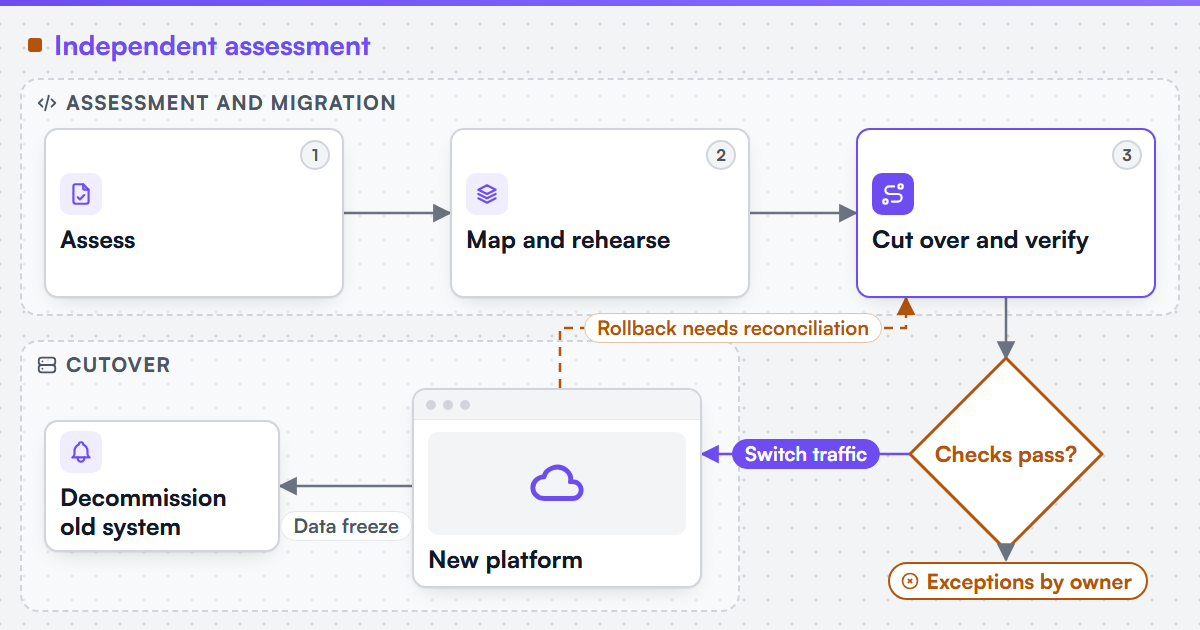 (opens the full-size diagram in a new tab)
What must survive a print platform migration?
Migration is about meaning, not copying rows. A product option in one system may be a variant in another. Order status may mean payment in the storefront and production state in the MIS. Artwork references may point to files outside the database. The mapping keeps a record of every field that cannot move without a new decision.
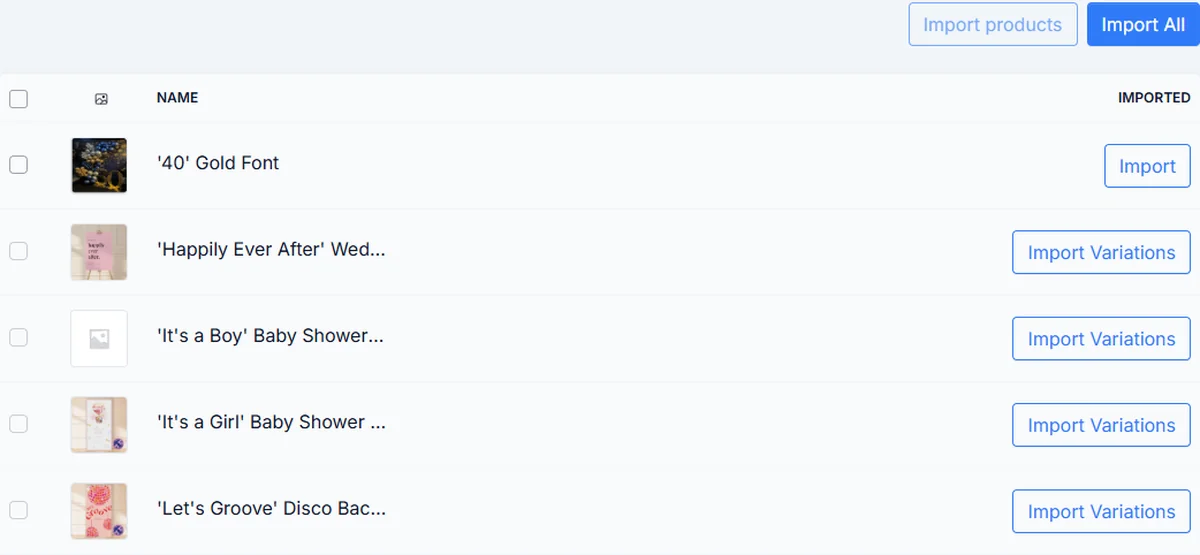
An inventory import screen lists what already exists in the old store and lets each product come across singly or with its variations.
The inventory goes beyond catalogue rows: customer accounts and password migration limits, price rules, uploaded artwork, saved designs from the online designer, reusable templates, approval histories, order history and the URLs search engines and customers already use. Export rights and formats are checked in the source system itself. Where the target is a new store, ecommerce platform integration owns the storefront build; where the MIS stays, print MIS and ERP integration owns the job handoff.
How is a cutover kept reversible?
The plan names the last write on the old platform, the data freeze or sync rule, the traffic switch and the point after which rollback needs reconciliation rather than a DNS change. Post-cutover checks ask the questions that justified the move: can a customer place the representative orders, does prepress receive the right file, does the MIS show one job with the right attributes, and can support find the order and its artwork version? The old environment is decommissioned only after the new route is stable and retention needs are recorded.
What does Netbase JSC bring to a rescue?
Netbase JSC, which operates Web2Print Solutions, has delivered 50+ web-to-print platforms. That group experience informs the assessment: the failure points at the storefront, designer, pricing and MIS boundaries are known territory, so the review goes to them first. The Botak Sign case study describes one such migration and upgrade project, on a signage storefront with several hundred products.
No client is named, logo shown, or work identified on this site without that client's release or the operator's recorded authorization, and a named client can ask for removal at any time. Your assessment belongs to you and is never published as a case study.
Client-specific deliverables, access and handover are defined in the engagement contract. Pre-existing software, products, APIs and third-party components remain subject to their respective ownership and licence terms.
Scope this work with a project brief
Send a project brief stating what is live, what fails, which access you control and the decision the assessment must support. If you suspect the storefront is the only problem, read replace the storefront and keep the print MIS; if the whole product feels too small, read outgrown a web-to-print product.
Frequently asked questions
Yes, when you hold the rights and access to it. The assessment reads the code as it is, reports what is sound and what is not, and does not warrant work it did not write until that work has been reviewed and accepted.
Only if the source system can export them in a usable form. The mapping checks each designer's data format early; some designs convert, some are archived as print-ready files, and the plan says which.
Not if URLs are mapped. The cutover plan includes a redirect map for product, category and account URLs, and post-cutover checks confirm the important paths still resolve.
Then you have saved the cost of a build that would not have fixed the problem, and the report explains the evidence and the alternatives.
Yes. Web2Print Solutions delivers remote-first from Hanoi, Vietnam, and Netbase JSC has delivered web-to-print projects for clients in 80+ countries.
Send a project brief at /project-brief, email project@netbasejsc.com or message us on WhatsApp at +84 937 869 689. A senior engineer reads every brief and replies in writing.
References (3)
- Google Search Central, Site moves with URL changes, accessed 2026-09-29.
- WooCommerce developer documentation, REST API, accessed 2026-09-29.
- Shopify Help Center, Migrating to Shopify, accessed 2026-09-29.