

Web-to-print architecture and discovery
Web-to-print architecture discovery is a paid, fixed-scope engagement that turns an uncertain platform plan into a written print platform architecture. Web2Print Solutions maps product and pricing rules, print output, existing systems and the order path, then delivers a data model, integration inventory, risk register and phased plan that another supplier could execute.
Start a project brief Explore servicesReviewed by CEO, Netbase JSC · Published 27 Sep 2026 · Updated 1 Oct 2026

At a glance
- Engagement type
- Assessment, then build
- What you provide
- One real product or workflow, plus your acceptance criteria
- What you receive
- A written print platform architecture, pricing-rule specification and phased plan, produced before anyone commits to a build.
- Who accepts
- The person who owns the specification or price list
What you need to provide
- One real product or workflow to scope against
- What correct looks like for it
- Any system that must stay in place
- Who in your organisation confirms the result
Ready to scope this service?
Why start a web-to-print project with discovery?
Two suppliers can quote the same sentence and price two different systems. One assumes the storefront calculates prices; the other assumes the MIS does. One expects customers to upload finished PDFs; the other includes an online designer and preflight. A fixed build scope cannot be honest until those decisions are written down, and discovery is the work of writing them down.
We can run a paid discovery engagement that produces an architecture, an explicit pricing-rule specification, an integration inventory and a phased plan you could hand to another supplier. It is the entry point among the web-to-print engineering services when the platform must change but nobody can yet state what the build is.
Key takeaways
- Web-to-print architecture discovery is a paid, fixed-scope engagement that ends in written documents, not a free sales pitch.
- The deliverables are a product data model, a pricing-rule specification, an output contract, an integration inventory, a risk register and a phased plan another supplier could price.
- Work starts by tracing real orders and quotes across every system that touches them, not by assuming which one owns a decision.
- Every risk the team cannot resolve gets a named decision owner and the smallest authorised test, written into the register rather than guessed.
- The report says plainly which system should own price, artwork version and job state, the three decisions most stalled builds never settled.
Who is this for, and when does another route fit better?
Good fit
- A printer, publisher or enterprise team about to commission a new or replacement platform
- A buyer holding supplier quotes that disagree about what they include
- An operator whose estimating, prepress and production teams describe the same workflow differently
Another route fits better
- A single broken component with a clear owner, such as prices, where a print pricing engine can be scoped directly
- A standard catalogue that a packaged product already handles without workarounds
- A team that needs working software this month and has already made the architectural decisions
What outcomes is discovery accepted against?
-
An estimator can trace a quote
A representative quoted product can be followed through the written price rule to the same amount the estimator would give.
-
Prepress can judge a file
The output specification decides whether each sample file passes, without anyone reading a preview.
-
A supplier can price the build
The plan is specific enough that a second supplier could estimate it without a new round of discovery.
What is in scope?
| Module | Input | Deliverable |
|---|---|---|
| Product model | Representative products, options and production routes | A target data model separating customer choices from production attributes |
| Pricing rules | Price lists, spreadsheets, known-good quotes, estimators | A pricing-rule specification with units, order of calculation and owners of disputed rules |
| Output contract | Accepted and rejected files, RIP and prepress requirements | A written print-output specification and preflight policy |
| Integration inventory | Storefront, designer, MIS or ERP, prepress and fulfilment systems | Every connection with data direction, identifier owner, interface, retry rule and failure view |
| Risk register | Assumptions, access limits and unknowns | Each risk with its smallest authorised test and the decision that depends on it |
| Phased plan | All of the above | Phases with usable boundaries, acceptance criteria and a recommendation with its own case against |
Pricing rules are a common source of disputed ownership: a custom print size needs an area or yield calculation discovery can specify, not a variant table the build assumes already exists.
What is not included?
-
No implementation
Discovery produces documents and small disposable spikes; building the platform is a separate scope.
-
No commercial pricing advice
The specification records your price policy; it does not set margins or rates.
-
No hardware or press selection
Presses, RIPs and finishing equipment are inputs to the plan, not choices it makes.
How does discovery move from real orders to a phased plan?
-
Trace real orders
Follow a small set of real products and orders, including exceptions, across every system
- Evidence you receive
- Annotated order traces and open questions by owner
-
Specify and test
Write the model, price rules, output contract and inventory; run small interface or specimen spikes
- Evidence you receive
- Draft specification and spike results
-
Decide and plan
Compare routes: keep, extend, replace a component, build a core, or stop
- Evidence you receive
- Final architecture, risk register and phased plan
The default engagement is fixed-scope with written acceptance criteria and priced change control. Managed operations is a separate, opt-in agreement.
The output of a discovery engagement is written so that a supplier other than us can execute it. That rule changes how the material is written: every component has an owner and an interface, every acceptance criterion has an input and an expected result, and every unknown has a decision owner. A diagram with boxes labelled "integration" and "automation" would not meet it.
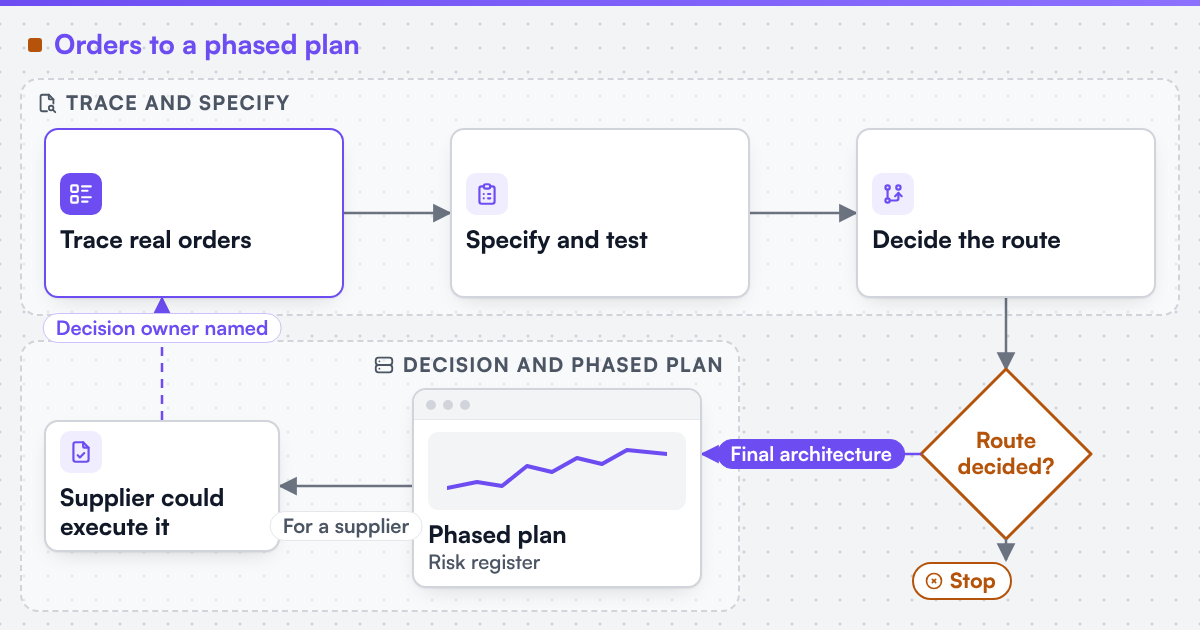 (opens the full-size diagram in a new tab)
Which systems does discovery usually map?
The inventory names every system that reads or writes an order: storefront, online designer, pricing engine, MIS or Print ERP, scheduler, prepress workflow and fulfilment partners. For the production side, it records whether the MIS offers a REST API, JDF and JMF messaging or a monitored import folder, and which of those your licence actually covers, before print MIS and ERP integration is scoped. A connector that "probably exists" is recorded as a risk, not a fact.
How does discovery differ for a new platform and an upgrade?
A new Media or Enterprise platform starts with users, approved assets, catalogue authority and the order lifecycle. A publisher needs content approval before production; a corporate buyer needs purchase approval before ordering. They are different controls and are specified separately.
An upgrade or replacement starts with the behaviour that must survive: product rules, saved designs, customer accounts, order history, URLs and the production interface. If the question is whether a packaged product has been outgrown, outgrown a web-to-print product sets out the tests discovery will run.
What does Netbase JSC bring to discovery?
Netbase JSC, which operates Web2Print Solutions, has delivered 50+ web-to-print platforms. Discovery uses that experience to know where platforms usually break and which reusable group components, such as an online designer, pricing templates, PDF output or storefront connectors, might meet a requirement without new code. Reuse is recommended only when a component passes the same acceptance tests as a custom build would. The Reprotel case study shows one such architecture decision in practice: a choice between an upload-only route and a built-in online designer, made explicit before the build started.
Client-specific deliverables, access and handover are defined in the engagement contract. Pre-existing software, products, APIs and third-party components remain subject to their respective ownership and licence terms.
Scope this work with a project brief
No discovery report is published on this site, because each belongs to the client who commissioned it. The quickest test of fit is a project brief with one difficult product, one current output file and the decision you need the architecture to support. How we work explains written acceptance.
Frequently asked questions
It depends on the number of products, systems and decision owners, not on page count. The proposal fixes the scope and the order sample in writing, so the timeline follows from the agreed inputs rather than an open-ended study.
Yes. That is the design rule. The deliverables are written so that another supplier can estimate and execute them, and you are free to take them elsewhere.
Access to estimating, prepress and production knowledge, sample files and quotes, documentation or sandbox access for connected systems, and one decision owner who can settle contested rules.
Then that is the result. Keeping a packaged product, replacing one component or stopping are all legitimate outcomes, and the report explains the evidence for each.
Yes. Web2Print Solutions delivers remote-first from Hanoi, Vietnam, and Netbase JSC has delivered web-to-print projects for clients in 80+ countries.
Send a project brief at /project-brief, email project@netbasejsc.com or message us on WhatsApp at +84 937 869 689. A senior engineer reads every brief and replies in writing.
References (4)
- CIP4 Organization, JDF and JMF print automation overview, accessed 2026-09-29.
- SEBoK, System Requirements Definition, accessed 2026-09-30.
- NIST Computer Security Resource Center, Glossary: risk register, accessed 2026-09-30.
- Roy Fielding, Architectural Styles and the Design of Network-based Software Architectures (Representational State Transfer), University of California, Irvine, accessed 2026-09-29.