
Web-to-print on Magento and Adobe Commerce
Magento and Adobe Commerce suit corporate web-to-print because Adobe Commerce B2B documents company accounts, shared catalogs with company-specific prices, negotiable quotes and purchase order approvals. The constraint is print pricing: customizable options add fixed or percentage markups to a single SKU, so size, yield and finishing rules need a separate pricing service.
Start a project brief Explore servicesReviewed by CEO, Netbase JSC · Published 28 Sep 2026 · Updated 14 Oct 2026

Where do Magento and Adobe Commerce fit a print catalogue?
Magento Open Source and Adobe Commerce fit print operations that sell to organisations rather than individuals: franchise and multi-location brands, corporate marketing departments, and printers running branded ordering portals for their business customers. Adobe Commerce B2B already models how companies buy, which no other mainstream storefront does natively. It fits poorly for a small retail print shop, because the platform is heavy to host and maintain, and a lighter store such as WooCommerce web-to-print is usually the smaller change.
This page is one of the platform pages in the web-to-print integration directory. It records the Adobe Commerce facts that change the engineering, checked against Adobe's documentation on 28 September 2026.
Does web-to-print work with Adobe Commerce?
Yes. Adobe Commerce B2B natively models company accounts, shared catalogs with company-specific prices, negotiable quotes and purchase order approvals, which corporate print portals reuse. Its gap is pricing: customizable options add only a fixed or percentage markup to one SKU, so a print price that depends on size, yield or finishing needs a separate pricing engine called from the quote.
Key takeaways
- Adobe Commerce B2B is the only mainstream storefront platform that documents company accounts, shared catalogs and purchase order approvals natively, which is why it fits corporate print portals.
- Customizable options add only a fixed or percentage markup to a single SKU; a print price that depends on size, yield or finishing is computed by a separate pricing service instead.
- Negotiable quotes, the usual starting point for large-format and packaging work, are available only once company accounts are configured, so the B2B setup has to be in place first.
- When purchase orders are active for a company, an order becomes a sales order only after approval, and the production handoff waits for that approved order.
- Magento Open Source can run the storefront, but company accounts, shared catalogs and approval rules are Adobe Commerce B2B features, not something Open Source adds on its own.
How does print data cross a Magento store?
-
Company buying
Adobe Commerce B2B documents company accounts with users and roles, shared catalogs that set custom prices per product for assigned companies, requisition lists, negotiable quotes and purchase order approvals. A corporate print portal maps brand teams, cost centres and approvers onto those objects instead of rebuilding them.
-
Product options
Customizable options add fields such as text, dropdowns and file upload to a product, each with a fixed or percentage markup. Adobe's documentation notes that they are variations of a single SKU and cannot manage stock or serve as price rule conditions.
-
Price
Because markups cannot express sheet yield, imposition waste or finishing sequence, the authoritative print price comes from a print pricing engine called by a plugin or observer during quote totals collection, then combined with the company's shared catalog price where the contract requires it.
-
Order to job
Events and observers let a module react to order placement and pass the job, with its company, cost centre and approval references, to the MIS through web-to-print MIS integration.
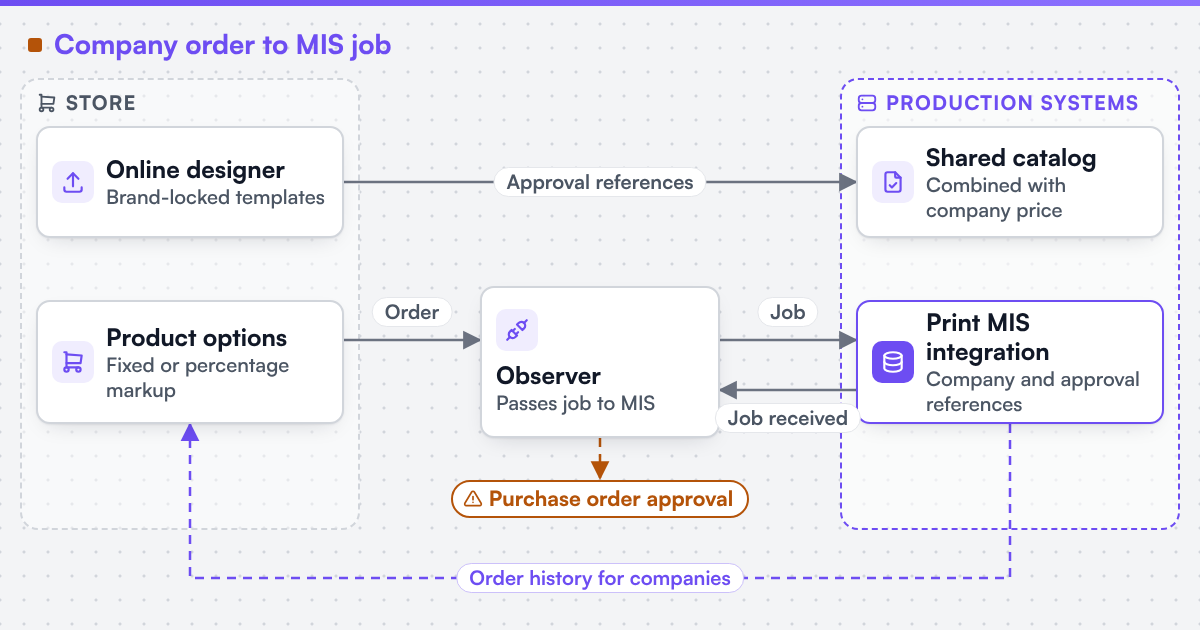 (opens the full-size diagram in a new tab)
Which Adobe Commerce constraints change the design?
| Constraint | Adobe Commerce's rule | Design response |
|---|---|---|
| Customizable options | Single-SKU variations with a fixed or percentage markup only | A pricing service computes size, yield and finishing rules and writes the price to the quote item |
| Negotiable quotes | Available only for stores configured to support company accounts | The B2B setup is confirmed before a quote-first print workflow is scoped |
| Purchase order approval | Orders are created as purchase orders first and must pass approval | The production handoff waits for the approved order, not the submitted purchase order |
Customizable options are not a pricing engine. They are single-SKU variations with simple markups, so a print price that depends on several interacting inputs must be computed elsewhere and written to the quote item on the server.
Negotiable quotes depend on company accounts. Adobe documents that negotiable quotes are available only for stores configured to support company accounts. A quote-first print workflow, common for large-format and packaging jobs, therefore depends on the B2B setup being in place.
Purchase orders change the order lifecycle. When purchase orders are active for a company, orders are created as purchase orders first and pass approval rules before becoming sales orders. The production handoff must wait for the approved order, not the submitted purchase order.
Which components and systems are involved?
A Magento or Adobe Commerce print portal combines the store with its B2B configuration, an online designer with brand-locked templates, a pricing service, and an adapter to production. We can build B2B and corporate print storefronts with account hierarchies, permission models, approval workflows and brand-locked template systems. We can scope and build web-to-print integrations for Shopify, WooCommerce, Magento / Adobe Commerce, BigCommerce, Wix and headless storefronts, and we state each platform's constraints before the work is priced.
Netbase JSC, which operates Web2Print Solutions, has delivered 50+ web-to-print platforms. Group components such as the online designer and print-ready PDF output are reused where they fit. Client-specific deliverables, access and handover are defined in the engagement contract. Pre-existing software, products, APIs and third-party components remain subject to their respective ownership and licence terms. No Adobe partnership is implied.
The engagement that builds this is web-to-print ecommerce integration.
What must survive a move to or from Magento?
Company structures, user roles, shared catalog prices, requisition lists, saved designs and templates, order and purchase order history, and URLs. Moving from Magento Open Source to Adobe Commerce adds B2B objects that did not exist before, so company data is modelled first and imported second.
Scope this work with a project brief that names your edition and version, whether B2B is enabled, one corporate product with its approval rule, and the system that should receive the job.
Discuss your web-to-print project
Frequently asked questions
For a portal that relies on company accounts, shared catalogs, negotiable quotes and purchase order approvals as documented Adobe Commerce B2B features, plan on Adobe Commerce. On Open Source those behaviours must come from extensions or custom modules.
Only for simple surcharges. When price depends on size, yield, finishing or quantity breaks together, a pricing service writes the calculated price to the quote item instead.
Templates are assigned per company or shared catalog, so each brand team sees only its approved designs, and the online designer locks the elements the brand guidelines protect.
References (5)
- Adobe Experience League, Introduction to Adobe Commerce B2B, accessed 2026-09-28.
- Adobe Experience League, Shared catalog overview, accessed 2026-09-28.
- Adobe Experience League, Negotiable Quotes, accessed 2026-09-28.
- Adobe Experience League, Product settings: Customizable Options, accessed 2026-09-28.
- Adobe Developer, Events and Observers, accessed 2026-09-28.