

Print pricing engine engineering
A print pricing engine turns a printer's estimating model into explicit, versioned rules that a storefront, quote tool or MIS can call. Web2Print Solutions formalises inputs such as stock, size, sheet yield, make-ready, finishing, quantity breaks and customer terms, and accepts the engine only when it reproduces the client's own known-good quotes.
Start a project brief Explore servicesReviewed by CEO, Netbase JSC · Published 27 Sep 2026 · Updated 1 Oct 2026

At a glance
- Engagement type
- Assessment, then build
- What you provide
- One real product or workflow, plus your acceptance criteria
- What you receive
- Your estimating rules as a callable engine with a trace per quote, accepted against a regression suite of your own known-good quotes.
- Who accepts
- The person who owns the specification or price list
What you need to provide
- One real product or workflow to scope against
- What correct looks like for it
- Any system that must stay in place
- Who in your organisation confirms the result
Ready to scope this service?
Why is a print price a rule rather than a table?
A print price is the output of a calculation with production and commercial inputs. A different stock changes the sheet yield. A custom size changes the imposition and the waste. A finish adds make-ready, may depend on another operation, or moves the job to a different press. Quantity breaks, customer tiers and contract terms change the result again. A matrix of variants can hide those relationships for a while, but it cannot remove them, which is why estimators end up re-checking the web price.
We can formalise a print pricing model into an engine the client owns, accepted against a regression suite of the client's own known-good quotes. Among the web-to-print engineering services, this is the one that owns the number on the quote.
Key takeaways
- A print price is a calculation over stock, size, yield, make-ready, finishing, quantity breaks and customer terms, not a lookup in a variant table.
- The engine is accepted against the client's own known-good quotes, not a general accuracy percentage.
- Every quote carries a trace of the rule values that produced it, so a disputed price can be explained line by line.
- A custom size cannot use a fixed variant price; it needs an area or yield calculation the engine runs at request time.
- A case the rules cannot decide returns a review state with the missing input named, instead of an invented amount.
Who is this for, and when does another route fit better?
Good fit
- A commercial, wide-format or packaging printer whose web prices are approximations of the estimator's
- A business whose storefront and MIS disagree on price for the same job
- A team replacing a spreadsheet only one person understands
Another route fits better
- A catalogue of fixed products at fixed prices, which any store's price table handles
- A business that has not decided its price policy, which needs a commercial decision before software
- A job mix where every price is a discretionary judgement with no stable rule
What outcomes is the engagement accepted against?
-
Known-good quotes reproduced
The engine returns the client's agreed amount for every case in the regression suite, including boundaries and deliberate invalid requests.
-
Every price explained
Each quote carries a trace of the rules that fired and the values used, so a disputed price can be explained line by line.
-
Safe rule changes
A proposed rule change shows which known quotes would move before it goes live.
What is in scope?
| Module | Input | Deliverable |
|---|---|---|
| Rule specification | Price lists, spreadsheets, sample quotes, estimators | A written rule set with units, calculation order, rounding and owners of disputed rules |
| Calculation service | The rule set and product model | A callable pricing API that returns an amount, a breakdown or a review state with its reason |
| Production inputs | Press sheets, yields, make-ready and waste allowances, finishing routes | Imposition-aware yield and waste calculation for the products that need it |
| Administration | The parameters the business may change | Controlled editing of rates and tables, with effective dates, reason and actor |
| Regression suite | Known-good quotes with the estimator's explanation | Automated tests run on every rule change, with a diff of affected quotes |
| Integration points | Storefront, quote tool and MIS | Server-side price validation at cart and checkout, and the quote inputs passed to the job |
What is not included?
-
No price-setting or margin advice
The engine implements the policy you decide. This site publishes no prices, rates, day rates or payment terms.
-
No competitor price monitoring
The inputs are your own costs, rules and terms.
-
No tax or carrier advice
Tax and shipping bands are represented only as you specify them.
How are the rules captured?
Work starts from your estimating practice: price lists, spreadsheets, sample orders and the people who explain exceptions. Each known-good quote is traced back to the rule that produced it. The specification then names the details that decide whether a system returns the right number: whether a custom size enters in millimetres or inches, whether the minimum charge applies before or after a trade discount, whether freight is quoted before or after production routing, and what happens when a finishing combination is invalid.
Where the product needs it, the engine accounts for substrate and weight, trim size, sheet yield from the press sheet and imposition, make-ready and spoilage, finishing sequence, press or device choice, quantity breaks, customer tier and contract terms. When two estimators disagree, the engine does not choose; the disagreement goes to a named owner and the decision is written into the rule set. Where quantity breaks apply, the quantity break and run-length pricing rules article sets out how the bands amortise setup cost and round consistently.
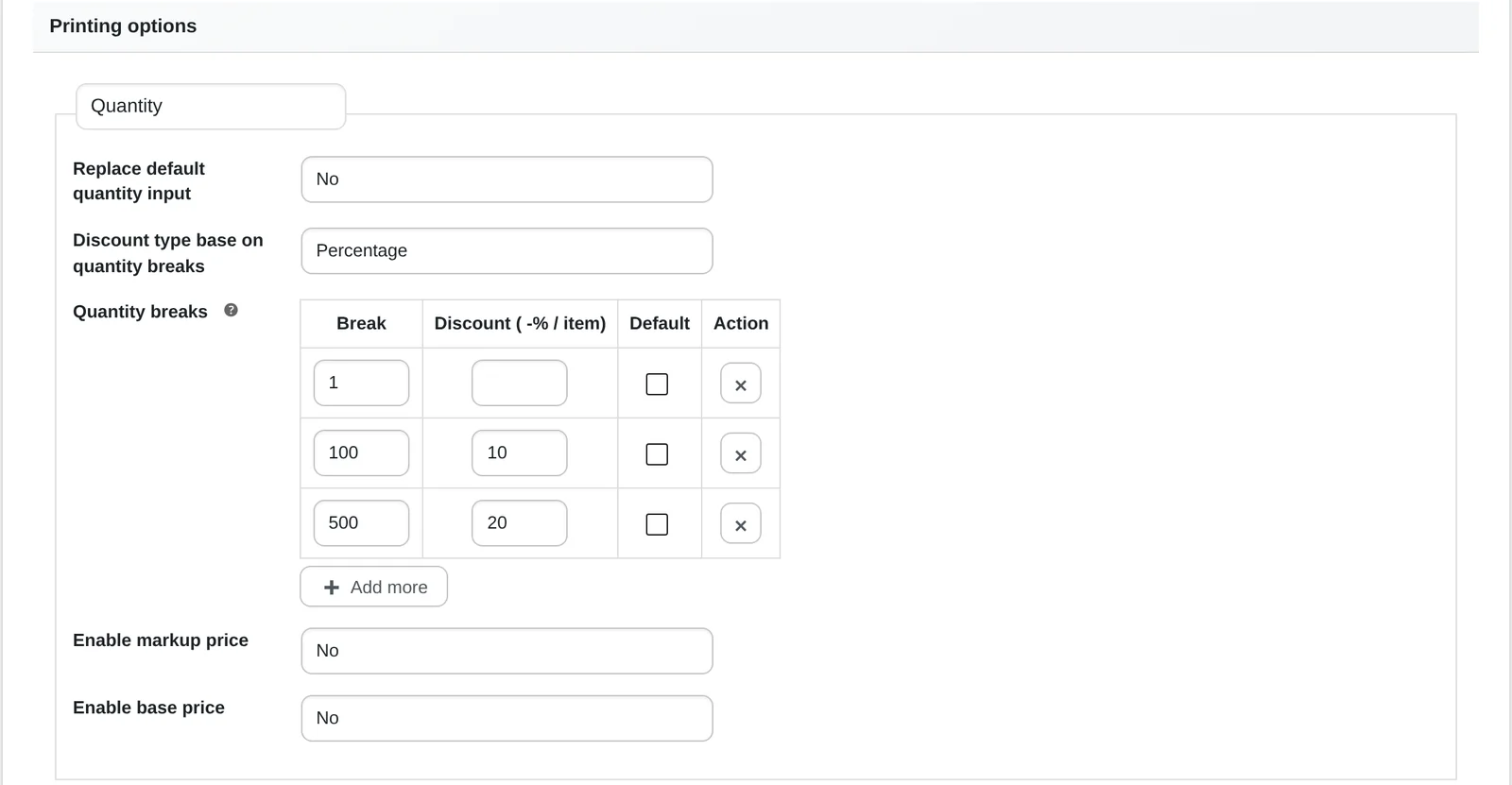
Quantity breaks are held as editable rules against an option set, the kind of rule a pricing engine reads instead of a fixed price table.
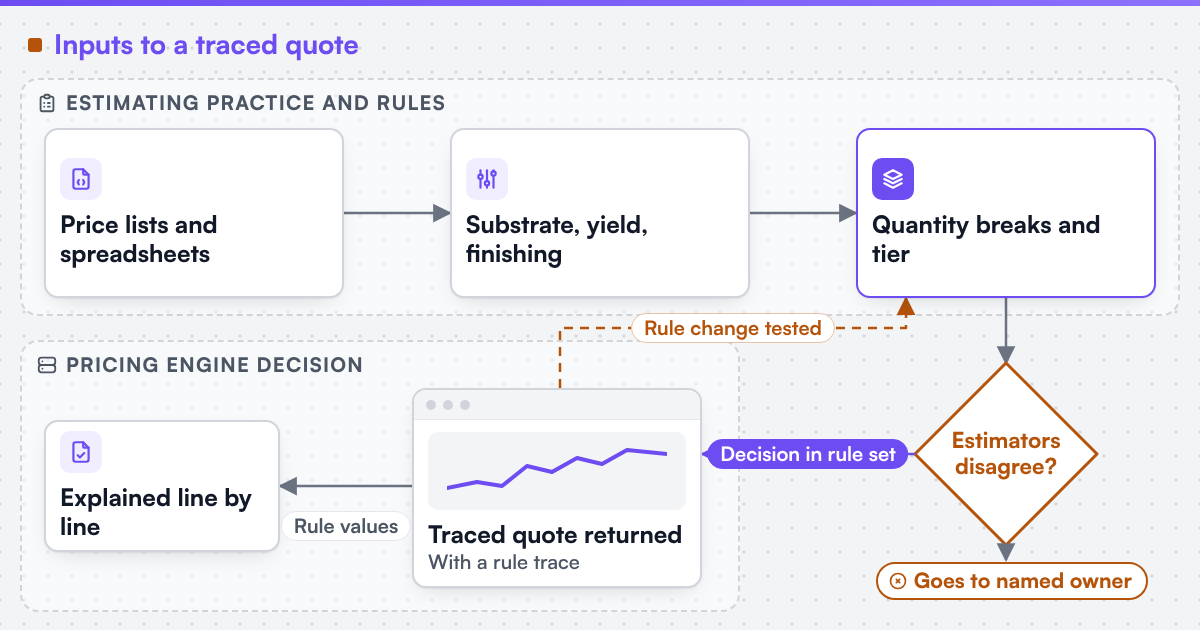 (opens the full-size diagram in a new tab)
How does the price stay the same from product page to job?
The same rule version governs the product page, the online designer, the cart and the order. The amount in the browser is an estimate until the server recalculates it from the submitted inputs. If the customer changes quantity or size, the price is recalculated and the old amount cannot reach checkout. Ecommerce platform integration wires that validation into the store, and print MIS and ERP integration passes the quote inputs into the job so production and invoicing see the same basis.
Each quote stores the rule-set version and input values used, subject to your retention policy. If a stock cost changes tomorrow, today's quote can still be explained. Some products should not get an instant amount at all: the engine can return a review state with the reason, and the buyer is told what happens next.
How does the work run?
-
Specify
Trace known-good quotes to rules; resolve disputes with named owners
- Evidence you receive
- Signed rule specification and regression set
-
Build
Implement the engine, administration and integration points
- Evidence you receive
- Engine passing the regression set on a test environment
-
Accept and hand over
Estimators run their own cases; the suite becomes the change gate
- Evidence you receive
- Acceptance record, runbook and rule-change procedure
The default engagement is fixed-scope with written acceptance criteria and priced change control. Managed operations is a separate, opt-in agreement.
What does Netbase JSC bring to pricing work?
Netbase JSC, which operates Web2Print Solutions, has delivered 50+ web-to-print platforms. The group maintains rule-based print pricing templates, which can seed a rule set when they match your model. Anything they cannot express is specified and built for your rules. The Print It of South Florida case study describes a related pattern: fast catalogue pricing kept separate from a quote route for complex jobs.
Client-specific deliverables, access and handover are defined in the engagement contract. Pre-existing software, products, APIs and third-party components remain subject to their respective ownership and licence terms.
Scope this work with a project brief
This site does not yet publish a pricing case study, so the proof is your own quotes. A project brief is most useful with two known-good estimates, their inputs, and one case the current system gets wrong. If the whole platform feels too small for your rules, read outgrown a web-to-print product first.
See it live
Live stores operated by their owners. Each link opens the store in a new tab.
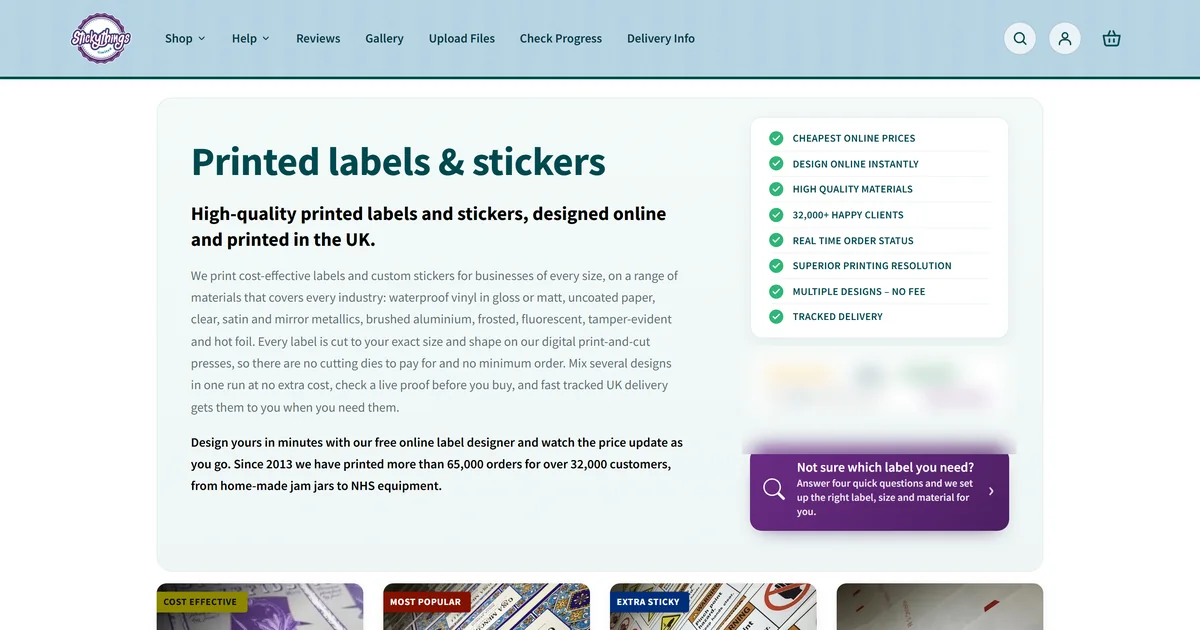
StickyThings
What it shows
A label product where the customer sets a custom width and height in millimetres and chooses a shape before designing.
Live store using web-to-print components delivered by Netbase JSC, which operates Web2Print Solutions.
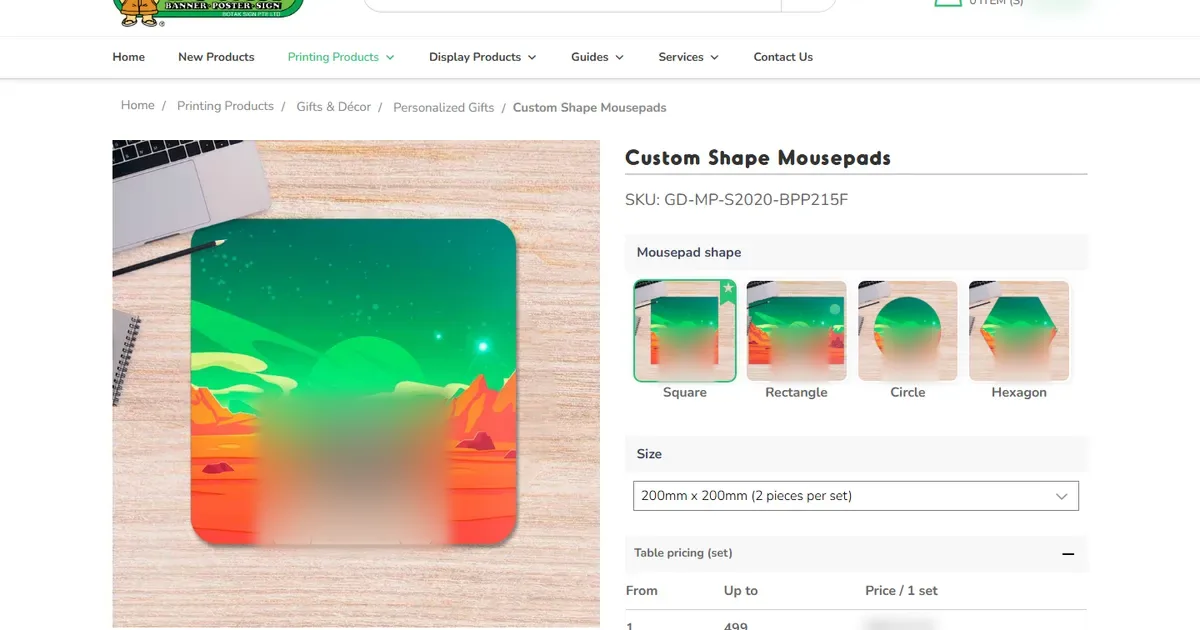
Botak Sign
What it shows
A shape selector and a quantity break table on a custom-shape product, ahead of the design step.
Live store using web-to-print components delivered by Netbase JSC, which operates Web2Print Solutions.

BillyPrint
What it shows
Size and material option chips on a car decal product, on a storefront that offers online design across its signage range.
Live store using web-to-print components delivered by Netbase JSC, which operates Web2Print Solutions.
Frequently asked questions
Yes. The storefront calls the engine for the products that need it and keeps its own prices for simple items. Replacing the storefront is a separate decision.
Against your known-good quotes, not a percentage. Every case in the regression suite has inputs, the expected amount and the estimator's explanation. A case is added whenever a rule is clarified.
Yes, for the parameters you choose to expose, such as stock costs, make-ready allowances or tier discounts. Each change has an effective date and a reason, and the regression suite shows which quotes it would move before it goes live.
The engine returns a controlled review state with the missing input named, instead of inventing a plausible amount.
Yes. Web2Print Solutions delivers remote-first from Hanoi, Vietnam, and Netbase JSC has delivered web-to-print projects for clients in 80+ countries.
Send a project brief at /project-brief, email project@netbasejsc.com or message us on WhatsApp at +84 937 869 689. A senior engineer reads every brief and replies in writing.