

Services
-
Home
-
Services

Web-to-print engineering services
Web2Print Solutions provides eighteen web-to-print engineering services, from architecture discovery, new platform implementation and migration to pricing engines, product configurators, prepress output, storefront, MIS, B2B portal, multi-tenant, workflow automation, AI agents, reporting and managed operations work. Each service is scoped around one operational boundary, fixed in writing, and accepted against the buyer's own quotes, files and orders.
Reviewed by CEO, Netbase JSC · Updated 14 Oct 2026

I know the service
Jump to its group with the chips below, then open the card to read the scope or start a brief.
I do not know yet
Start a brief that begins with discovery. Naming one real product and one real order is enough to find the fit.
Start a discovery briefPlan, configure and price
 Web-to-print architecture and discovery
Web-to-print architecture discovery is a paid, fixed-scope engagement that turns an uncertain platform plan into a written print platform architecture. Web2Print Solutions maps product and pricing rules, print output, existing systems and the order path, then delivers a data model, integration inventory, risk register and phased plan that another supplier could execute.
Learn More
 Print product configurator engineering
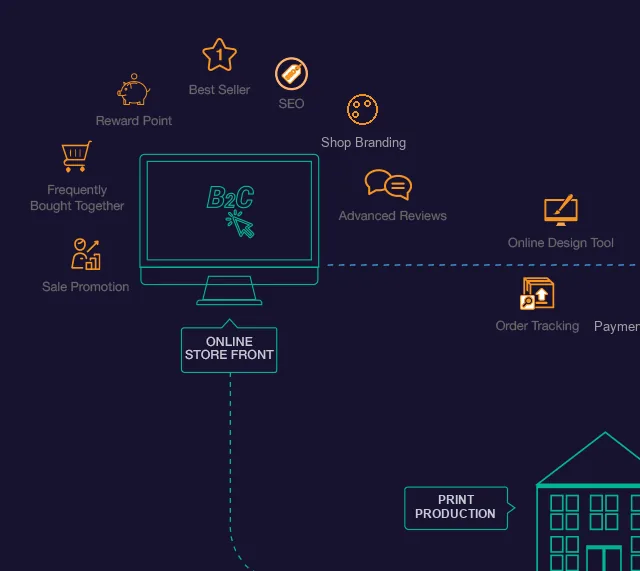
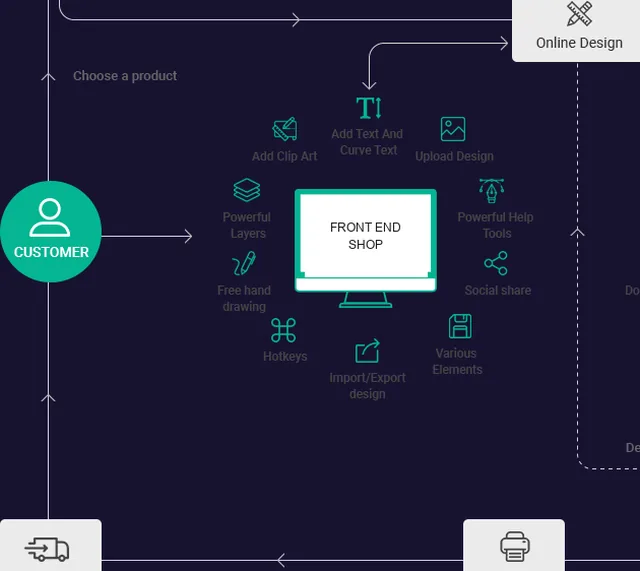
A print product configurator is the part of a web-to-print store that turns a product's options, constraints and artwork into one valid, producible order. Web2Print Solutions models the option rules, builds the configurator and online design tool, and accepts them only when every tested combination is valid and emits a print-ready file.
Learn More
 Print pricing engine engineering
A print pricing engine turns a printer's estimating model into explicit, versioned rules that a storefront, quote tool or MIS can call. Web2Print Solutions formalises inputs such as stock, size, sheet yield, make-ready, finishing, quantity breaks and customer terms, and accepts the engine only when it reproduces the client's own known-good quotes.
Learn More
Build and launch a platform or storefront
 New web-to-print platform implementation
Custom print platform development builds a new web-to-print platform from an approved specification and takes it to launch. Web2Print Solutions assembles the storefront, product rules, pricing, online designer, print-ready output and production handoff, tests them against the buyer's real products and orders, and launches only after the agreed acceptance cases pass.
Learn More
 B2B and corporate print storefronts
A corporate print storefront is a closed ordering portal where an organisation's locations and teams order print on brand without routing every job through one print manager. Web2Print Solutions builds the account hierarchy, permission model, brand-locked templates, approval workflow and cost-centre handling, and accepts the storefront against a tested permission matrix.
Learn More
 Multi-tenant and white-label print platforms
A multi-tenant or white-label print platform lets one codebase serve several branded storefronts, each with its own catalogue, pricing and users. Web2Print Solutions designs and builds these with tested data isolation between tenants, per-tenant branding, pricing and catalogue control, and a documented trade-off analysis of the tenancy model chosen for the buyer's reseller or ISV setup.
Learn More
Integrate storefront, MIS and fulfilment
 Ecommerce platform integration for print
Web-to-print ecommerce integration connects a storefront such as Shopify, WooCommerce or a custom build to print pricing, an online designer and production. Web2Print Solutions decides which print options become variants and which travel as line-item data, validates every price on the server, and proves that one configured product becomes one complete production job.
Learn More
 Print MIS and ERP integration
Web-to-print MIS integration maps each web order into the job model of a print MIS or ERP through a supported interface: a REST API, JDF and JMF messages or a monitored import folder. Web2Print Solutions defines field ownership, idempotent submission, status return and reconciliation, and accepts the work when one order creates exactly one correct job.
Learn More
 Print fulfilment network integration
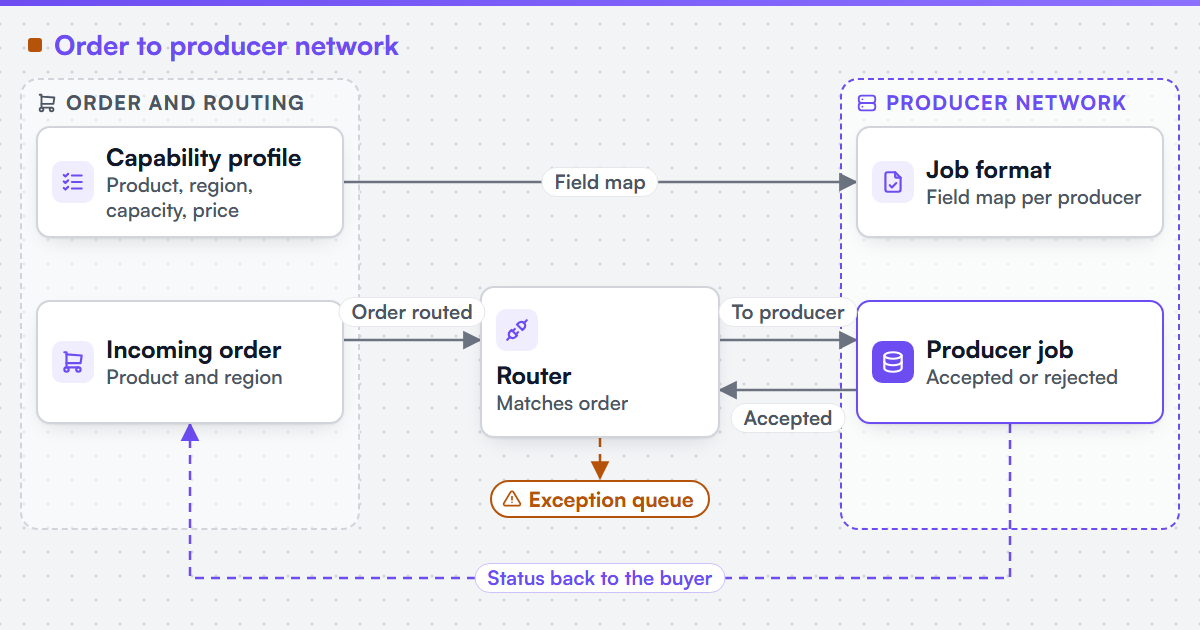
Print fulfilment network integration routes a web order to the producer that can make it, matched by product, region, capacity and cost, and carries an order and status contract between the two systems. Web2Print Solutions scopes the routing rules and the exception path for a rejected job, a partial shipment or an offline producer.
Learn More
Produce, approve and personalise output
 Print-ready PDF and prepress automation
Print-ready PDF generation turns a web order and its artwork into the production file a prepress workflow accepts without repair. Web2Print Solutions engineers the output to the client's specification, such as PDF/X-1a or PDF/X-4, CMYK conversion with named ICC profiles, bleed and trim boxes, then preflights it and hands it to the hot folder or JDF workflow.
Learn More
 Online proofing and artwork approval workflow
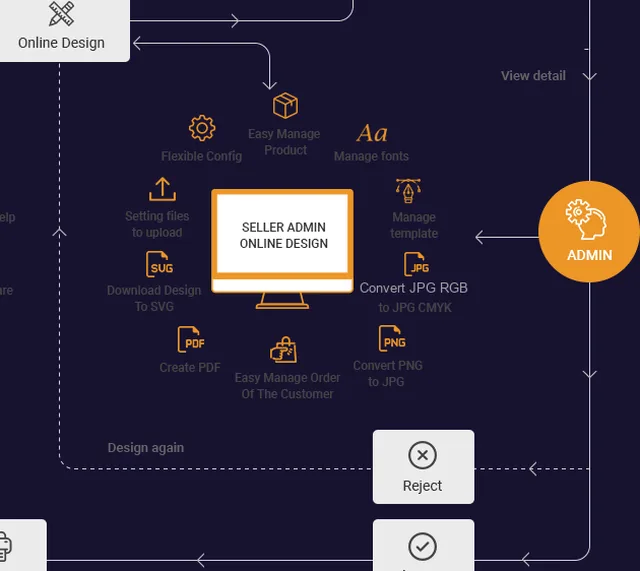
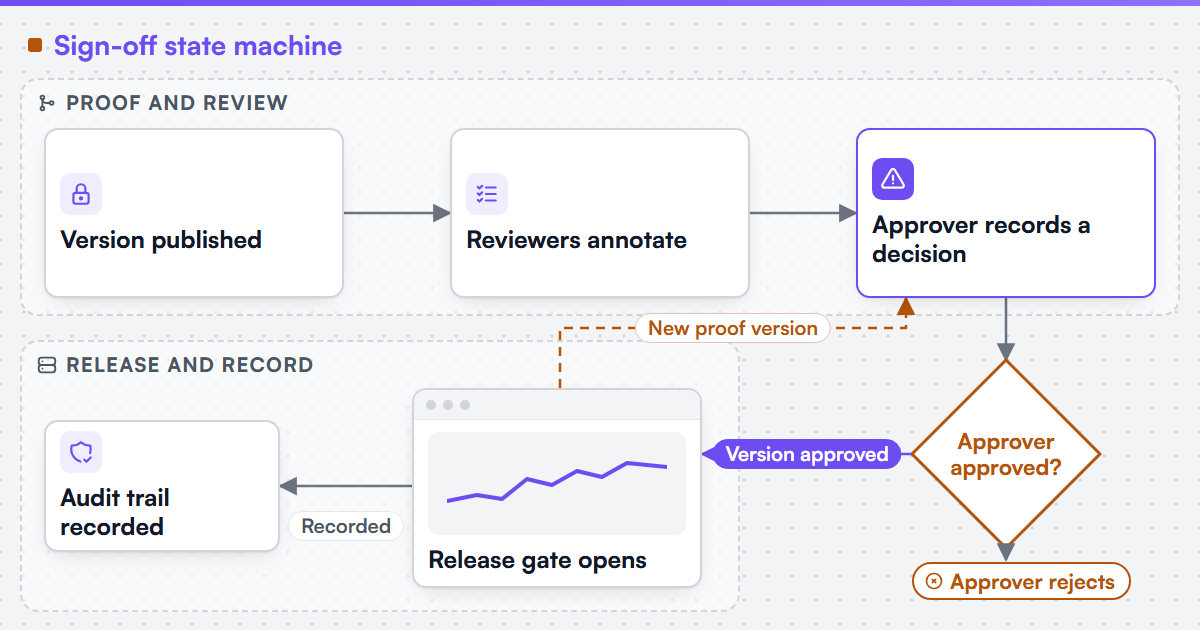
Online proofing and artwork approval workflow gives every proof version a reviewer, an annotation, a recorded decision and an audit trail, then opens a release gate to production once every required sign-off is recorded. Web2Print Solutions builds the state machine and the re-proof rules; this is a documented sign-off record, not a colour-managed contract proof itself.
Learn More
 Variable data print pipeline engineering
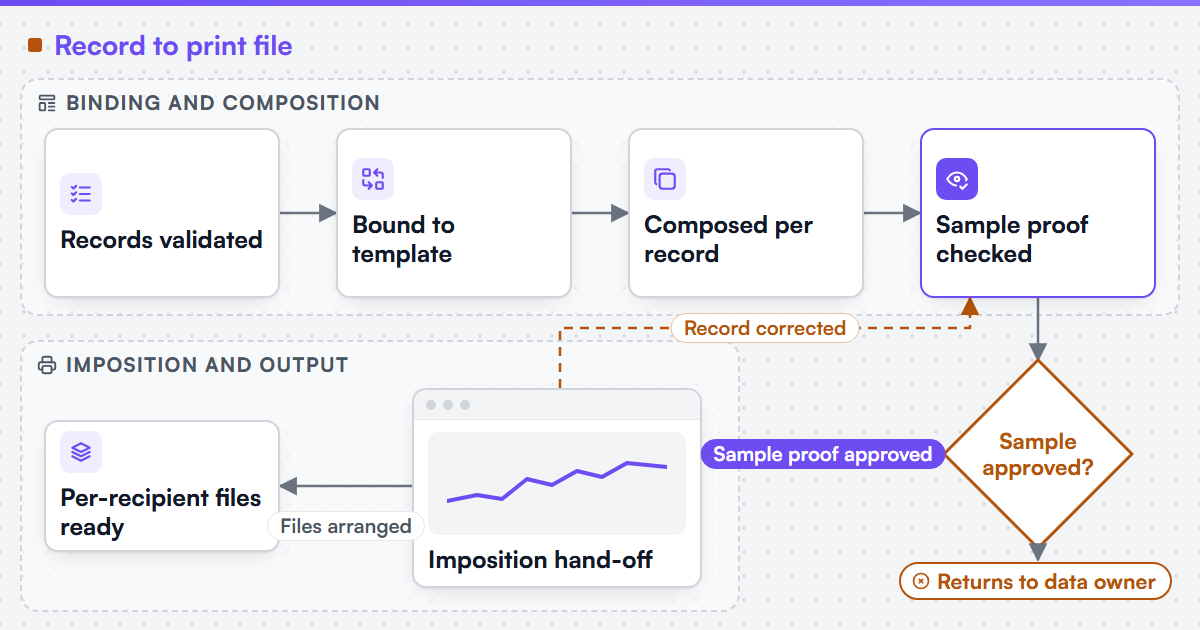
A variable data print pipeline takes validated records from a file, binds each one to a template, composes the per-recipient artwork, proofs a sample, and hands the result to imposition as individual output files. Web2Print Solutions builds the pipeline as a capability with no published case study yet; list brokering, address hygiene and mailing are out of scope.
Learn More
Add AI and workflow automation
 AI-assisted steps in print workflows
AI-assisted print workflow features add specific, reviewed AI steps inside a web-to-print workflow, such as flagging likely artwork problems or drafting a specification from a brief. Web2Print Solutions builds these so a human reviews the result, with accuracy measured on the client's own data before acceptance. Pricing authority, artwork approval and production release stay with a person.
Learn More
 Print production workflow automation
Print production workflow automation moves a paid web order into a production job ticket, routes it to the right queue by written rules, and sends status back to the buyer without anyone retyping it. Web2Print Solutions scopes the rules, the interfaces the client's systems sanction, and an exception inbox that a named person owns and clears.
Learn More
 AI agents for print sales and support
An AI agent for a print shop collects the specification from a quote enquiry, asks for missing details, passes the complete specification to the shop's pricing engine and answers order-status questions from the order system. Web2Print Solutions builds agents where prices come from that engine, and a named person approves quotes, commitments, refunds and exceptions.
Learn More
Migrate, operate and report
 Web-to-print migration and rescue
A print platform migration starts with an independent assessment of the existing web-to-print code, data, interfaces and live order path. Web2Print Solutions reports whether to complete, replace, migrate or stop, and if migration is justified, delivers field mapping, parity tests on real orders, a cutover plan and a rollback point before production traffic moves.
Learn More
 Managed operations for web-to-print platforms
Managed print platform operations is a separate, opt-in agreement that keeps a web-to-print platform running after launch, or after a takeover assessment of an inherited stack. It covers monitoring, incident handling, updates, backups with restore tests and a planned improvement backlog. AI tools assist triage and log review; a named engineer decides and stays accountable.
Learn More
 Print data and reporting automation
Print business reporting automation pulls order, quote and production data from the storefront, pricing engine and MIS into one reporting store, and delivers scheduled reports on margin per product, quote-to-order conversion, reprint rate and on-time dispatch. Web2Print Solutions agrees each metric definition in writing with the client before any report is built.
Learn More
Which web-to-print service fits the problem you have?
Every service here is engineering work with a defined input, a written deliverable and an acceptance test the buyer runs, not a licence to a packaged product. Web2Print Solutions provides scoped services for new web-to-print setup, upgrades, migration and software integration for media organisations, print businesses and enterprise teams.
Pick the service by the boundary that is failing, not the size of the project: no build scope yet, start with discovery; an inherited platform in trouble, start with an assessment; a wrong price, file or order handoff, commission the component that owns it.
| Track | Commission it when | Accepted against |
|---|---|---|
| Web-to-print architecture and discovery | The platform must change but the build scope cannot yet be written | A specification another supplier could execute |
| New web-to-print platform implementation | A specification is approved and must be built and launched | Real products traced from storefront to job, then a rehearsed launch |
| Web-to-print migration and rescue | A stalled, inherited or ageing platform needs a verdict and a safe exit | A written assessment, then parity and cutover checks |
| Print product configurator | The configurator cannot express the product, or its files need repair | Tested option combinations and prepress-approved output |
| Print pricing engine | Estimators still re-check online prices by hand | A regression suite of your known-good quotes |
| Print-ready PDF and prepress automation | Prepress repairs files that the storefront accepted | Specimen PDFs your prepress team signs off |
| Online proofing and artwork approval workflow | Sign-off happens by email and nobody can prove who approved what | A recorded decision per approver and a release gate to production |
| Variable data print pipeline | Each recipient needs a correctly personalised file, not a mail-merge | Per-recipient files sample-proofed before the full run |
| Ecommerce platform integration | Shopify, WooCommerce or another store must sell configurable print | One configured product traced from cart to job |
| Print MIS and ERP integration | Web orders are retyped into the production system | One order becoming exactly one correct MIS job |
| Print fulfilment network integration | One producer cannot make everything, or goes offline mid-order | A routing rules table and one status contract regardless of producer |
| B2B and corporate print storefronts | Locations and teams must order on-brand print without a gatekeeper | A permission matrix tested role by role |
| Multi-tenant and white-label print platforms | One platform must carry several branded storefronts or resellers | A written isolation test, with branding, pricing and catalogue verified per tenant |
| AI-assisted print workflow features | A workflow step, such as an artwork check or a draft specification, needs AI help with review intact | An accuracy figure on your own data, with a named reviewer for every flagged result |
| Managed print platform operations | A live platform needs monitoring, patching, incident handling and tested backups | Restore-test results, patch logs and an improvement backlog on an agreed cadence |
| Print production workflow automation | Staff still create job tickets and route orders by hand | Real orders traced from event to ticket, queue and buyer status |
| AI agents for print sales and support | Staff chase missing enquiry details and answer status questions | Extraction measured on your enquiries, prices from your engine |
| Print data and reporting automation | Margin and dispatch figures come from spreadsheet exports | Reports that reconcile to source records under signed definitions |
What does each track deliver?
Architecture and discovery turns product rules, pricing, output and system interfaces into an architecture, a pricing-rule specification, an integration inventory and a phased plan.
New platform implementation builds from an approved specification: storefront, product rules, pricing, design tool, output and production handoff, delivered incrementally and launched with a rollback point.
Migration and rescue starts from the platform that exists: an assessment says whether to complete, replace, migrate or stop, and a migration adds field mapping, parity tests, cutover and rollback.
A print product configurator turns option dependencies, custom sizes and multi-part products into rules the storefront enforces, with an online design tool that emits the production file.
A print pricing engine formalises sheet yield, imposition waste, make-ready, finishing, quantity breaks and customer terms into callable rules with a trace, so any price can be explained.
Print-ready PDF and prepress automation defines the production artefact: PDF/X-1a or PDF/X-4 output, CMYK conversion with named ICC profiles, bleed and trim boxes, preflight and hot-folder or JDF handoff.
Ecommerce platform integration makes a storefront sell print without breaking the product model: variant strategy, line-item data, server-side price validation, the saved-design lifecycle and the order webhook.
Online proofing and artwork approval workflow gives every proof version a reviewer, an annotation and a recorded decision, with a release gate to production and a named rule for what happens on rejection.
Variable data print pipeline engineering turns validated records into correct per-recipient print files through template binding, composition and sample proofing, with no manual merge step.
Print MIS and ERP integration maps a web order into the production system's job model through a sanctioned interface, with idempotent submission and status return, so nobody retypes an order.
Print fulfilment network integration routes each order to the producer that can make it, by product, region, capacity and cost, under one status contract regardless of producer.
B2B and corporate print storefronts give locations and teams a closed portal with roles, brand-locked templates, approval routing and cost-centre budgets.
Multi-tenant and white-label print platforms let one codebase serve several branded storefronts, each with tested data isolation and its own branding, pricing and catalogue.
AI-assisted print workflow features add specific, reviewed AI steps, such as an artwork quality flag or a draft specification, to an existing workflow, with a named reviewer and an exclusion list longer than the offer list.
Managed print platform operations keeps a live platform running after launch or a takeover assessment, with monitoring, incident handling, patching and restore-tested backups.
Print production workflow automation turns paid orders into job tickets and status updates, with an exception inbox a person owns.
AI agents for print sales and support collect enquiry specifications and answer status questions, while prices and commitments stay with the engine.
Print data and reporting automation delivers scheduled margin, conversion, reprint and dispatch reports under signed definitions.
What does Netbase JSC bring to an engagement?
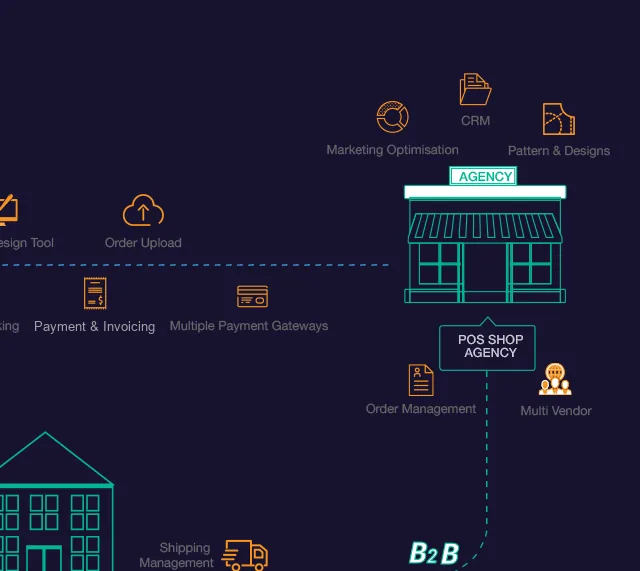
Netbase JSC, which operates Web2Print Solutions, has delivered 50+ web-to-print platforms. That group record includes reusable components an engagement can adopt instead of rebuilding: a browser-based online designer, rule-based pricing templates, print-ready PDF output, storefront connectors for major platforms, and a photobook editor. Reuse is decided per requirement during discovery, never forced.
Client references from Netbase JSC delivery work include ACT, Deyar, CanvasPrints, MMP Craft Blanks and Above-Aerosol, spanning apparel, packaging, signage, canvas and aerosol artwork.
Client-specific deliverables, access and handover are defined in the engagement contract. Pre-existing software, products, APIs and third-party components remain subject to their respective ownership and licence terms.
How is an engagement scoped and accepted?
The default engagement is fixed-scope with written acceptance criteria and priced change control. Managed operations is a separate, opt-in agreement.
Acceptance is split by the person who can judge the result: an estimator accepts prices against known-good quotes, prepress accepts output against specimen files, production accepts job data against the MIS record it expects.
Scope stays narrow on purpose: discovery produces a decision, not software, and bundling it all into one "platform project" makes acceptance vague — which is how web-to-print builds stall.
How do you start?
If you are still describing a symptom rather than a boundary, the solutions directory explains the mechanism behind common failures first. Otherwise, bring one real product, one real order and the result your operation would accept. A project brief that names the storefront, the design tool if there is one, the pricing source, the prepress route and the receiving MIS is enough to say which service applies, or whether a packaged product would serve you better.