

You have outgrown a web-to-print product
A print business has outgrown a packaged web-to-print SaaS product when a rule it applies every day, such as a price calculation, an option constraint or an output requirement, can only live outside the system as an override, a spreadsheet or a note to production. The fix is often one owned component, not a full replacement.
Start a project brief Explore servicesReviewed by CEO, Netbase JSC · Published 27 Sep 2026 · Updated 1 Oct 2026

What does outgrowing a web-to-print product look like?
A packaged web-to-print product earns its keep on ordinary work: standard sizes, standard stocks, tiered price tables and an upload button. The warning sign is not an occasional exception. It is a rule the business applies every day that the product can only hold as a manual override, a spreadsheet beside checkout or a note typed into the job. At that point the online order is no longer a reliable record of what was sold.
| Symptom | What you see today | What a sound setup does |
|---|---|---|
| Pricing | Estimators re-check every custom-size or multi-finish quote | The web price comes from the same rule the estimator uses, with a trace |
| Product options | Customers can order combinations the press cannot make | Invalid combinations are blocked at configuration, with the reason shown |
| Output | Prepress rebuilds files that passed upload | Production receives a checked PDF to its own specification |
Each row is a boundary in the product model. The page on web-to-print platform limitations groups the other symptoms this site covers.
Key takeaways
- A packaged web-to-print product usually fails on a daily rule it can only hold as a manual override, a spreadsheet or a note to production, not on an occasional exception.
- Test the limit with your own awkward product against the vendor's own supported configuration or extension point; a generic demo or a promise that "customisation is possible" is not evidence.
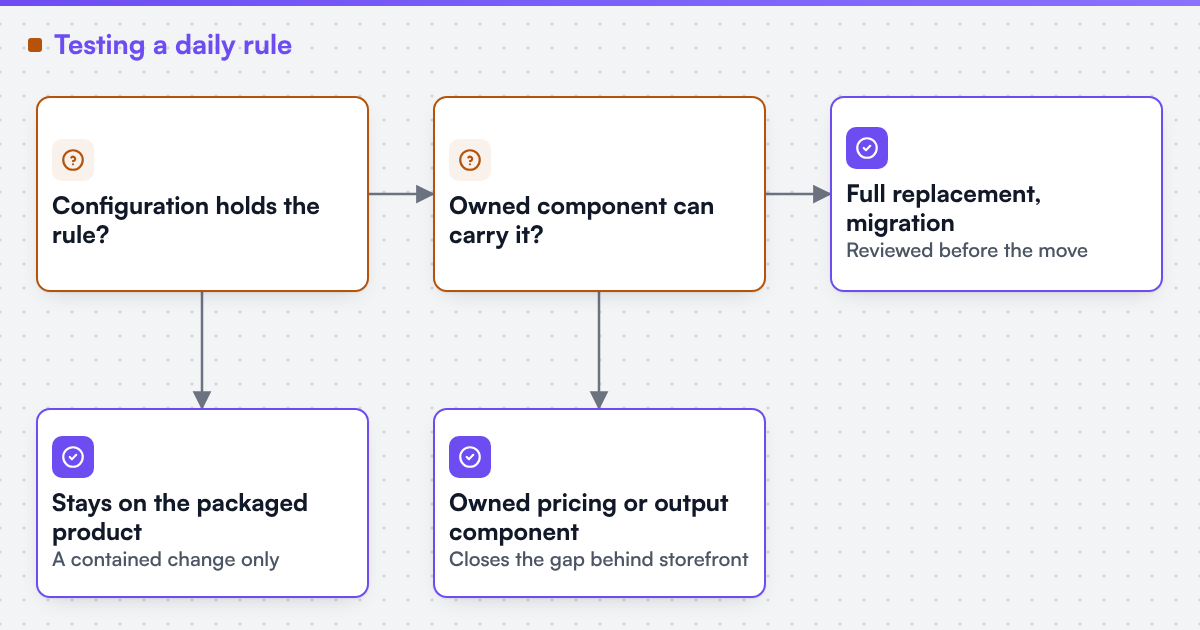
- An owned pricing component or output pipeline often closes the gap behind the existing storefront, without a full replacement.
- A full replacement is justified only when the product and its extension points cannot carry the rule at all.
- Who can inspect and change the price calculation, and what order data can be exported, matters more than brand loyalty to any one product.
How does the workflow break?
-
The rule lives outside the product
A price depends on sheet yield, make-ready, finishing sequence and a trade account's terms, but the product offers only option surcharges and quantity tables, so the real calculation stays in a spreadsheet.
-
Staff bridge the gap by hand
Estimators approve prices after checkout, customer service explains changed amounts, and prepress fixes files the upload step accepted. Each workaround is small; together they are the workflow.
-
The record stops being true
The order no longer shows what was sold, why it cost what it did, or which artwork was approved. Changing any rule now means changing the software, the spreadsheet and the habits of the people who bridge them.
 (opens the full-size diagram in a new tab)
How do you test whether the limit is real?
Before planning a replacement, test the limit with your own awkward product. Ask the vendor to show the exact input and the correct output for it, using the product's supported configuration, extension points or a documented integration. A generic demo is not evidence. Neither is a promise that "customisation is possible" without saying who owns the changed logic and whether it survives the vendor's next release.
Some manual steps are sound controls. An estimator may review an exceptional job because the business has not yet decided the rule. Keep that review. The target is the stable, repeatable rule that sits outside the system and makes every change harder to audit.
What changes the outcome?
-
An owned pricing component
Input: your estimating rules and known-good quotes. Action: a print pricing engine calculates specialised products behind the existing storefront. Output: one authoritative price with a trace, while ordinary products stay on the packaged model. Two common shapes this component takes are custom size pricing from a typed width and height, and a quantity break table that bands the unit price as volume rises.
-
An owned output pipeline
Input: the order specification and artwork. Action: print-ready PDF and prepress automation generates and preflights the production file. Output: a PDF prepress accepts, whatever the product's own export does.
-
A new ordering layer
Input: the product model, accounts and the production interface. Action: replace the storefront while keeping the MIS, as described in replace the storefront and keep the print MIS. Output: orders that map to jobs without retyping.
A full replacement is justified only when the product and order model itself prevents a contained change, for example when options cannot carry the data a price rule needs, or when the vendor offers no supported extension point at all.
Which systems are involved?
The boundary usually runs between four systems: the storefront, the online designer, the pricing logic and the production system. On a hosted store such as Shopify the platform's own limits add a fifth constraint; Shopify web-to-print records those limits with dated sources. Data that exists only inside a vendor's service, such as saved designs, template libraries or order history, decides how hard any move will be, so export rights and formats are checked first.
How does this differ by segment?
Commercial and trade printers usually outgrow the pricing model first: sheet yield, gang runs and trade terms do not fit option surcharges. Photo, apparel and packaging businesses usually outgrow the designer and output: variable templates, dielines, white ink or photobook layouts need production rules the product's editor cannot enforce. Enterprise and media buyers usually outgrow governance: approval chains, brand-locked templates and procurement links that a retail-style product does not model.
What should you weigh before replacing more?
A contained component still has an operating cost: someone maintains its interface to the packaged product, watches failed events and tests vendor upgrades. A full replacement moves products, accounts, order history, artwork and staff habits at once. Compare both burdens with the manual work you are trying to remove. The right route is the smallest one that keeps the commercial rule true from quote to job.
Ownership is practical, not ideological. Ask who can inspect and change the price calculation, who controls order data, and what can be exported in a form another system understands. We can assess a stalled, inherited or failing web-to-print build and report plainly whether it should be completed, replaced, migrated or stopped. The print platform migration service owns that assessment and, if a move is justified, the cutover.
What evidence stands behind this page?
Netbase JSC, which operates Web2Print Solutions, has delivered 50+ web-to-print platforms. The tests on this page come from that group experience, not from a survey of the market. Our engineering focus is web-to-print: product configurators, print pricing logic, print-ready output pipelines and integration with print production systems. No case study for this specific decision is published on this site yet. A related migration and upgrade engagement, on a signage and display storefront that had outgrown its earlier setup, is published as the Botak Sign case study.
Check whether this boundary applies to your setup
Send a project brief with one product the current system gets wrong, the manual correction your team makes, and the result the operation would accept. That one order usually shows whether you need a component, a new ordering layer or no change at all.
Frequently asked questions
No. If the product represents your rules faithfully through supported configuration, stay. A packaged product carries upgrades, hosting and support that custom software must replace. Leave, or build around it, only for rules it cannot hold.
Often, yes, if the product accepts an externally calculated price or line-item data through a supported API or extension. The pricing engine then serves the difficult products while the packaged catalogue serves the rest.
Product and customer identifiers, saved designs and templates, order history, price rules, URLs and the production interface. Check which of these can be exported, in what format and under which rights, before choosing the new platform.
The estimator, the prepress lead and the production manager together with the storefront owner. A polished buying journey can hide a daily repair downstream, and only those operators see it.
Yes. Web2Print Solutions delivers remote-first from Hanoi, Vietnam, and Netbase JSC has delivered web-to-print projects for clients in 80+ countries.
Send a project brief at /project-brief, email project@netbasejsc.com or message us on WhatsApp at +84 937 869 689. A senior engineer reads every brief and replies in writing.
References (2)
- Shopify developer documentation, Build apps for Shopify merchants, accessed 2026-09-29.
- NIST, SP 800-145, The NIST Definition of Cloud Computing (software as a service model), accessed 2026-09-30.