Web-to-print for corporate in-plant print
Corporate in-plant print teams use web-to-print to replace email and walk-up requests with a print requisition system. Internal customers sign in with the organisation's single sign-on, order approved products and route each request to a budget holder. The in-plant produces or outsources the job and records a chargeback to the right cost centre.
Start a project brief Explore servicesReviewed by CEO, Netbase JSC · Published 29 Sep 2026 · Updated 3 Oct 2026

How does a corporate in-plant order and produce print?
A corporate in-plant is an internal print or reprographics department serving its own organisation: a university, hospital, bank, insurer, public body or large manufacturer. Its customers are internal customers, and its budget is a cost centre, often funded by chargeback to the departments it serves.
The workflow runs from requisition to chargeback. An internal customer raises a print requisition with a file and a specification. A budget holder approves it against a departmental budget. The in-plant checks the file, schedules the job on its own devices or routes it to an external supplier under a framework agreement, delivers it, and charges the cost back to the requesting cost centre. Reports on volume, cost recovery and turnaround justify the department's existence when the organisation reviews whether to outsource print.
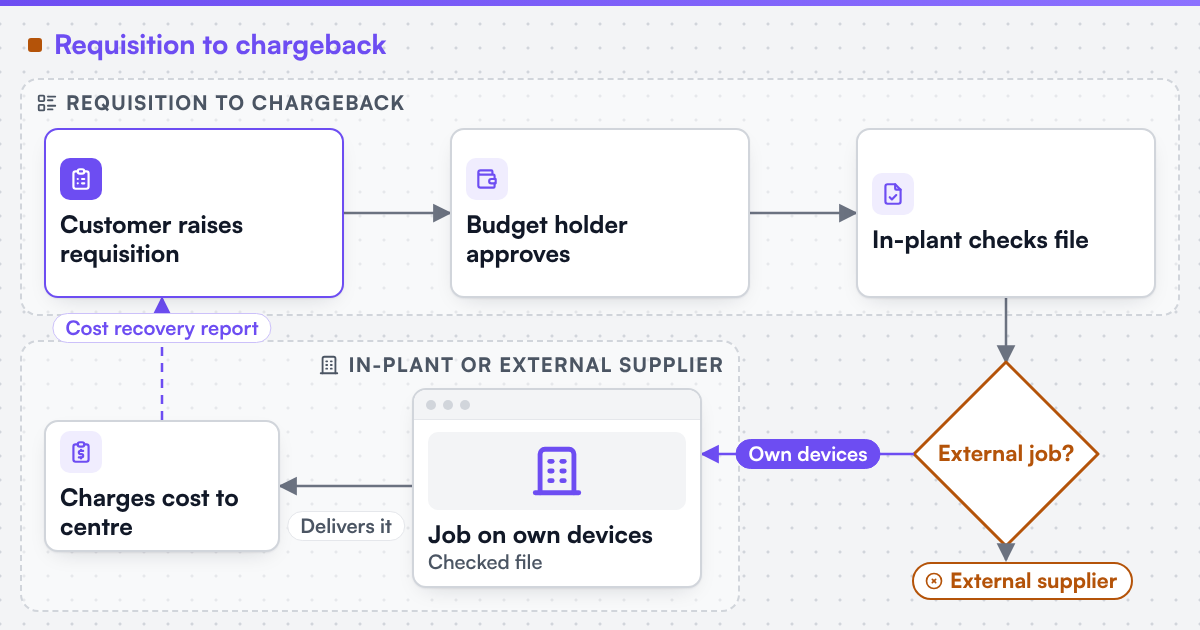 (opens the full-size diagram in a new tab)
Key takeaways
- An in-plant's workflow runs from requisition to chargeback: raise, approve against a budget, produce or route externally, deliver, and charge the cost centre.
- Without per-job cost and cost-centre records, an in-plant cannot show what it saves, and the next outsourcing review starts without numbers.
- Departments buy around a slow internal route, so the requisition system's speed is itself a retention question, not just a convenience.
- A requisition system tied to a retiring identity provider breaks the moment the organisation moves its single sign-on, taking the portal down with it.
- IT, procurement, finance and accessibility reviews gate the purchase; a tool that cannot answer them in writing is not bought.
Where does the in-plant workflow break?
-
Requests by email and at the counter
Specifications are incomplete, files are unchecked and the same questions are asked on every job.
-
No chargeback data
Without per-job cost and cost-centre records, the in-plant cannot show what it saves, and the next outsourcing review starts without numbers.
-
Departments buy around the in-plant
Internal customers order from external suppliers directly, because the internal route is slower to use than a supplier's website.
-
Identity changes break the portal
An older requisition system with its own passwords, or one tied to a retiring identity provider, stops working when single sign-on moves.
-
Every requirement goes through an RFP
IT, procurement, finance and accessibility reviews all gate the purchase, and a tool that cannot answer them in writing is not bought.
Which routes can an in-plant team take?
Web2Print Solutions provides scoped services for new web-to-print setup, upgrades, migration and software integration for media organisations, print businesses and enterprise teams.
-
New requisition portal
We can build B2B and corporate print storefronts with account hierarchies, permission models, approval workflows and brand-locked template systems. Discovery writes the requirements an RFP will ask for.
-
Finance and production integration
We can integrate a web-to-print front end with an existing MIS, ERP or production scheduler where that system exposes a sanctioned interface, so cost centres and chargebacks post to finance.
-
Replacing an ageing enterprise product
Moving requisitions, templates and history off an existing portal is scoped as web-to-print migration and rescue.
-
Operations takeover
We can assess an existing print software stack for a maintenance or operations takeover. The assessment defines access, dependencies, recovery procedures, responsibilities and the support scope before any ongoing service is agreed.
Where the organisation prefers an ecommerce platform with a native company model, Magento and Adobe Commerce web-to-print describes the company accounts and purchase order approvals that platform documents.
Who is this not for?
An organisation that has already outsourced all print to one supplier usually uses that supplier's portal, and a custom requisition system adds little. Web2Print Solutions does not act as a print broker, does not buy print on a client's behalf and does not hold client funds. The work is building and connecting the systems the in-plant runs, not replacing its supplier relationships.
Which systems does an in-plant run?
An identity provider for single sign-on, commonly through SAML or OpenID Connect, which the OpenID Foundation defines as an identity layer on top of OAuth 2.0; an ERP or finance system that holds cost centres and receives chargebacks; a print MIS or device management system for the in-plant's own equipment; a procurement system, which may exchange cXML documents with external suppliers, a protocol published at cxml.org; and the intranet where internal customers start. Accessibility and records retention requirements apply to the portal as much as to any other internal system.
What evidence exists for corporate in-plant work?
Netbase JSC, which operates Web2Print Solutions, has delivered 50+ web-to-print platforms. Web2Print Solutions is the web-to-print engineering service of Netbase JSC. Delivery records cited on this site belong to Netbase JSC; where no delivered example of a capability is published, the page says so rather than implying a record. No corporate in-plant portal is published as a case on this site.
How does an engagement start?
An engagement starts with the in-plant's own numbers and rules. The most useful inputs are a month of requests with their specifications, the approval rules by budget, the cost centre structure finance uses, the identity provider, and the RFP or security questionnaire the organisation will apply. The default engagement is fixed-scope with written acceptance criteria and priced change control. Managed operations is a separate, opt-in agreement. How that works is set out in how we work. Send the inputs with a project brief.
Frequently asked questions
Yes, where the identity provider supports a standard protocol such as SAML or OpenID Connect. Roles such as requester, budget holder and in-plant operator are mapped from the organisation's groups rather than managed as separate passwords.
Each approved job records its cost centre and cost. The portal posts those records to the finance or ERP system through its supported interface, or produces the file finance already imports, on the schedule finance sets.
Yes. Rules decide whether a job stays in-house or goes to a framework supplier, and the external order carries the same specification and approval record as an internal job.
The portal is scoped against your questionnaire before build: identity, data location, access roles, logging, accessibility and records retention are written into the acceptance criteria rather than answered afterwards.