

Headless and custom print storefronts
A headless web-to-print storefront separates the buyer-facing front end from the commerce, pricing, design and production services behind it. It suits print businesses whose catalogue no packaged store can express, but the team then owns what a platform would supply: server-side prices, a same-site design session, idempotent orders and the production job contract.
Start a project brief Explore servicesReviewed by CEO, Netbase JSC · Published 29 Sep 2026 · Updated 2 Oct 2026

Where does a headless storefront fit a print catalogue?
A headless storefront is a front end that talks to commerce, pricing, design and production services through APIs instead of one platform's theme. For print, it fits three situations: the product model cannot be expressed as variants and options on any packaged store, the buying flow needs steps a checkout does not offer, such as proof approval before payment, or one catalogue must serve several brands or channels from the same rules.
It fits poorly when the catalogue is a bounded set of standard products and no team will own the services a headless build moves in-house. When the main gap is one price rule or one missing field, a packaged store with a contained component, such as Shopify web-to-print, is usually the smaller change; choosing between the two is the job of web-to-print architecture and discovery.
This page is one of the platform pages in the web-to-print integration directory. It records the browser and protocol facts that change a headless print build, each checked against its source on 29 September 2026.
Key takeaways
- Headless fits a product model no packaged store can express, a buying flow checkout does not offer, or one catalogue serving several brands from the same rules.
- Safari and other browsers block third-party cookies by default, so an embedded designer's session must run on the storefront's own site, not an iframe's cookie.
- RFC 9110 does not treat POST as idempotent, so every submission needs a client-generated key the receiver stores and returns on a repeat.
- The build still sits behind whichever commerce engine it uses, so that engine's variant ceilings and price-override rules still apply.
- The team, not a platform vendor, now owns tax, payment, fraud checks and accessibility, each as a scope item with its own acceptance test.
How does print data cross a headless storefront?
-
Product options
The front end reads product definitions from the catalogue service: attributes, allowed combinations, artwork requirements and quantity breaks. Validation runs on the server too, because a browser can send any combination.
-
Price
The front end shows an estimate. The authoritative amount comes from a print pricing engine and is recalculated on the server, from the same rule version, before payment is taken. The order stores the rule version, so a later dispute can be answered from data rather than memory.
-
Artwork and design
An online designer saves a design and returns an identifier. The cart line stores that identifier and the approved version, never a preview image. The production file is generated after checkout from the identifier.
-
Order to job
Order placement emits an event that an adapter turns into a production job for the MIS, the prepress hot folder or a fulfilment partner. We can integrate a web-to-print front end with an existing MIS, ERP or production scheduler where that system exposes a sanctioned interface; web-to-print MIS integration scopes that work, including JDF and JMF messages as defined by CIP4.
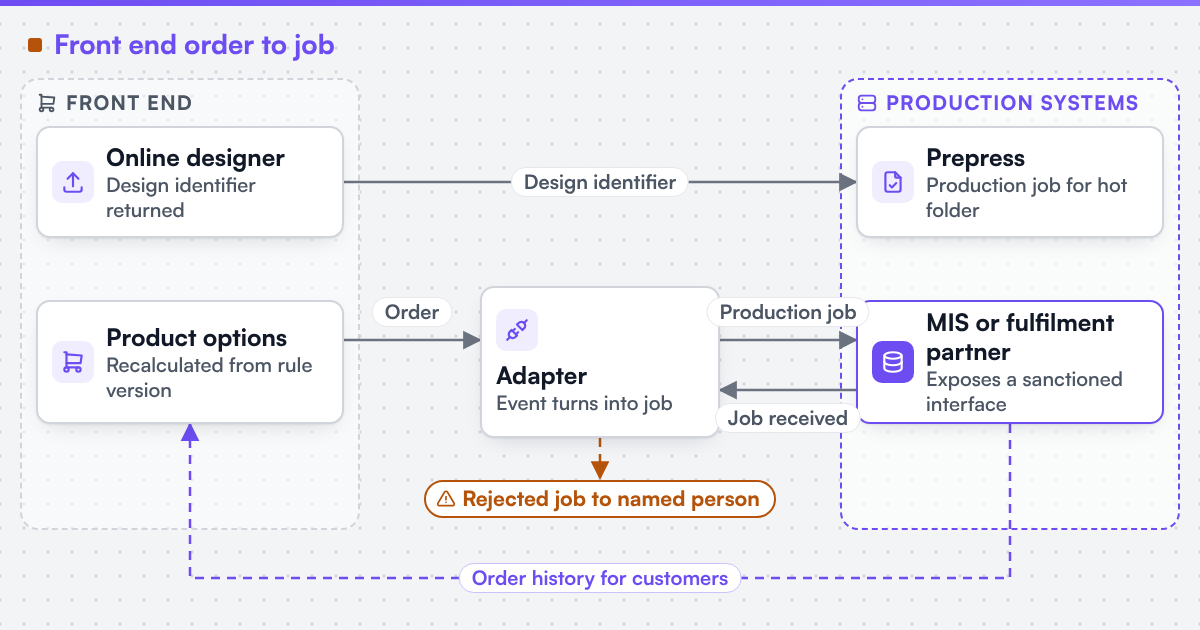 (opens the full-size diagram in a new tab)
What does the order and event contract need to say?
A headless print store has no platform deciding what an order event contains, so the contract is written down first, naming each event, its stable key and the system that owns the state.
| Event | Stable key | Owner of the state |
|---|---|---|
| Price quoted | quote id plus pricing rule version | pricing service |
| Design approved | design id plus approved version | online designer |
| Order line placed | order id plus line number | commerce service |
| Job accepted or rejected | external job key from the order line | MIS or production system |
| Job status changed | external job key plus status sequence | MIS or production system |
Every consumer must accept the same event twice without creating a second job, and must be able to ask for the current state when an event is missing. A rejected job goes to a named person with the reason, not to a log nobody reads.
Which constraints change a headless print design?
-
Third-party cookie blocking
WebKit announced on 24 March 2020 that Safari blocks cookies for cross-site resources by default; MDN's Storage Access API documentation describes the same policy family, requiring a user gesture before embedded content may request access. An online designer loaded in an iframe cannot rely on its own session cookie, so the design session runs on the storefront's own site or carries a short-lived token the server issues.
-
Order submission is not idempotent by default
RFC 9110 (June 2022) defines GET, HEAD, PUT and DELETE as idempotent, not POST, so a retried submission can create a job twice. The contract gives every submission a client-generated key; the receiver stores it and returns the first result on a repeat.
-
The commerce engine keeps its own limits
If the front end sits on a platform's storefront API, that platform's variant ceilings and price-override rules still apply: headless changes the presentation, not the data model.
-
Checkout duties move to the build
Tax, payment, fraud checks, accessibility and consent handling are platform features on a packaged store. On a fully custom store they are scope items with their own acceptance tests.
Which components and systems are involved?
Our engineering focus is web-to-print: product configurators, print pricing logic, print-ready output pipelines and integration with production systems. A headless print build usually combines a front end, a commerce engine, a pricing service, an online designer, an output service and an adapter to production.
Netbase JSC, which operates Web2Print Solutions, has delivered 50+ web-to-print platforms. Netbase JSC maintains reusable web-to-print components, including a browser-based online designer, rule-based pricing templates and print-ready PDF output with CMYK conversion, bleed and trim, plus storefront connectors for WooCommerce, Shopify, Wix and custom stores, which an engagement may reuse under its own licence terms. A headless storefront is custom by definition, so each build is scoped against its own APIs rather than an installed connector, and no headless delivery is published here. Client-specific deliverables, access and handover are defined in the engagement contract. Pre-existing software, products, APIs and third-party components remain subject to their respective ownership and licence terms.
We can scope and build web-to-print integrations for Shopify, WooCommerce, Magento / Adobe Commerce, BigCommerce, Wix and headless storefronts, and we state each platform's constraints before the work is priced. The engagement that builds this is web-to-print ecommerce integration.
What must survive a move to or from a headless store?
Saved designs and templates, customer accounts, order history with design identifiers, product URLs, pricing rules with their versions, and the production interface. Moving to headless usually keeps the commerce engine and replaces the front end, so URL redirects and design identifiers are the main risks.
Write the event contract before choosing a framework. Scope this work with a project brief that names the commerce engine, if any, one product whose price the current store cannot calculate, the designer you use, and the system that should receive the job.
Discuss your web-to-print project
Frequently asked questions
No. Headless adds services the business must run and maintain, and pays off only when the product model or buying flow cannot fit a packaged store; when one rule is missing, a contained component is usually cheaper to own.
Usually, if it exposes an API for saving designs and generating output, with its session run on the storefront's own site or a server-issued token, since browsers block third-party cookies in embedded frames.
Give each submission a stable key, store it on the receiving side and return the first result when the same key arrives again; RFC 9110 does not treat POST as idempotent, so the key is part of the contract.
The project does: on a packaged platform these are vendor features, but on a custom build each is a scope item with acceptance criteria, which is why discovery comes before the framework choice.
References (4)
- WebKit, Full Third-Party Cookie Blocking and More, 24 March 2020: cookies for cross-site resources blocked by default in Safari, accessed 2026-09-29.
- MDN Web Docs, Storage Access API: browser policies that partition or block third-party cookies, and the user-gesture requirement, accessed 2026-09-29.
- IETF, RFC 9110 HTTP Semantics, June 2022, section 9.2.2 Idempotent Methods, accessed 2026-09-29.
- CIP4, JDF and JMF job and messaging formats, accessed 2026-09-29.