

New web-to-print platform implementation
Custom print platform development builds a new web-to-print platform from an approved specification and takes it to launch. Web2Print Solutions assembles the storefront, product rules, pricing, online designer, print-ready output and production handoff, tests them against the buyer's real products and orders, and launches only after the agreed acceptance cases pass.
Start a project brief Explore servicesReviewed by CEO, Netbase JSC · Published 29 Sep 2026 · Updated 14 Oct 2026

At a glance
- Engagement type
- Build and launch
- What you provide
- One real product or workflow, plus your acceptance criteria
- What you receive
- Build and launch a new web-to-print platform from an approved specification, tested on your real products, prices and orders.
- Who accepts
- The business owner, against real products and orders
What you need to provide
- One real product or workflow to scope against
- What correct looks like for it
- Any system that must stay in place
- Who in your organisation confirms the result
Ready to scope this service?
What does a new web-to-print implementation deliver?
A new web-to-print implementation delivers a running ordering platform: a storefront where customers configure and design print products, a price they can trust, a production file prepress accepts, and an order that arrives in production as a job. It starts from a specification the buyer has already approved and ends when the agreed acceptance cases pass on the live platform.
Web2Print Solutions provides scoped services for new web-to-print setup, upgrades, migration and software integration for media organisations, print businesses and enterprise teams. Among the web-to-print engineering services, implementation is the one that assembles the parts into one platform and takes responsibility for them working together. Our engineering focus is web-to-print: product configurators, print pricing logic, print-ready output pipelines and integration with print production systems.
What does custom web-to-print development include?
Custom web-to-print development includes platform foundation (environments, pipeline, backups), a storefront with accounts and checkout, a product configurator and online designer, pricing rules or a print pricing engine, print-ready output and preflight, and a production handoff into the client's MIS, hot folder or fulfilment partner, plus a tested launch with a rollback point.
Key takeaways
- A new web-to-print implementation builds and launches a platform from a specification the buyer has already approved, not from an open-ended brief.
- The build proceeds in increments, one product family at a time, so wrong assumptions surface on the first family instead of across the whole catalogue.
- Launch goes live only after every agreed acceptance case passes on real products, prices and orders, with a rollback point prepared in advance.
- The production handoff is designed around the MIS, hot folder or fulfilment partner the client already uses, where that system offers a sanctioned interface.
- Data migration from an older store is separate, scoped work; implementation does not improvise it during launch week.
Who is this for, and when does another route fit better?
-
A buyer who cannot yet say which system owns price, files or jobs, where architecture discovery comes first
A print business or brand launching online ordering for the first time, with its products, rules and production route written down
-
A business with a live store that is failing, where migration and rescue starts from what exists
A printer replacing spreadsheets and email ordering with a platform it controls
-
A catalogue that a packaged product already serves well; when not to hire us explains that case honestly
A media or enterprise team that needs a new ordering portal connected to existing systems
What outcomes is the engagement accepted against?
-
Real products, end to end
Each agreed product is configured, designed or uploaded, priced, ordered and received by production on the staging platform, then again after launch.
-
Prices the estimator agrees with
Storefront prices for the agreed test quotes match the estimator's known-good figures.
-
Files prepress accepts
Output for representative designs passes the agreed preflight profile and is signed off by prepress.
-
Orders that become jobs once
A retried or duplicated order event creates one job, and a failed handoff is visible to a named operator.
-
A platform someone can run
Administrators add products, templates and users from the documentation, and the runbook covers deployment, backup and recovery.
What is in scope?
| Module | Input | Deliverable |
|---|---|---|
| Platform foundation | The approved specification and hosting decision | Environments, deployment pipeline, backups and monitoring hooks |
| Storefront and accounts | Catalogue, customer types and checkout rules | Storefront, customer accounts, checkout and order management |
| Product rules and design | Options, templates and artwork rules | A print product configurator and online design tool |
| Pricing | The estimating model and known-good quotes | Rules or a print pricing engine with a regression suite |
| Print output | The prepress specification | Print-ready file generation and preflight for each order line |
| Production handoff | The receiving MIS, hot folder or fulfilment partner | An order-to-job adapter, often through print MIS and ERP integration |
| Launch | Domain, content, payment provider and test plan | A launch checklist, rehearsal and rollback point |
What is not included?
-
No platform choice by assumption
If the specification does not settle the architecture, discovery does that first; the build does not start on a guess.
-
No content, photography or marketing
Product copy, imagery and campaigns stay with the client or its agency.
-
No payment handling beyond the provider
Card data stays within the chosen payment provider's own boundary.
-
No data migration by default
Moving customers, designs and orders from an old store is a separate, scoped migration.
-
No open-ended operation
Support after launch is agreed separately, with its own scope.
How does the work run?
-
Specification check
Confirm the approved specification is buildable and list open decisions
- Evidence you receive
- A build plan, acceptance cases and a dependency list
-
Foundation
Set up environments, pipeline, storefront and accounts
- Evidence you receive
- A staging platform you can log in to
-
Build in increments
Add product rules, design, pricing and output one product family at a time
- Evidence you receive
- A working product family at the end of each increment
-
Integration
Connect payment, production and any existing systems
- Evidence you receive
- Test orders traced from checkout to job
-
Acceptance and launch
Run every acceptance case, rehearse launch, go live with a rollback point
- Evidence you receive
- Signed acceptance per case and a launch report
Increments matter because the first product family exposes most of the wrong assumptions. Fixing them there is cheaper than fixing them across the whole catalogue. The default engagement is fixed-scope with written acceptance criteria and priced change control. Managed operations is a separate, opt-in agreement. The how we work page describes the engagement model in full.
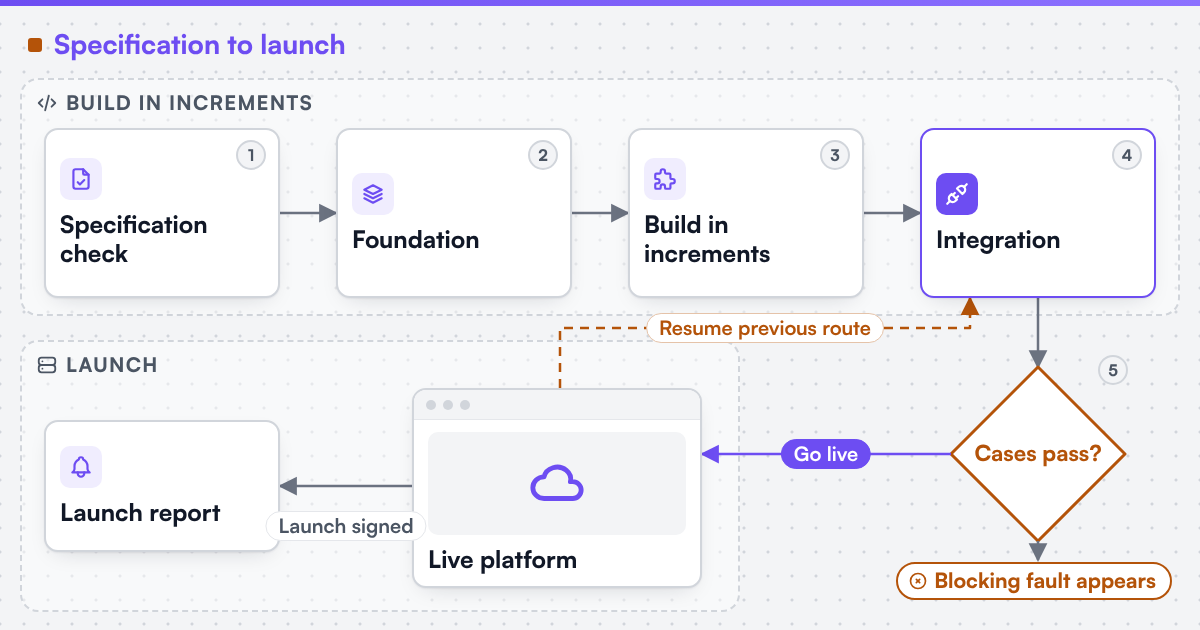 (opens the full-size diagram in a new tab)
Which architecture does a new build start from?
The architecture comes from the approved specification, not from habit. Most new platforms combine a commerce core, reusable web-to-print components for design, pricing and output, and client-specific integrations with the store, payment provider and production system. The deciding questions are which system owns price, which owns the artwork version, and which owns the job.
Whatever the stack, its maintenance window is recorded before launch. For example, the Laravel release notes (accessed 29 September 2026) state that each major release receives bug fixes for 18 months and security fixes for 2 years, and list security fixes for Laravel 12 until 24 February 2027. A platform launched on a framework version near the end of that window starts life with an upgrade already due, so the build plan names the version and the date the first upgrade becomes necessary.
How is launch kept safe?
A web-to-print launch fails in predictable places: a payment callback that never reaches the order, a price that differs between the product page and checkout, a production file generated from the wrong design version, or an order that never becomes a job. The launch checklist tests each of those with real orders before public traffic arrives. A rollback point is prepared so the previous ordering route can resume if a blocking fault appears.
When an older store already exists, the new platform runs in parallel until its orders match. Customer, design and order migration then follows the parity and cutover method of the migration service, rather than being improvised during launch week.
What does Netbase JSC bring to a new implementation?
Netbase JSC, which operates Web2Print Solutions, has delivered 50+ web-to-print platforms. The group maintains reusable components that an engagement may adopt under their own licence terms: a browser-based online designer, rule-based print pricing templates, print-ready PDF output with CMYK conversion, bleed and trim, storefront connectors for WooCommerce, Shopify, Wix and custom stores, and a photobook and multi-page layout editor. The scope names which components are reused and which parts are built for the client. The Reprotel case study shows one of those components, a browser-based designer, live on a client's own store.
The live web-to-print stores page lists owner-operated stores where Netbase JSC delivered the designer or print-option components. Web2Print Solutions has not yet published a full new-platform case study under its own name.
Client-specific deliverables, access and handover are defined in the engagement contract. Pre-existing software, products, APIs and third-party components remain subject to their respective ownership and licence terms.
Scope this work with a project brief
Send a project brief with your approved specification or the closest document you have, three representative products, how orders reach production today, and the date the platform needs to take its first real order.
Frequently asked questions
Only when the specification is not ready. If you can already name your products and rules, the pricing source, the output specification and the system that receives jobs, implementation can start with a short specification check. If two suppliers would read your document differently, discovery comes first.
Usually, yes. The production handoff is designed around the MIS, hot folder or fulfilment partner you already use, provided that system offers a sanctioned interface. Replacing production software is a separate decision and is rarely required to launch online ordering.
By the number of product families, the complexity of their rules, and the integrations required. The build plan in phase 1 sets the sequence of increments and the acceptance cases for each, and any change after that follows written change control.
The platform runs under the arrangement agreed in the contract. Support, maintenance and further development can be agreed as separate scoped work, and the runbook written during the build is the starting point for whoever operates the platform.
Yes. Web2Print Solutions delivers remote-first from Hanoi, Vietnam, and Netbase JSC has delivered web-to-print projects for clients in 80+ countries.
Send a project brief at /project-brief, email project@netbasejsc.com or message us on WhatsApp at +84 937 869 689. A senior engineer reads every brief and replies in writing.