

Too many variants for real print products
Print products produce too many variants when every option, such as size, stock, finish and quantity, is modelled as a sellable SKU. The combinations multiply past platform limits and past what production can check. The fix is a product model with few purchasable variants, open choices carried as attributes, and rules plus a price engine that validate each combination.
Start a project brief Explore servicesReviewed by CEO, Netbase JSC · Published 29 Sep 2026 · Updated 1 Oct 2026

Why do print products explode into variants?
A variant explosion happens when a print catalogue is forced into a retail product model. Retail platforms assume that each purchasable combination is a stock-keeping unit with its own price, stock level and identifier. A print product is different: it is a set of choices that production resolves at order time. Six sizes, five stocks, four finishes, three corner options and ten quantity tiers already describe 3,600 combinations for one business card. Add custom dimensions and the space is unbounded.
| Area | What you see today | What a rule-based product model does |
|---|---|---|
| Catalogue | Thousands of generated variants per product, most never ordered | A handful of purchasable variants plus attributes validated by rules |
| Price | A spreadsheet re-imported whenever a stock price changes | One price calculation reads the chosen attributes at order time |
| Production | Impossible combinations can be ordered and are caught by hand | Rules block combinations production cannot make before checkout |
| Platform | Imports fail or slow down near the platform's variant ceiling | The platform holds only what it models well |
This page covers the product-model boundary. Other failing boundaries are listed under web-to-print platform limitations.
Key takeaways
- A variant explosion happens when print options such as size, stock, finish and quantity are each modelled as a sellable SKU instead of an attribute production resolves at order time.
- Shopify and WooCommerce both document hard or practical ceilings on variants per product; a catalogue that keeps growing past them will eventually fail to import or edit.
- The fix is a small set of purchasable variants plus attributes, validated by compatibility rules and priced by a calculation engine, not a bigger variant limit.
- Custom dimensions, such as a typed width and height, cannot be pre-built variants at all and need their own pricing model.
- Keep real variants only for items a warehouse physically counts; print choices that are produced to order belong in the attribute model.
How does the variant model break the workflow?
-
Every option becomes an axis
A merchandiser adds paper weight, lamination, rounded corners and a quantity break as product options. The platform multiplies them into a variant for every combination.
-
The platform ceiling arrives
Shopify documents a maximum of 2048 variants per product in its GraphQL Admin API (version 2026-07). WooCommerce stores each variation of a variable product as its own record, so large sets become slow to generate, edit and load. The web-to-print on Shopify and WooCommerce web-to-print pages cover each platform's exact mechanics.
-
Prices go stale
Each variant carries its own price. When a stock price or a make-ready cost changes, someone regenerates or re-imports thousands of rows.
-
Invalid combinations ship
A variant grid cannot say "soft-touch lamination is not available on 170 gsm uncoated" unless someone deletes those rows by hand. Customers order them anyway, and production fixes the job by email.
-
Custom sizes do not fit at all
A width and height typed by the customer cannot be a pre-built variant. Teams either refuse custom sizes or quote them manually, unless the product carries its own custom size pricing calculation instead of a variant row.
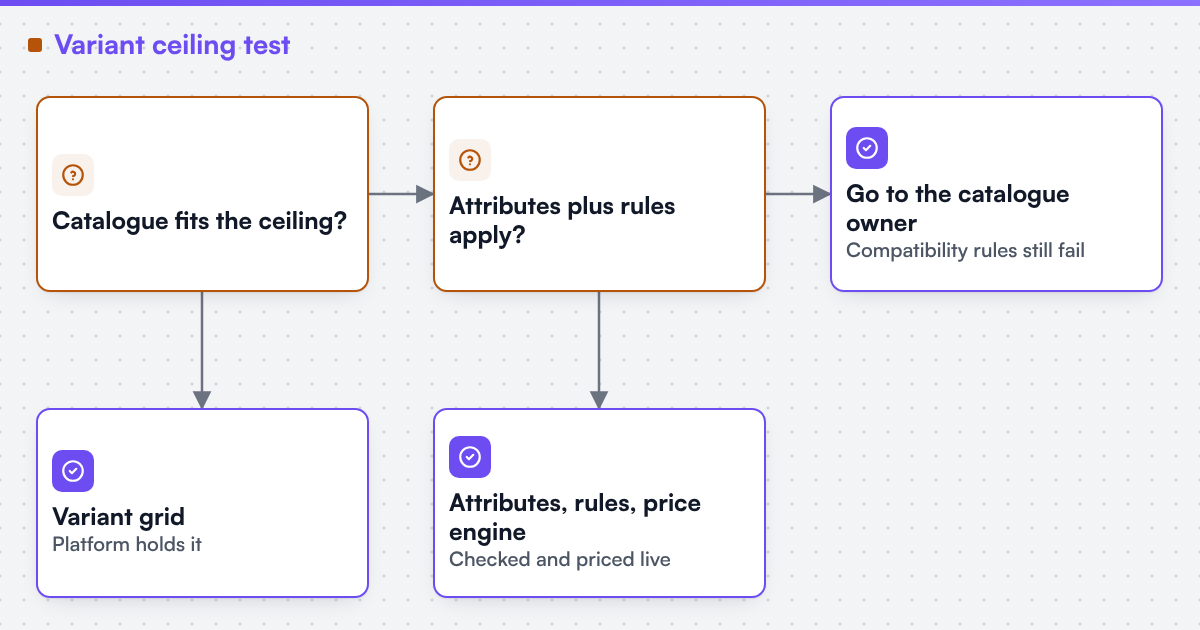 (opens the full-size diagram in a new tab)
What changes the outcome?
The fix is a different product model, not a bigger variant limit. Four components usually carry it.
-
An attribute model
Input: the options production actually offers. Action: separate the few choices that deserve a purchasable variant, such as a standard size with its own stock level, from attributes that only describe the job. Output: a catalogue small enough for the platform and complete enough for production.
-
Compatibility rules
Input: the constraints production already knows, such as minimum stock weight for a fold or the finishes a press can apply. Action: express them as rules the configurator checks as the customer chooses. Output: only producible combinations reach the cart.
-
A price calculation
Input: the chosen attributes and quantity. Action: compute the price from the business's own costing logic instead of a price stored on each variant, often banding the unit price with a quantity break table rather than one row per tier. Output: one price source that updates when a cost changes. The print pricing engine service owns that calculation.
-
An order payload production can read
Input: the configured line. Action: carry every attribute, its code and the artwork reference into the order with stable names. Output: a job the MIS or the operator can act on without guessing, which also prevents the retyping described in print orders retyped into the production system.
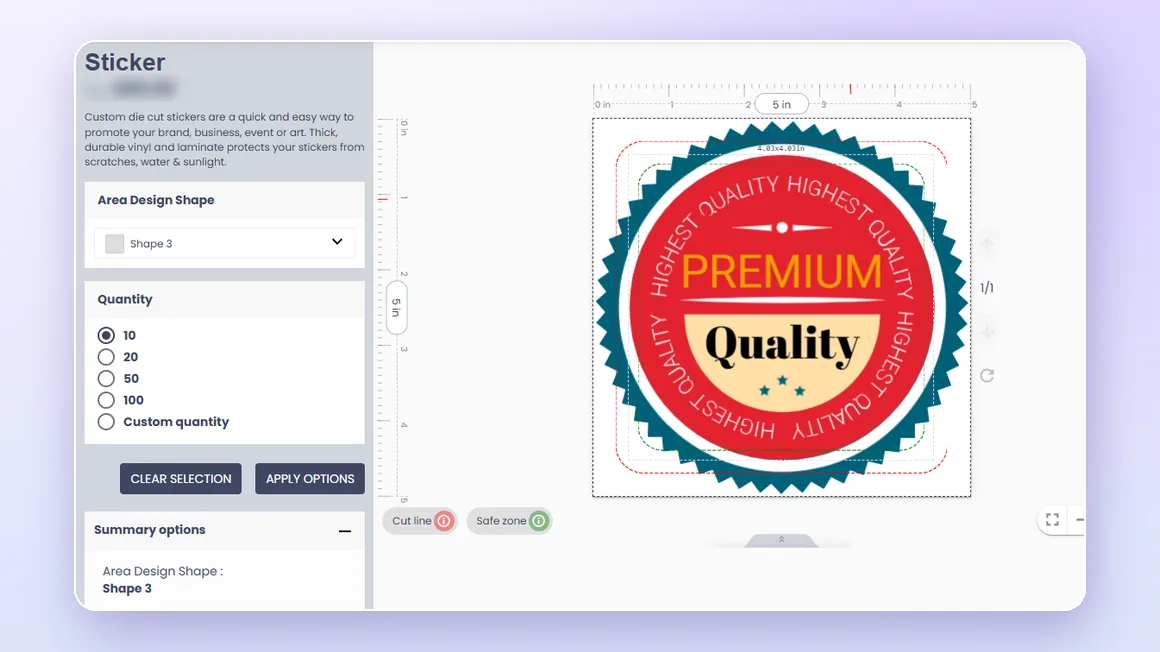
We can build custom product configurators and browser design tools that emit print-ready artwork to an agreed specification, and we can formalise a print pricing model into an engine the client owns, accepted against a regression suite of the client's own known-good quotes.
Which systems are involved?
The storefront platform holds products, carts and orders. A configurator or online designer collects attributes and artwork. A price service answers for each configuration. The print MIS or order handler receives the result. Each storefront platform exposes a different route for attributes and calculated prices: line item properties and cart transforms on Shopify, product add-ons and cart item data on WooCommerce, custom options on Magento. We can scope and build web-to-print integrations for Shopify, WooCommerce, Magento / Adobe Commerce, BigCommerce, Wix and headless storefronts, and each platform's constraints are stated before the work is priced.
Structured data follows the same logic. Schema.org describes products that vary by size, colour or material as a ProductGroup with a variesBy property, rather than as thousands of unrelated products.
How does this differ by segment?
Commercial and trade printers feel the explosion in stocks, finishes and quantity breaks. Their rules come from estimators and press capability, so compatibility rules matter more than catalogue size. Photo, apparel and promotional businesses multiply sizes, colours and print positions, and often need real variants for blank stock that is counted in a warehouse, with print choices kept as attributes; a t-shirt designer is a worked example of that split for apparel. Enterprise and media buyers add a different axis: approved templates, cost centres and brand versions. For them, the fix is usually a smaller approved catalogue per account rather than a larger public one.
What evidence stands behind this page?
Netbase JSC, which operates Web2Print Solutions, has delivered 50+ web-to-print platforms. Netbase JSC also maintains reusable web-to-print components, including a browser-based online designer and rule-based print pricing templates, which an engagement may reuse under their own licence terms. Live stores shown in the live web-to-print store examples are operated by their owners; Netbase JSC delivered the web-to-print designer or print-option components they use. No case study of a variant-model migration is published on this site yet, so the model is tested against your own catalogue. One published record with a wide option set is the MyTeeMyPrint case study, an apparel storefront with seven decoration methods. The delivery method explains how that test is scoped.
If the platform cannot represent your rules even with attributes, the question becomes whether you have outgrown the web-to-print product itself.
Check whether this boundary applies to your setup
Send a project brief with your storefront platform, one product with its full option list, the combinations production refuses, and how prices are updated today.
Frequently asked questions
There is no single number. The practical limit is reached when the platform ceiling blocks a product, when price updates need a bulk re-import, or when staff delete impossible combinations by hand. Any of the three means the options should become attributes with rules.
No, if the model keeps real variants for items that are physically counted, such as blank garments or pre-cut card. Attributes cover the print choices that are produced to order and never sit in a warehouse.
Yes. The configurator asks the price calculation for each configuration and shows the result before the customer adds it to the cart. The price shown and the price charged come from the same calculation, which is checked against known quotes before launch.
Mostly modelling. Every mainstream storefront has a variant limit or a performance cost for very large variant sets. Moving to another platform with the same model only moves the problem.
Yes. Web2Print Solutions delivers remote-first from Hanoi, Vietnam, and Netbase JSC has delivered web-to-print projects for clients in 80+ countries.
Send a project brief at /project-brief, email project@netbasejsc.com or message us on WhatsApp at +84 937 869 689. A senior engineer reads every brief and replies in writing.
References (3)
- Shopify, Product object, GraphQL Admin API 2026-07: maximum of 2048 variants per product, accessed 2026-09-29.
- WooCommerce, Variable product documentation: each variation of a variable product is managed as its own record, accessed 2026-09-29.
- Schema.org, ProductGroup type and the variesBy property, accessed 2026-09-29.