

Online printing and digital marketing, engineered to work together
Online printing and digital marketing work as partners only when the campaign and the web-to-print storefront share one product model, one price calculation and one campaign code stored on the order. Most orders a print campaign loses are lost in that handoff, not in the advertisement, so the fix is engineering across storefront, designer, pricing and production.
Start a project brief Explore servicesReviewed by CEO, Netbase JSC · Published 28 Sep 2026 · Updated 3 Oct 2026 · 10 min read

How do online printing and digital marketing work together?
The question behind this page is an old one for print businesses: can digital marketing actually sell print online, and what has to be true for it to work? The short answer, as of September 2026, is yes, but only when the campaign and the web-to-print storefront are built as one path. An advertisement, an email or a social post creates the intent. The storefront either turns that intent into a producible, correctly priced order, or loses it.
The two disciplines are usually owned by different people, run on different tools and measured with different numbers. Marketing counts clicks and sessions. Production counts jobs and reprints. Finance counts orders. Nobody owns the path between the click and the job, so nobody designs it, and that unowned path is where campaigns quietly fail.
This article sets out that argument, what it looks like in practice, and the four connections worth engineering first. It is an insight, dated and open to correction, not a service description.
Why do print campaigns lose orders after the click?
The thesis is simple enough to test: most orders a print campaign loses are lost after the click, in the storefront, not in the creative. If that is true, better targeting and better copy will not fix the problem, and engineering the handoff will.
Four handoff failures support the thesis.
The landing page sells a product the storefront cannot configure. The campaign offers folded leaflets on recycled stock; the product page opens on gloss paper in a size the offer never mentioned. The buyer has to rebuild the offer from a menu of options, and many do not.
The price changes between the ad and checkout. Marketing quoted a number from a spreadsheet. The storefront calculates from its own tables and adds finishing and delivery later. Even a small difference reads as bait and becomes a customer-service ticket.
Personalisation looks right on screen and cannot be printed. The design tool lets a customer push a photo to the trim edge, type in a colour outside the press gamut or overflow the safe area. The campaign worked, the order was paid, and prepress now has to phone the customer.
Nobody can connect an order to its campaign. Marketing knows the clicks and finance knows the orders, but tying one to the other seems to need more personal data than the business wants to hold, so it is not done at all.
The counter-argument deserves a fair hearing. Some campaigns do fail on the offer: the wrong product, the wrong audience, a price the market will not pay. Engineering the handoff does not rescue a bad offer. It only stops a good offer from leaking orders. The two causes can be separated by following one real campaign end to end, which is the method proposed below.
Where do handoff failures show up?
A handoff failure rarely announces itself as a marketing problem. A product the storefront cannot configure shows up as an abandoned cart. A price that changed after the click shows up as a customer-service dispute. Personalisation that cannot be printed shows up as prepress rework after payment. Each lands in a different team's queue, which is why the path between the click and the job so often stays undesigned.
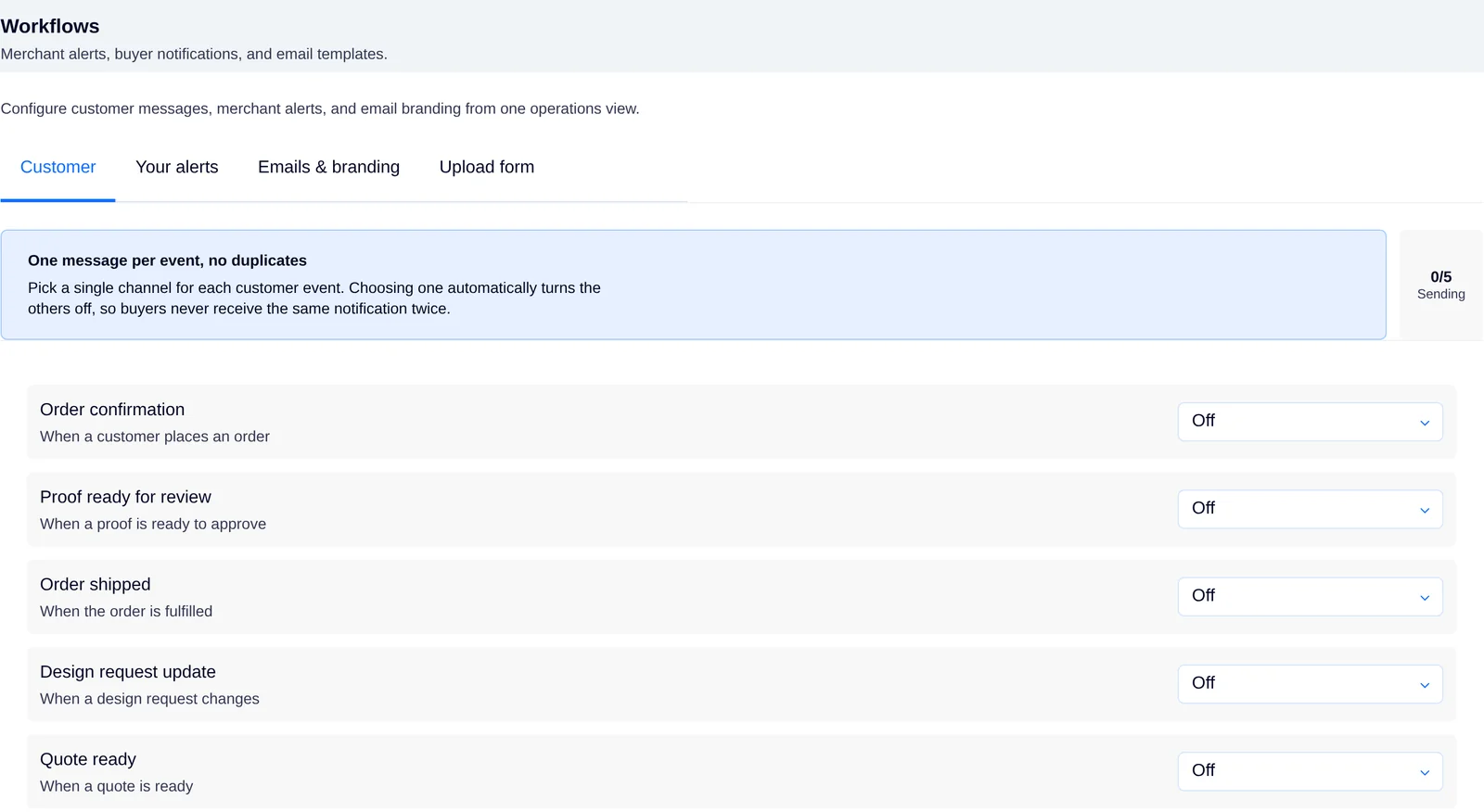
Customer messages are tied to order events such as confirmation, proof ready and shipped.
Netbase JSC, which operates Web2Print Solutions, has delivered 50+ web-to-print platforms; that group experience is the background to this article. No conversion rate, abandonment figure or campaign result is claimed here, because none has been measured to a published method.
Which four connections are worth engineering first?
Campaign link to a configured product. A campaign link should open the product already set to the offer: stock, size, quantity, finishing and, where relevant, a starting template. The storefront reads a campaign code, looks up an approved preset and applies it. The preset lives in the product data, not in the advertisement, so an expired campaign falls back to the standard product instead of an error. Product owners decide which combinations are producible; marketing requests presets from that approved set.
One product model and one price. Campaign copy, storefront options and production specifications should describe the same product with the same identifiers. When marketing writes "premium matt", the storefront and the MIS must know which stock that is. The price in the campaign should come from the same calculation the checkout uses, which is what a print pricing engine provides: one authoritative amount for the editor, the cart and the order.
Personalisation that production can print. The online designer should enforce the rules prepress depends on: bleed and safe areas, minimum effective image resolution at final size, embeddable fonts, colour that survives conversion to CMYK, and brand elements the customer cannot move. The output should be a print-ready PDF produced to an agreed specification, as described in print-ready PDF and prepress automation, never a screenshot that prepress must rebuild.
Campaign measurement without personal data. Attribution does not require tracking individuals. A campaign code travels with the session into the cart and is saved on the order as a plain value: which campaign, which offer, which preset. Reports count orders, products and revenue by campaign code without storing browsing histories or advertising identifiers against a customer. Printed pieces can carry a campaign-specific short URL or QR code that identifies the campaign, never the recipient.
-
Campaign link
- Fails today as
- A generic product page the buyer must reconfigure from scratch
- Engineered as
- A link that opens the exact preset the offer promised
-
Product model and price
- Fails today as
- Two different numbers from two different systems
- Engineered as
- One calculation shared by the campaign, the cart and checkout
-
Personalisation
- Fails today as
- A design that looks right on screen and fails in print
- Engineered as
- Bleed, resolution, colour and brand rules enforced before export
-
Campaign measurement
- Fails today as
- Clicks and orders tracked in systems nobody connects
- Engineered as
- A campaign code saved on the order, without tracking the visitor
What does this mean for a print business, a brand or a publisher?
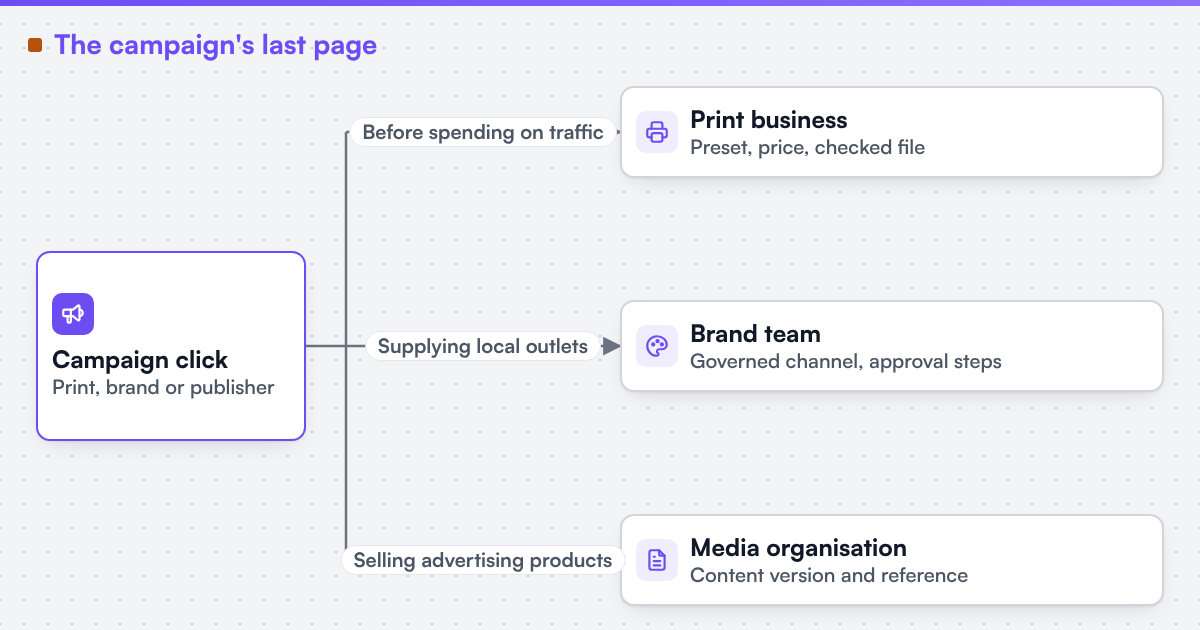
For a print business, the storefront is the campaign's last page. Before spending on traffic, check that each offer opens as a preset, prices from the real rules and produces a checked file.
For a brand team supplying local outlets, the storefront is a governed channel. Approved templates, locked brand elements and approval steps sit in front of production, and local staff personalise within fixed limits.
For a media organisation selling advertising products that include print, the order must carry the approved content version and the campaign reference, so a late revision never prints the wrong edition.
None of this requires a new platform by default. Many storefronts already accept URL parameters, product presets and order metadata. On a Shopify store, for example, line item properties and the plan's price-override rules decide which connections are practical; Shopify web-to-print records those limits with dated sources. Where the store needs deeper work, web-to-print ecommerce integration is the engineering service that builds it.
 (opens the full-size diagram in a new tab)
How we reached this
The argument comes from the group delivery experience cited above and from the storefront, designer, pricing and production boundaries that Web2Print Solutions scopes as services. Web2Print Solutions provides scoped services for new web-to-print setup, upgrades, migration and software integration for media organisations, print businesses and enterprise teams. We can build custom product configurators and browser design tools that emit print-ready artwork to an agreed specification. The article was drafted with AI assistance and reviewed by the CEO of Netbase JSC before publication.
Limitations
This is an engineering view, not a marketing study. It does not measure campaign performance, compare advertising channels or claim that any business will sell more print. It does not cover variable data printing or addressed direct mail, which carry their own data-protection and production requirements and deserve their own treatment. Platform facts cited on linked pages are dated and should be rechecked before a build.
Test the thesis on one campaign
Take one recent campaign and follow it from the advertisement to the production job: landing page, configured product, price, artwork, order and job ticket. Every point where a person retypes, corrects or explains something is a candidate for engineering. Send that path, the product involved and the result you expect through a project brief, and the reply will name the connections worth building first.
Discuss your web-to-print project
Frequently asked questions
Web2Print Solutions provides scoped services for new web-to-print setup, upgrades, migration and software integration, not marketing advice alone. We can build custom product configurators and browser design tools that emit print-ready artwork to an agreed specification, so one engagement can cover the storefront, pricing, personalisation and production, not only the campaign layer.
Yes. We can scope and build web-to-print integrations for Shopify, WooCommerce, Magento / Adobe Commerce, BigCommerce, Wix and headless storefronts, and we state each platform's constraints, such as Shopify's line item properties and price-override rules, before the work is priced, rather than assuming every platform allows the same connections.
Web2Print Solutions does not yet publish a delivered example of this specific connection. Netbase JSC, which operates Web2Print Solutions, has delivered 50+ web-to-print platforms, and that group experience is the background this article draws on, but no case study for this exact handoff is published on this site.
No. A plain campaign code travels with the session into the cart and is saved on the order, and reports can count orders and revenue by that code without storing browsing history or an advertising identifier against a named customer, so campaign measurement does not require tracking individuals.
References (4)
- Shopify developer documentation, Liquid line_item object (line item properties), accessed 2026-09-29.
- DENSO WAVE, QR Code Standardization, accessed 2026-09-30.
- International Color Consortium, ICC profile specifications, accessed 2026-09-29.
- Google Analytics Help, Custom campaign parameters, accessed 2026-09-29.