

Web-to-print on BigCommerce
BigCommerce can host a print catalogue with a product customizer, but its limits decide the design. BigCommerce allows 600 SKUs per product, modifiers add only fixed or percentage price adjustments, and a calculated print price reaches the cart through the Cart API list_price override, which by default removes the line from product-level promotions.
Start a project brief Explore servicesReviewed by CEO, Netbase JSC · Published 29 Sep 2026 · Updated 2 Oct 2026

Where does BigCommerce fit a print catalogue?
BigCommerce fits print businesses that want a hosted store with documented catalogue, cart and order APIs that a product customizer and a production adapter can build on. It suits catalogues of configurable but bounded products: business cards, flyers, stickers, labels, photo gifts and signage in standard sizes. It fits less well when every job is quoted, when custom dimensions drive most of the price, or when the business needs the store to behave like a production system.
This page is one of the platform pages in the web-to-print integration directory. It records the BigCommerce facts that change the engineering, each checked against BigCommerce's developer documentation on 29 September 2026.
Key takeaways
- BigCommerce's Create Product Variant reference caps a product at 600 SKUs, so quantity and custom dimensions belong in modifiers and price logic rather than the variant model.
- Modifier price adjusters are only relative or percentage, which covers a flat surcharge but not area pricing, sheet yield or a quantity-dependent finishing sequence.
-
A calculated print price reaches the cart through the Cart API's
list_priceoverride, a server-to-server call that, by default, removes the line from V3 product-level promotions. - Webhook payloads carry minimal information, so the adapter fetches the order itself, and BigCommerce deactivates a subscription after 48 hours of failed deliveries.
- Scripts deployed through the Scripts API do not render on the legacy Blueprint theme engine, so the theme is checked before a customizer is promised.
How does print data cross a BigCommerce store?
Product options. BigCommerce separates variant options from modifiers. Variant options create SKUs that can carry their own inventory and price. Modifiers, in BigCommerce's words, represent choices the shopper makes to customise or add on to a product; their values do not change which variant is fulfilled, and inventory cannot be tracked for modifier combinations. For print, stock and size usually become variant options, while finishing, custom text, dimensions and the design reference become modifiers.
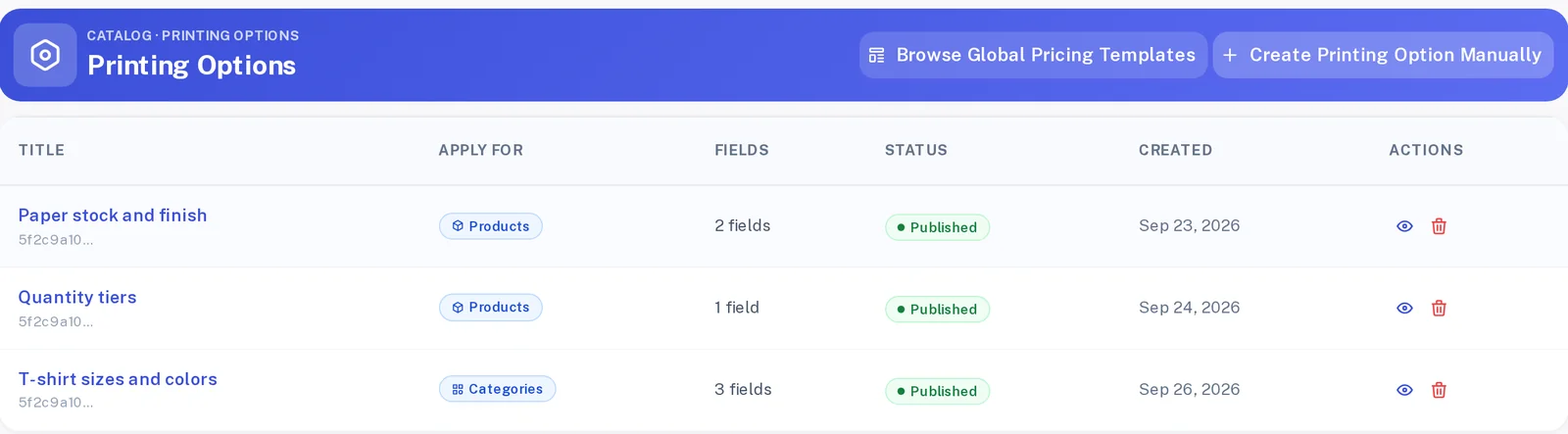
Option sets list their fields and publish status.
-
Design and artwork
A product customizer or online designer loads on the product page and returns a design identifier, which travels on the cart line as a text modifier value. BigCommerce also documents a file modifier for uploads, but an uploaded file is not a checked print file: preflight and output still happen after checkout, to the contract in print-ready PDF and prepress automation.
-
Price
The customizer shows an estimate. The authoritative amount comes from a print pricing engine and is written to the cart line on the server.
-
Order to job
An order webhook tells the adapter that an order exists. The adapter then reads the order and its line items through the API, maps modifier values to production codes and submits one job for each order line.
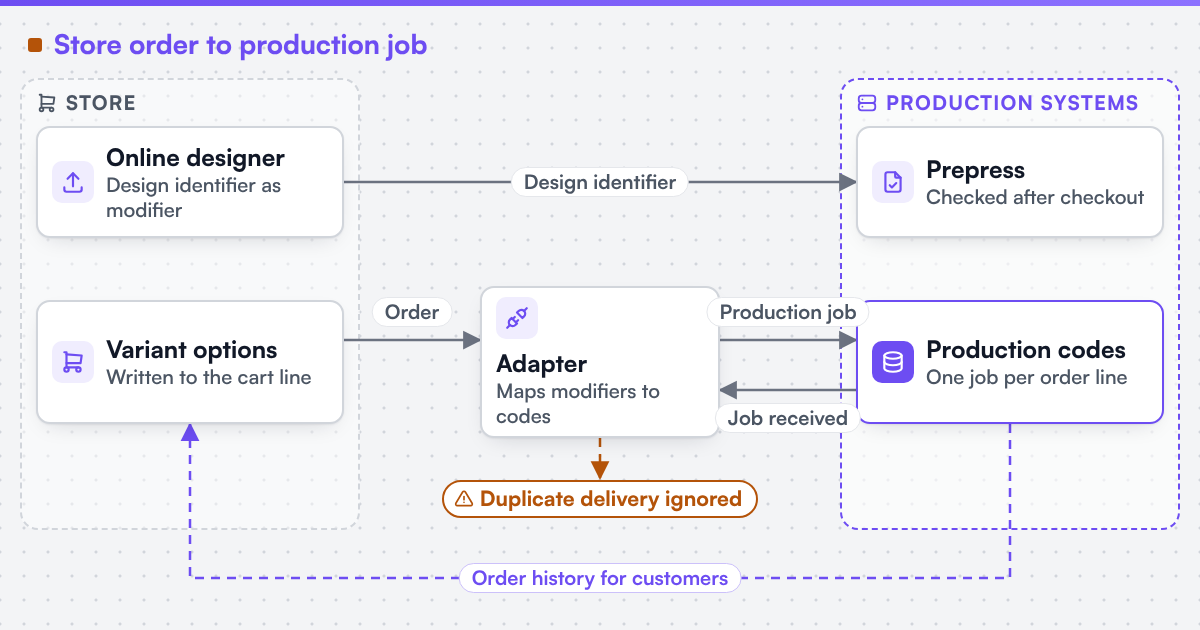 (opens the full-size diagram in a new tab)
Which BigCommerce constraints change the design?
| Constraint | Limit | Response |
|---|---|---|
| SKUs per product | 600 | Quantity and dimensions move to modifiers |
| Modifier price | Fixed or percentage only | A pricing service sets the real price |
| Price override | Server-to-server list_price call |
Promotion eligibility is agreed before launch |
| Webhook delivery | Deactivated after 48 hours of failures | The adapter fetches the order and alerts on deactivation |
600 SKUs per product. BigCommerce's Create Product Variant reference states a limit of 600 SKUs per product. Four stocks, five sizes, four laminates and ten quantity tiers make 800 combinations, already above the limit, so a print catalogue that models every attribute as a variant option runs out quickly. Quantity and custom dimensions belong in modifiers and price logic.
Modifier prices are simple adjusters. BigCommerce documents modifier price adjusters as relative (fixed) or percentage adjustments. That covers a flat lamination surcharge. It cannot express area pricing, sheet yield or a finishing sequence whose cost depends on quantity.
Price override runs server to server. The Cart API's Add Cart Line Items endpoint accepts a list_price field that overrides the product's price. BigCommerce documents that, by default, an overridden list_price makes the line ineligible for V3 product-level promotions, a setting the merchant can change under Promotions and Coupons. This endpoint belongs to the authenticated management API, so the calculated price is set by the store's server, never by the browser.
Webhooks are notifications, not orders. BigCommerce's webhook overview says payloads contain minimal information about the store and event, so the adapter fetches the order itself. Unacknowledged deliveries are retried, and after the final retry, cumulatively 48 hours after the first attempt, the webhook is deactivated. BigCommerce recommends idempotent operations, which for print means keying each job on the order line so a repeat delivery never creates a second job, and monitoring that the subscription is still active.
Scripts depend on the theme engine. The Scripts API deploys scripts to Stencil themes and headless storefront locations. BigCommerce notes that the legacy Blueprint theme engine does not render scripts added this way, so the theme is checked before a customizer is promised on an older store.
Which components and systems are involved?
A BigCommerce print build combines the store and its theme, a product customizer or online designer, a pricing service called before items reach the cart, and an adapter from order webhooks to production. We can build custom product configurators and browser design tools that emit print-ready artwork to an agreed specification.
Netbase JSC, which operates Web2Print Solutions, has delivered 50+ web-to-print platforms. Netbase JSC maintains reusable web-to-print components, including a browser-based online designer, rule-based print pricing templates, print-ready PDF output with CMYK conversion, bleed and trim, and storefront connectors for WooCommerce, Shopify, Wix and custom stores, which an engagement may reuse under their own licence terms. BigCommerce is not on that connector list. A BigCommerce build is scoped engineering against BigCommerce's own APIs, and no BigCommerce delivery is published on this site. Client-specific deliverables, access and handover are defined in the engagement contract. Pre-existing software, products, APIs and third-party components remain subject to their respective ownership and licence terms. No BigCommerce partnership or app-store status is implied.
We can scope and build web-to-print integrations for Shopify, WooCommerce, Magento / Adobe Commerce, BigCommerce, Wix and headless storefronts, and we state each platform's constraints before the work is priced. The engagement that builds this is web-to-print ecommerce integration.
What must survive a move to or from BigCommerce?
Product definitions with their variant options and modifiers, saved designs and templates, customer accounts and groups, order history with modifier values, product URLs and the production interface. A store that outgrows the storefront but keeps BigCommerce as its commerce engine can move to a headless web-to-print front end; the 600-SKU limit and the price-override rule still apply behind it.
Count the combinations before anything else. Scope this work with a project brief that names your BigCommerce plan and theme, one configurable product with its option counts, how its price is calculated today, and the system that should receive the job.
Discuss your web-to-print project
Frequently asked questions
It can display a price from simple adjusters. A price that depends on size, quantity and finishing together is calculated by a pricing service and written to the cart line through the Cart API's list_price override on the server.
Keep the attributes that need stock or their own SKU as variant options, move quantity, dimensions and finishing to modifiers, and let price logic handle the rest. Splitting a product into several products is the fallback, not the design.
By default, BigCommerce makes an overridden list_price line ineligible for V3 product-level promotions. The merchant can change that setting, and the choice is agreed before launch so discounts behave as the business expects.
The adapter fetches the order after each webhook, keys every production job on the order line, and ignores a notification it has already processed. It also alerts someone if BigCommerce deactivates the webhook after 48 hours of failed deliveries.
References (5)
- BigCommerce Docs, Create Product Variant: 600 SKUs per product limit, accessed 2026-09-29.
- BigCommerce Docs, Product Modifiers: modifier types, relative or percentage adjusters, no inventory tracking for modifier values, accessed 2026-09-29.
- BigCommerce Docs, Add Cart Line Items: list_price override and promotion eligibility, accessed 2026-09-29.
- BigCommerce Docs, Webhooks overview: minimal payloads, retries, deactivation after 48 hours, idempotent operations, accessed 2026-09-29.
- BigCommerce Docs, Scripts API: Stencil and headless locations; legacy Blueprint themes do not render API scripts, accessed 2026-09-29.