

Web-to-print for franchise and multi-location brands
A franchise or multi-location brand needs every location ordering print from the same locked templates, so the brand stays consistent while local fields such as an address or a manager's name change. The buyer rarely asks for web-to-print by name; they ask for brand governance, location permissions, approval routing and a budget each location cannot exceed.
Start a project brief Explore servicesReviewed by CEO, Netbase JSC · Published 29 Sep 2026 · Updated 3 Oct 2026

How does a franchise or multi-location brand buy print?
A franchisor or a corporate multi-location brand sets a brand system once, centrally, and then has dozens, hundreds or thousands of locations that each need to order print against it: window signage, menu boards, in-store posters, business cards, direct mail for a local promotion, or a seasonal campaign kit. Head office designs the templates and sets the rules. Each location fills in what is local - an address, a phone number, a manager's name, a store-specific offer date - and orders.
The buyer who needs this rarely opens the conversation with the words web-to-print. They ask how to stop a location from redesigning the logo, how to let a location customise only the fields that are allowed to change, how an order gets approved before it prints, and how to stop one location's marketing spend from running over budget. The system that answers those questions is a web-to-print portal, described in the brand's own vocabulary rather than the industry's.
Key takeaways
- A franchise or multi-location brand needs every location ordering from the same locked templates, with only local fields such as an address or a manager's name left open.
- Flat permissions are the most common failure: a location manager with head-office access can approve or spend without a ceiling.
- A non-standard, large or over-budget order needs a named approver and a no-approval-no-print rule, or orders stall or print unchecked.
- Local fields typed by hand into a design file turn one missed typo into an error printed across the whole run.
- Budget or cost-centre caps, checked at order time, stop a location exceeding its allocation before the invoice arrives.
Where does the franchise ordering flow break?
-
Off-brand locations
Without locked templates, a location resizes a logo, swaps a colour or edits copy that was meant to be fixed, and the piece no longer matches the brand.
-
Template coverage gaps
A brand system that misses the seasonal promotion, the grand-opening kit or a regional variant pushes locations back to email and a local print shop.
-
Flat location permissions
A location manager who should only edit local fields has the same access as head office marketing, with no ceiling on approval or spend.
-
Unowned approvals
A non-standard, large or over-budget order has no named approver and no no-approval-no-print rule, so it stalls or prints unchecked.
-
Hand-typed local fields
An address, phone number or manager name is typed into a design file by hand, and the one missed typo prints on every piece in the run.
Which routes can a franchise or multi-location brand take?
Web2Print Solutions provides scoped services for new web-to-print setup, upgrades, migration and software integration for media organisations, print businesses and enterprise teams.
-
A location-facing ordering portal
We can build B2B and corporate print storefronts with account hierarchies, permission models, approval workflows and brand-locked template systems: locked templates with editable local fields, location roles and an approval chain that matches how the brand actually signs off print are scoped as B2B and corporate print storefront work.
-
Platform integration
Where the brand already runs, or prefers, an ecommerce platform with a native company or B2B account model, Magento and Adobe Commerce web-to-print describes the company accounts and purchase-order approvals that platform documents, which can carry a location hierarchy instead of a single storefront.
Who is this not for?
A single-location business, or a small group of locations that already shares one marketing calendar and one ordering routine with no need for per-location permissions or budgets, does not need the account hierarchy and approval routing a franchise portal is built around; a standard storefront serves it better. Web2Print Solutions does not set franchise fees, royalty terms or the franchise agreement itself - the work is the ordering and brand-governance system, not the franchise relationship.
Which systems does a franchise portal connect to?
The typical stack has a brand or digital asset library that holds the approved templates and logo files; a location or store directory that identifies which locations exist and what tier or region each belongs to, often carrying an identifier similar in purpose to a GS1 Global Location Number; a role and permission model that maps head office, regional and location-level access, following the same least-privilege principle documented in access-control guidance such as OWASP's; a budget or cost-centre structure that caps what a location can spend before an order needs escalation; and an approval workflow that routes a non-standard or over-budget order to a named approver before it reaches production. Where the brand operates as a registered franchise, its own franchise disclosure and governance obligations - separate from this portal - are set out in guidance such as the FTC's Franchise Rule compliance guide.
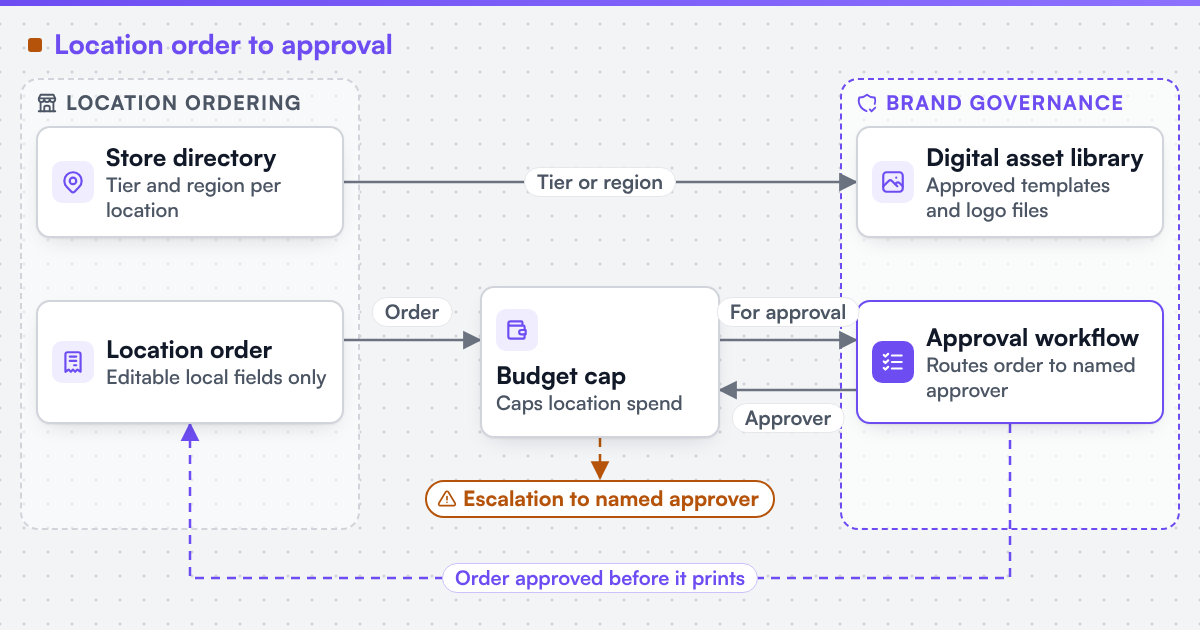 (opens the full-size diagram in a new tab)
What evidence exists for franchise and multi-location work?
Netbase JSC, which operates Web2Print Solutions, has delivered 50+ web-to-print platforms. Stores built by the group that are live today are listed on the live web-to-print stores evidence page. Web2Print Solutions is the web-to-print engineering service of Netbase JSC: delivery records cited on this site belong to Netbase JSC, and where no delivered example of a capability is published, the page says so rather than implying a record. No franchise or multi-location print portal is published as a case on this site.
How does an engagement start?
An engagement starts with the brand system and the location hierarchy, not the print catalogue. The most useful inputs are the current template set and which fields on each template a location is allowed to change, the location or store list with any regional or tier grouping, the approval rule for a non-standard or over-budget order, and how spend is currently tracked per location. Those inputs show whether the first release is the template portal, the approval workflow or the budget and reporting layer. Send them with a project brief, leaving out location-level financial detail you do not want to share at this stage.
Frequently asked questions
Yes. Templates are locked to the brand's approved design, with editable fields limited to what the brand decides is local - typically an address, phone number, manager name or a local offer date.
Reporting can roll up by location, region or brand-wide total, so head office sees spend and order volume without having to ask each location.
Yes. Approval rules can be scoped by order type, value or template, so a standard reorder can proceed automatically while a non-standard or high-value job waits for a named approver.
A location or cost-centre budget can be enforced at order time, so a location is stopped or flagged before it exceeds what it has been allocated, rather than after the invoice arrives.
References (3)
- Federal Trade Commission, Franchise Rule Compliance Guide: governance and disclosure obligations for franchise brands, accessed 2026-09-29.
- GS1 US, standards body for location and product identifiers used across multi-location supply and data systems, accessed 2026-09-29.
- OWASP, Access Control Cheat Sheet: least-privilege and role-based permission guidance, accessed 2026-09-29.