Managed operations for web-to-print platforms
Managed print platform operations is a separate, opt-in agreement that keeps a web-to-print platform running after launch, or after a takeover assessment of an inherited stack. It covers monitoring, incident handling, updates, backups with restore tests and a planned improvement backlog. AI tools assist triage and log review; a named engineer decides and stays accountable.
Start a project brief Explore servicesReviewed by CEO, Netbase JSC · Published 29 Sep 2026 · Updated 3 Oct 2026

At a glance
- Engagement type
- Assessment, then operate
- What you provide
- One real product or workflow, plus your acceptance criteria
- What you receive
- An opt-in agreement that keeps a web-to-print platform running after launch or a takeover assessment, with monitoring, patching and tested backups.
- Who accepts
- The operator named in the engagement
What you need to provide
- One real product or workflow to scope against
- What correct looks like for it
- Any system that must stay in place
- Who in your organisation confirms the result
Ready to scope this service?
What is managed print platform operations?
Managed print platform operations is a separate, opt-in agreement for a web-to-print platform that is already live. It applies in two situations: a platform Web2Print Solutions has just launched, where the client wants ongoing operation instead of taking the runbook in-house, or an inherited platform that has been through a takeover assessment and cleared for ongoing operation rather than replacement. The agreement is scoped in writing before it starts, and it sits alongside, not inside, a build or migration engagement.
Among the web-to-print engineering services, this is the one that owns what happens to the platform between releases: the patch that closes a known vulnerability, the failed webhook nobody noticed until an order went missing, the backup nobody had tested until the day it was needed. The offer is the operating agreement itself; this page does not claim an operating record for a named platform, and it carries no uptime, response-time or availability figure. Service levels are set in the contract, not on this page.
Key takeaways
- Managed print platform operations is a separate, opt-in agreement for a platform that is already live, either one Web2Print Solutions just launched or an inherited platform cleared by a takeover assessment.
- The scope is monitoring, incident handling, patching, backups with restore tests and a prioritised improvement backlog, not device fleet management.
- No uptime, response-time or availability figure is published here; any service level is set in the contract.
- AI tools assist triage and log review only; a named engineer decides what shipped, what is safe to deploy and what the backlog holds.
- A backup is only treated as tested once it has actually been restored and checked on an agreed schedule, with a written result.
Who is this for, and when does a one-off rescue fit better?
Good fit
- A platform we launched, where the client wants ongoing operation under a written agreement rather than building an internal team immediately
- An inherited platform that passed a takeover assessment and needs a named owner for monitoring, patching and incidents
- A team that wants backups actually tested, not merely scheduled, and an improvement backlog instead of an unmanaged list of known issues
Another route fits better
- A platform that has never been assessed, where the first need is a verdict on whether to complete, replace, migrate or stop
- A platform in active failure right now, where the immediate need is triage and a decision, covered by migration and rescue
- A one-off project with a defined end date and no ongoing relationship intended after handover
The distinction matters because the two services answer different questions. Migration and rescue is a bounded, one-off engagement: it assesses a stalled or ageing platform, delivers a verdict, and if migration is justified, ends at a successful cutover. Managed print platform operations is what can follow it, or follow a new launch, once the client and Web2Print Solutions agree to a standing arrangement. A takeover assessment can conclude that a platform is fit to keep running; that assessment is not itself the operating agreement, and moving from one to the other is always a separate, explicit decision.
What is in scope?
| Module | Input | Deliverable |
|---|---|---|
| Takeover assessment | Access to the existing platform, its code, data and dependencies | A written assessment of what can be safely operated as-is, and what needs remediation before operations start |
| Monitoring | Agreed signals: error rates, queue depth, failed jobs, certificate expiry | Alerting to a named on-call route, with an agreed escalation path |
| Incident handling | An incident as it occurs | Triage, a written record of cause and resolution, and a decision on whether a fix becomes a scheduled change |
| Updates and patching | The platform's dependency and framework versions | A patch cadence agreed with the client, tested before it reaches production |
| Backups with restore tests | The platform's data and file stores | Scheduled backups and a periodic restore test with a written result, not just a completed backup job |
| Improvement backlog | Findings from incidents, patching and restore tests | A prioritised backlog the client reviews and approves, rather than silent, undocumented changes |
| Exit and handover | The agreed end of the arrangement, whenever it occurs | Access, documentation and the current backlog handed to whoever operates the platform next |
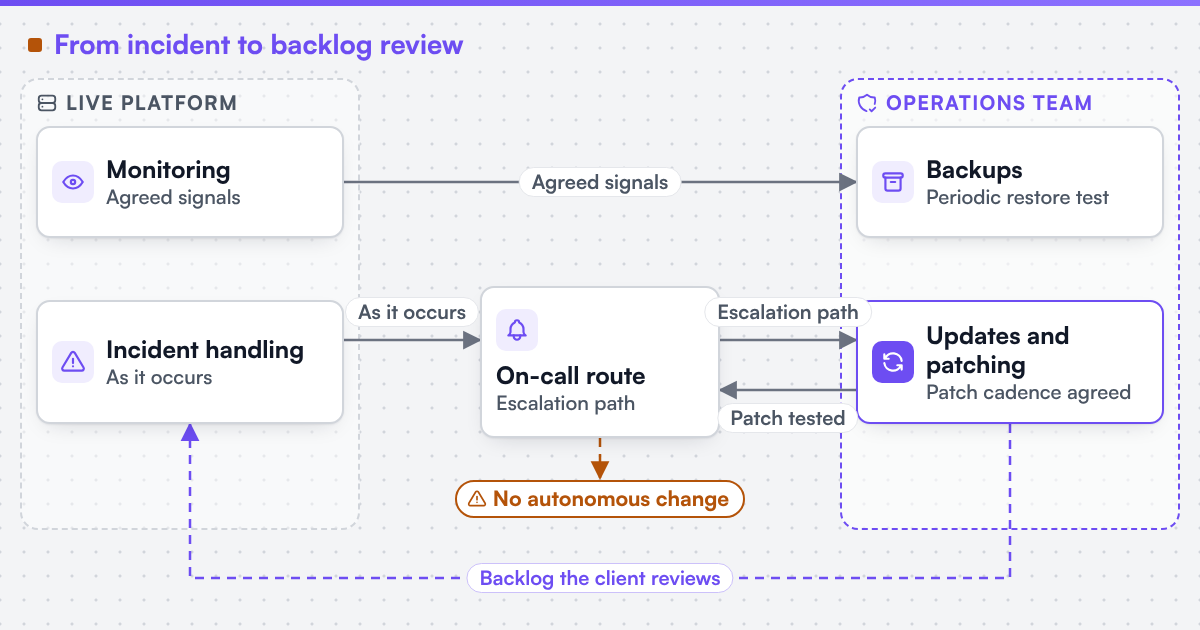 (opens the full-size diagram in a new tab)
What is not included?
-
No uptime, response-time or availability figure
Service levels, if any, are set in the contract; this page states none.
-
No claim of a current operating record
Where no example of this service delivered under the Web2Print Solutions name is published, the page says so rather than implying one.
-
No autonomous change
AI tools assist triage and log review only; they do not deploy a fix, restore a backup or close an incident on their own.
-
No open-ended scope
The takeover assessment and the operating agreement are two decisions, not one bundled commitment; either party can decline to proceed from one to the other.
-
No device fleet management
This is platform operations software, monitoring, incidents, patching and backups, not managing printers, presses or other production hardware.
What does the AI angle actually mean?
AI tools assist our own engineering work. A named human engineer reviews and remains accountable for everything we deliver, and no generated output ships unreviewed. In managed operations specifically, that means an AI tool may help triage an incident by correlating log lines against a known error pattern, summarise what changed in a release before an engineer reviews the diff, or draft the first pass of an incident write-up from the raw logs. The engineer decides what the incident actually was, whether a change is safe to deploy, and what goes in the backlog. Nothing in this service implies an AI tool restores a backup, applies a patch or closes an incident without that review.
The same boundary applies on the AI-assisted workflow page, which covers AI-assisted steps inside the print ordering workflow itself rather than inside platform operations. The two pages describe different parts of the system: one operates the platform, the other assists specific steps a customer or operator takes on it.
How does the work run?
-
Takeover assessment (inherited platforms only)
Review access, code, data, dependencies and known issues
- Evidence you receive
- A written assessment naming what can be operated as-is and what must be remediated first
-
Baseline
Agree monitoring signals, patch cadence, backup schedule and the escalation route
- Evidence you receive
- A written operating baseline both parties sign off
-
Standing operation
Monitor, triage incidents, apply agreed patches, run scheduled backups and restore tests
- Evidence you receive
- Incident records, patch logs and restore-test results on the agreed cadence
-
Review
Walk through the improvement backlog and any incidents since the last review
- Evidence you receive
- An updated, prioritised backlog and a decision on what happens next
-
Exit
Either party ends the arrangement per the contract
- Evidence you receive
- Full documentation, access and the current backlog handed to the next operator
The default engagement is fixed-scope with written acceptance criteria and priced change control. Managed operations is a separate, opt-in agreement. That is the sentence that describes every other service on this site; this page is what "separate, opt-in agreement" actually contains once a client asks for it. The how we work page describes the fixed-scope engagement model that a build or migration follows before this agreement is ever proposed.
Scope this work with a project brief
If the platform already exists, send a project brief naming who currently has access, how incidents are reported today, when the last backup was tested and what "tested" meant, and whether patching has a current owner. If the platform is one Web2Print Solutions is building or has just launched, raise managed operations as a separate line in the same brief, since it is agreed on its own terms rather than folded into the build.
Frequently asked questions
No. A rescue or migration engagement is a bounded, one-off assessment and, where justified, a cutover to a new platform. Managed operations is what can follow it, once the client wants a standing agreement for ongoing operation rather than a one-time project.
No. This page states none, and any service level is set out in the contract, not published here.
A backup that has been restored and checked, on an agreed schedule, with a written result. A completed backup job with no restore test is not treated as tested.
A named engineer. AI tools may assist triage, log review or a change summary, but the decision to deploy a fix, apply a patch or close an incident is the engineer's.
Yes. Web2Print Solutions delivers remote-first from Hanoi, Vietnam, and Netbase JSC has delivered web-to-print projects for clients in 80+ countries.
Send a project brief at /project-brief, email project@netbasejsc.com or message us on WhatsApp at +84 937 869 689. A senior engineer reads every brief and replies in writing.
References (3)
- NIST Special Publication 800-40 Revision 4, Guide to Enterprise Patch Management Planning: Preventive Maintenance for Technology, accessed 2026-09-29.
- NIST Special Publication 800-34 Revision 1, Contingency Planning Guide for Federal Information Systems, accessed 2026-09-29.
- NIST Computer Security Resource Center glossary, Recovery Time Objective, accessed 2026-09-29.