

Web-to-print for trade printers
A trade printer sells only through resellers, never to the end customer, so its portal needs reseller accounts with their own price tiers, blind shipping so the reseller's brand reaches the end customer, file intake built for reseller volume, and an order status feed the reseller's own site can query. A print broker's storefront is a different system.
Start a project brief Explore servicesReviewed by CEO, Netbase JSC · Published 29 Sep 2026 · Updated 3 Oct 2026

Trade printer or print broker?
The two words get used loosely, and the systems behind them are not the same. A trade printer owns or contracts production and sells wholesale to resellers - graphic designers, marketing agencies, sign shops and smaller print businesses - who resell the output under their own brand. A print broker owns no production; it takes an end customer's order and places it with whichever printer suits the job, and its portal is the one the end customer sees.

A trade printer's portal has to serve the reseller as the customer, not the reseller's own customer. The reseller sets its own retail price on top of the trade price, keeps its name on everything that reaches the end customer, and expects the trade printer to stay invisible in that relationship. A print broker's storefront, by contrast, is built for the end customer directly and never needs to hide who fulfilled the order. Building one when the business runs the other produces a portal that leaks the wrong brand at the worst moment: on the shipping label.
Key takeaways
- A trade printer sells wholesale to resellers, never to the end customer, so its portal is built around the reseller's identity, not the trade printer's.
- Blind shipping - no trace of the trade printer on the return address, invoice or tracking notification - is a hard requirement, not a finishing touch.
- Resellers negotiate their own price tiers; a single flat price list overcharges some accounts and undercharges the rest.
- File intake has to hold up under reseller batch volume, from a design tool, a hot folder or an API, not just one file at a time.
- An order status feed the reseller's own site can query turns a status question from a phone call into a lookup.
Where does a trade printer's ordering flow break?
-
Flattened reseller pricing
A catalogue-style storefront prices every buyer the same; a single price list overcharges a trade printer's best accounts and undercharges the rest.
-
Wrong name on packing slips
An order ships with the trade printer's own return address, invoice or tracking notification, and the reseller's customer sees a supplier they never agreed to.
-
File intake cannot hold reseller volume
A reseller submits one job or fifty in a batch, and each file still needs the same preflight before it reaches a press.
-
No status without a phone call
Without an order status feed the reseller's own site can query, every status question becomes a call to the trade printer.
Which routes can a trade printer take?
Web2Print Solutions provides scoped services for new web-to-print setup, upgrades, migration and software integration for media organisations, print businesses and enterprise teams. For a trade printer, the routes usually start with reseller pricing and identity, because those are what a generic storefront gets wrong first.
-
Reseller accounts and tiers
We can design and build multi-tenant, white-label and reseller print platforms with tested data isolation and a documented tenancy trade-off analysis: reseller accounts, per-reseller price tiers and white-label packing slips and notifications are scoped as multi-tenant and white-label print platforms work.
-
Pricing
Where the trade price list itself needs formalising - tiered by reseller, category or volume - that is print pricing engine work, accepted against the trade printer's own known-good price list.
-
Replacing a storefront that cannot carry the reseller model
Moving reseller accounts, price tiers and order history off a platform that was never built for wholesale is scoped from replace a storefront, keep the MIS.
Who is this not for?
A shop that sells directly to the public, with no reseller layer and no need to hide who fulfilled an order, is a commercial printer's storefront, not a trade printer's portal, and a simpler build serves it better. Web2Print Solutions does not act as a print broker and does not place a trade printer's own work with third-party production - the work is the reseller-facing system, not the fulfilment relationship itself.
Which systems does a trade printer run?
The typical stack has a wholesale price list, often tiered per reseller or reseller category; a reseller-facing storefront or order form that accepts single jobs and batch uploads; a file intake and preflight step ahead of imposition, commonly checked against PDF/X-based settings such as those published by the Ghent Workgroup; a shipping and label process that must suppress the trade printer's identity on anything the end customer sees; and an order status interface, which may be a customer portal, a webhook or a REST API the reseller's own systems poll, in the pattern described by the OpenAPI Initiative's API specification. Carrier tools such as USPS Web Tools illustrate the kind of tracking and label data a blind-shipping flow has to carry without exposing the sender.
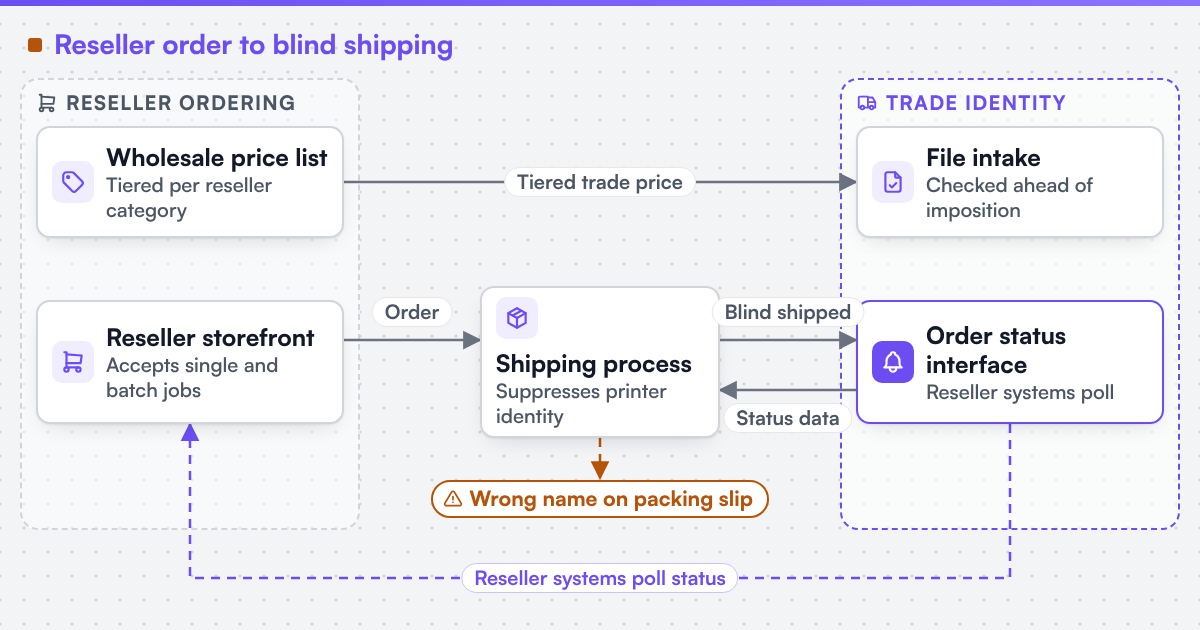 (opens the full-size diagram in a new tab)
What evidence exists for trade print?
Netbase JSC, which operates Web2Print Solutions, has delivered 50+ web-to-print platforms. Stores built by the group that are live today are listed on the live web-to-print stores evidence page. Web2Print Solutions is the web-to-print engineering service of Netbase JSC: delivery records cited on this site belong to Netbase JSC, and where no delivered example of a capability is published, the page says so rather than implying a record. No trade-printer reseller portal is published as a case on this site.
How does an engagement start?
An engagement starts with the reseller relationship, not the press. The most useful inputs are the current reseller price list or the rule behind it, a sample of what a reseller-branded packing slip and shipping notification should look like, the file formats and volumes resellers actually submit, and whether resellers need to query order status themselves or only receive notifications. Those inputs show whether the first release is the reseller account model, the price-tier engine or the shipping and status layer. Send them with a project brief, leaving out reseller names you do not want to share at this stage.
Frequently asked questions
Yes. Reseller accounts are scoped so one reseller cannot see another's price tier, order history or customer detail, with the isolation tested rather than assumed.
Blind shipping is scoped as a named requirement, covering return address, packing slip branding and tracking notifications, not treated as an afterthought once packaging is chosen.
Batch and API-based file intake can be scoped alongside the standard single-order form, so a reseller submitting fifty jobs is not forced through a form built for one.
They can, through a reseller-facing status view or an API their own site queries, so a status question does not have to become a phone call.
References (4)
- Printing Industries of America (PIA), a national trade association for the printing industry, accessed 2026-09-29.
- PRINTING United Alliance, an industry association serving the printing and graphics communications trade, accessed 2026-09-29.
- USPS Business, Web Tools & APIs for shipment tracking and label data, accessed 2026-09-29.
- OpenAPI Initiative, the open specification for describing REST APIs such as an order-status interface, accessed 2026-09-29.