

Multi-tenant and white-label print platforms
A multi-tenant or white-label print platform lets one codebase serve several branded storefronts, each with its own catalogue, pricing and users. Web2Print Solutions designs and builds these with tested data isolation between tenants, per-tenant branding, pricing and catalogue control, and a documented trade-off analysis of the tenancy model chosen for the buyer's reseller or ISV setup.
Start a project brief Explore servicesReviewed by CEO, Netbase JSC · Published 29 Sep 2026 · Updated 3 Oct 2026

At a glance
- Engagement type
- Build and launch
- What you provide
- One real product or workflow, plus your acceptance criteria
- What you receive
- Design and build a multi-tenant or white-label web-to-print platform with tested data isolation and per-tenant branding, pricing and catalogue.
- Who accepts
- The business owner, against real products and orders
What you need to provide
- One real product or workflow to scope against
- What correct looks like for it
- Any system that must stay in place
- Who in your organisation confirms the result
Ready to scope this service?
What is a multi-tenant or white-label print platform?
A multi-tenant print platform is one codebase and one operational stack serving several storefronts, each belonging to a different tenant: a franchise network's locations, a reseller's clients, or an independent software vendor's own customers. A white-label platform is the same idea seen from the storefront outward: each tenant's site shows its own brand, domain and catalogue, with no visible trace of the platform underneath or of the other tenants sharing it. We can design and build multi-tenant, white-label and reseller print platforms with tested data isolation and a documented tenancy trade-off analysis.
Among the web-to-print engineering services, this is the one that decides how many separate print businesses one platform can safely carry, and what breaks first if that number grows. It differs from a new implementation built for a single storefront in one respect that changes most of the architecture: every design decision has to be checked against "what happens when this is shared across tenants," not just "what happens for one customer."
Key takeaways
- A multi-tenant platform is one codebase serving several storefronts; a white-label platform is the same system showing no trace of the platform underneath or of other tenants.
- The tenancy model, shared schema, separate schema per tenant, or separate database per tenant, is a trade-off between isolation strength, operational complexity and cost, chosen on the buyer's own scale and growth rate.
- Data isolation is tested directly: one tenant's queries, exports and background jobs are checked that they cannot read or affect another tenant's data.
- Per-tenant branding, pricing and catalogue are verified independently against each tenant's own configuration, never a shared default.
- Retrofitting isolation into a platform not built for it is its own assessment, not something this scope assumes is safe.
Who is this for, and when does another route fit better?
Good fit
- A reseller or agency that wants to put its own brand and pricing on a shared platform for multiple clients
- A print-adjacent software vendor adding print fulfilment as a feature of its own product, across its customer base
- A print group consolidating several separate storefronts onto one operated platform without merging their catalogues or customer data
Another route fits better
- A single business with one storefront and one catalogue, where tenancy adds complexity with no buyer
- A franchise network whose locations need brand-governed ordering more than tenant-level customisation; see the brand-governance question first
- A platform already built without tenancy in mind, where the first question is whether retrofitting isolation is safer than a new build
What outcomes is the engagement accepted against?
-
Data isolation tested, not assumed
Each tenant's catalogue, orders, customer data and files are checked against a written isolation test: one tenant's queries, exports and background jobs cannot read or affect another's.
-
Per-tenant branding, pricing and catalogue verified independently
A representative set of tenants is set up with different brands, price rules and product catalogues, and each is checked against its own configuration, not a shared default.
-
A tenancy model chosen on evidence, not habit
The engagement documents the trade-offs of the tenancy model selected for the buyer's scale, update cadence and isolation requirement, so the choice can be explained and revisited.
-
Tenant onboarding and offboarding defined
Adding a tenant, and removing one without leaving orphaned data or broken references, are both tested procedures, not manual, undocumented steps.
What is in scope?
| Module | Input | Deliverable |
|---|---|---|
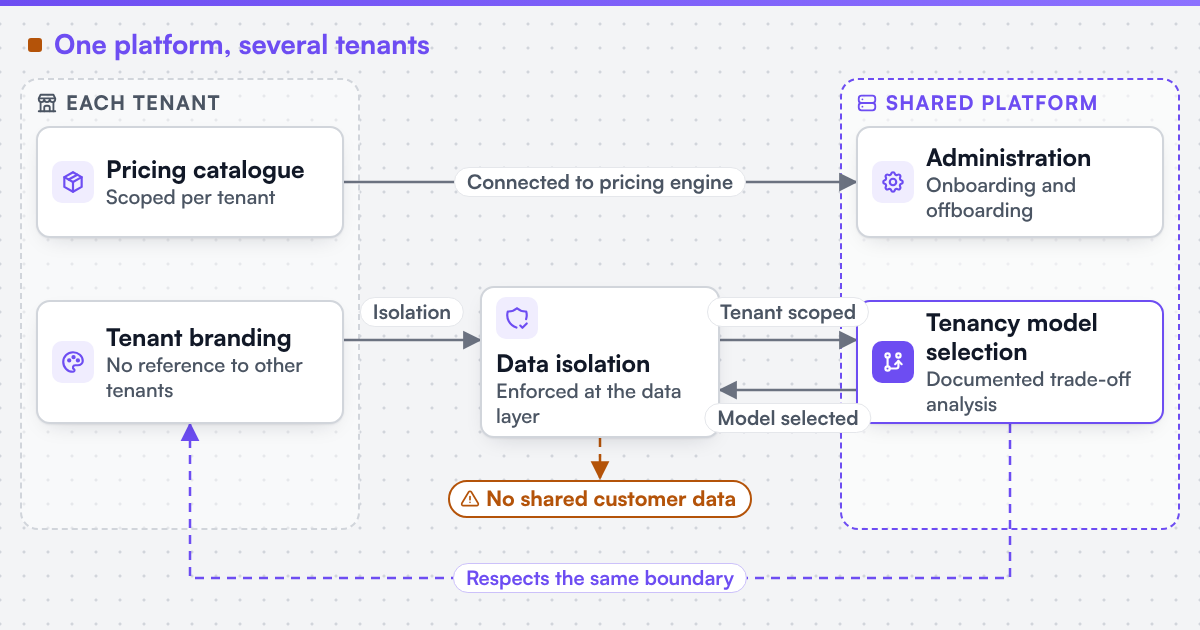
| Tenancy model selection | Expected tenant count, growth rate, isolation requirement and update cadence | A documented trade-off analysis and the selected model: shared schema with tenant scoping, separate schema per tenant, or separate database per tenant |
| Data isolation | The tenancy model and the platform's data access patterns | Isolation enforced at the data layer, with a written isolation test covering queries, exports, background jobs and file storage |
| Per-tenant branding | Each tenant's domain, logo, colour and template requirements | Domain or subdomain routing, themeable storefront branding, and white-label output with no reference to other tenants or the underlying platform |
| Per-tenant pricing and catalogue | Each tenant's product range and pricing rules | Catalogue and pricing scoped per tenant, connected to the print pricing engine where pricing rules are complex |
| Tenant administration | Who manages tenants day to day: platform owner, reseller, or both | Tenant onboarding, configuration and offboarding procedures, with role-scoped access for platform and tenant administrators |
| Cross-tenant reporting (where agreed) | What the platform owner needs to see across tenants, if anything | Aggregate reporting that respects the same isolation boundary as the underlying data |
 (opens the full-size diagram in a new tab)
What is not included?
-
No tenant count or throughput figure
The tenancy model is chosen and tested against the buyer's own expected scale; this page states no generic number of tenants a platform can carry.
-
No shared customer data across tenants by default
A tenant's customers, orders and files stay scoped to that tenant unless the buyer explicitly designs and requests a shared feature, with its own isolation review.
-
No pricing or margin decisions between platform owner and tenants
The engine implements whatever commercial split the buyer decides; this site publishes no prices, rates or payment terms of its own.
-
No retrofitting guarantee for an existing single-tenant platform
Whether an existing platform can be converted to multi-tenant safely is itself an assessment, not assumed as part of this scope.
How is the tenancy trade-off decided?
The choice between a shared schema with tenant scoping, a separate schema per tenant, or a separate database per tenant is a trade-off between isolation strength, operational complexity and cost, not a single correct answer. A shared schema is simpler to operate and update but asks more of the isolation logic in every query. A separate database per tenant gives the strongest isolation but multiplies the operational surface: migrations, backups and monitoring all run per tenant. The engagement documents which factors decided the model for this buyer specifically: the isolation requirement stated by the buyer or its own customers, the expected number of tenants and their growth rate, how often the schema changes, and who is accountable if isolation fails.
Whatever the model, isolation is checked rather than assumed. A written isolation test exercises the boundary directly: one tenant's account attempting to read or write another tenant's data, a background job scoped to the wrong tenant, an export that should be filtered and is checked to confirm it is. The test set becomes part of the regression suite the same way a pricing engine's known-good quotes do, so a later change that weakens isolation is caught before it reaches production.
How does the work run?
-
Specify
Establish expected tenant count, growth, isolation requirement and update cadence; select the tenancy model
- Evidence you receive
- A documented trade-off analysis and the selected model, signed off by the buyer
-
Build
Implement tenancy at the data layer, branding, pricing and catalogue scoping, and administration
- Evidence you receive
- A working platform on a test environment with two or more representative tenants configured
-
Isolation testing
Run the written isolation test across tenants, including background jobs and exports
- Evidence you receive
- An isolation test report naming what was checked and its result
-
Accept and launch
Onboard the first real tenants, verify their branding, pricing and catalogue independently
- Evidence you receive
- Acceptance record per tenant and a launch report
The default engagement is fixed-scope with written acceptance criteria and priced change control. Managed operations is a separate, opt-in agreement.
Scope this work with a project brief
Send a project brief naming your expected number of tenants and their growth rate, how tenants differ today in branding, pricing and catalogue, who administers tenants day to day, and what isolation guarantee your own customers or contracts already require. Web2Print Solutions has not yet published a delivered multi-tenant platform case study under its own name; the isolation test report from your own engagement is the evidence this page offers.
Frequently asked questions
This page states no generic figure. The tenancy model is chosen against your expected scale and growth rate during the specification phase, and the trade-off analysis explains what changes as tenant count grows.
Yes. Per-tenant pricing is part of the scope, connected to the print pricing engine where a tenant's pricing rules are complex enough to need it.
No, though they are usually built together. Multi-tenant describes how the platform separates tenants' data and configuration internally; white-label describes what each tenant's storefront shows externally. A platform can be multi-tenant without being white-label if the underlying platform is visible.
Sometimes, but that is its own assessment. Retrofitting isolation into a platform not built for it can be safer as a rebuild of the data layer than as an incremental change; the specification phase says which applies before work starts.
Yes. Web2Print Solutions delivers remote-first from Hanoi, Vietnam, and Netbase JSC has delivered web-to-print projects for clients in 80+ countries.
Send a project brief at /project-brief, email project@netbasejsc.com or message us on WhatsApp at +84 937 869 689. A senior engineer reads every brief and replies in writing.
References (3)
- NIST Special Publication 800-145, The NIST Definition of Cloud Computing, accessed 2026-09-29.
- NIST Special Publication 800-125, Guide to Security for Full Virtualization Technologies, accessed 2026-09-29.
- NIST Special Publication 800-53 Revision 5, Security and Privacy Controls for Information Systems and Organizations, accessed 2026-09-29.