

Web-to-print for US print businesses
Web2Print Solutions has no US office, staff or entity; every engagement for a US print business is delivered remotely from Hanoi, Vietnam by Netbase JSC. For US buyers this means configuring a storefront for state-by-state sales tax nexus, resale certificates on trade orders, Letter-size templates and ZIP+4 addresses, not adding a US team.
Start a project brief Explore servicesReviewed by CEO, Netbase JSC · Published 30 Sep 2026 · Updated 30 Sep 2026

What is web-to-print for US print businesses?
Netbase JSC, which operates Web2Print Solutions, configures web-to-print storefronts for print businesses selling into the United States. All engineering and delivery for Web2Print Solutions is performed remote-first from Hanoi, Vietnam. Web2Print Solutions has no office, legal entity, employee base, representative or local support window in any other location. A US engagement configures a storefront's tax logic, units, address formats, carriers and payment methods for that market, delivered remotely from Hanoi.
This page is one of the markets Web2Print Solutions configures for. The US differs from most in one respect: there is no single national sales tax. Tax is set state by state, and a print business selling nationally can owe tax in a state it has never shipped from, once it crosses that state's own threshold.
Key takeaways
- The US has no federal sales tax; each state (and many cities and counties) sets its own rate, and "nexus" rules decide which states a seller must collect for.
- Since South Dakota v. Wayfair (2018), a seller can owe tax in a state based on sales volume alone, with no physical presence there.
- A resale certificate lets a reseller buy print tax-free to resell, shifting the tax-collection duty to that reseller's own sale; a storefront needs a place to capture and validate one per trade account.
- US templates run on Letter size and inches, not A4 and millimetres, and a US business card is 3.5 by 2 inches.
- Every engagement is delivered remotely from Hanoi, Vietnam; nobody on the account is US-based, and no local support window is offered.
How does an order move from checkout to delivery in the US?
The buyer configures a product and enters a ship-to address. The storefront checks whether the seller has sales tax nexus in that state; if so, it adds the state, county and city tax that address requires. If the buyer holds an approved resale certificate, tax is not charged and the certificate is referenced on the order instead. The order becomes a production job, and once produced it is handed to a carrier with a ZIP+4 address, tracked through that carrier rather than the storefront.
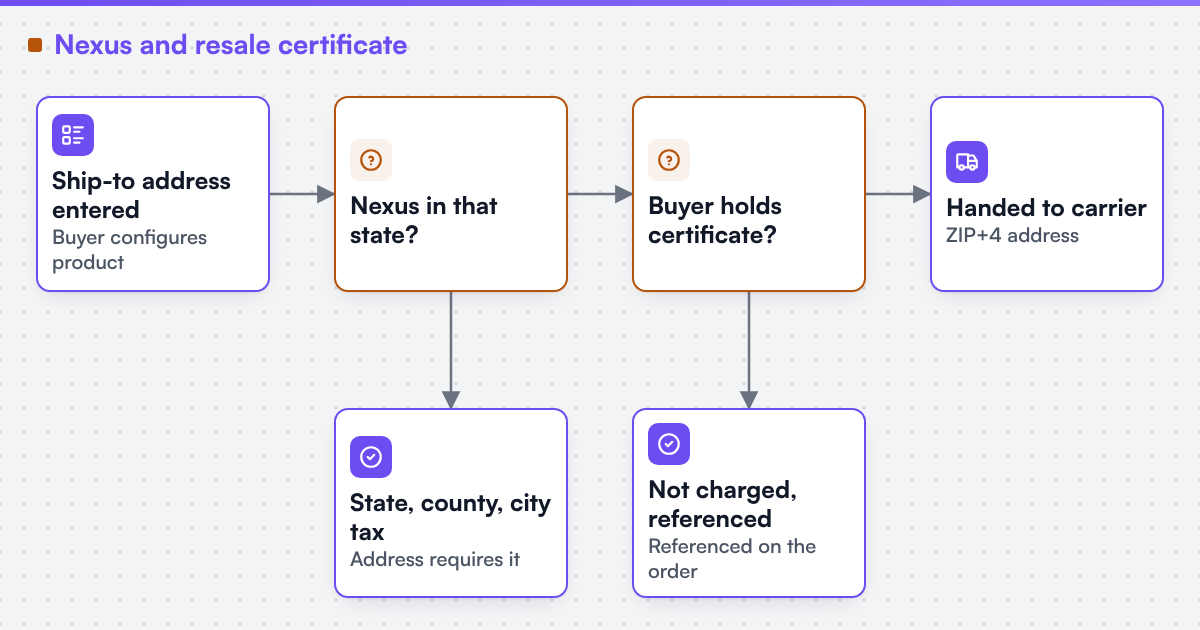 (opens the full-size diagram in a new tab)
Where does sales tax nexus and the resale certificate apply?
-
Does the seller have nexus in the ship-to state?
A nexus table by state, driven by the seller's own physical and economic presence, reviewed with their accountant
-
What rate applies?
Combined state, county and city rates for that ship-to address, from a maintained tax-rate service, not a single flat rate
-
Is the buyer a reseller?
A place to upload and store a resale certificate per state per trade account, and a rule that suppresses tax when one is on file
-
What if a certificate expires or is missing?
The order falls back to charging tax until a valid certificate is recorded
Worked case: a Texas promotional-products reseller buys blank apparel from a Georgia print business to decorate and resell. With a Texas resale certificate on file, the Georgia seller charges no tax on that order; the Texas reseller then collects tax from its own end customer. Without the certificate, the Georgia seller must charge Texas tax if it has nexus there, and tax is effectively paid twice down the chain.
What units, sizes and address format does the US use?
-
Paper sizes
Letter, Legal, Tabloid; basis weight, not gsm
-
Business card size
3.5 × 2 inches
-
Address format
Street address, city, two-letter state code, five-digit ZIP or ZIP+4
-
Carriers
USPS, UPS, FedEx
-
Payment
Cards, ACH, purchase order and net terms for trade accounts
What privacy and accessibility law should a US engagement respect?
US privacy law runs state by state, not federally: California's CCPA and CPRA are the most prescriptive today, and other states have their own laws, so data handling is checked against the ship-to and business states involved, with the client's own counsel. Website accessibility is litigated under the Americans with Disabilities Act, Title III, with no single technical standard in the statute; courts and settlements reference WCAG success criteria, so building against them is a risk-reduction practice, not a held certification.
What does a US market engagement include, and what does it not?
Included
- Nexus-aware tax calculation and resale-certificate capture
- Letter-size and US card-size product templates
- ZIP+4 address validation and carrier integration
- Trade-account logic for purchase orders and net terms
Not included
- Filing the client's own state sales tax returns
- Registering the client for sales tax in any state
- A US office, staff, entity or local support window
- Advice that substitutes for the client's own accountant or attorney
What proof already exists for the US market?
Netbase JSC, which operates Web2Print Solutions, has delivered 50+ web-to-print platforms. Among the live web-to-print store examples, 4OVER4 is a US cards and stationery storefront with an online designer, and BillyPrint and Kustom Koozies are US storefronts selling decals and personalised gifts. Live store using web-to-print components delivered by Netbase JSC, which operates Web2Print Solutions. No US nexus or resale-certificate case study is published under the Web2Print Solutions name yet; where that record does not exist, this page says so.
What is the time-zone difference with a team based in Hanoi?
| Factor | Detail | Applies to |
|---|---|---|
| Hours difference from Hanoi | Eleven to fifteen hours ahead of the continental United States, depending on the state and daylight saving | United States |
| Collaboration pattern | Asynchronous work against a written change-control process; the offset is a planning fact, not a commitment | United States |
Send a project brief with the states you ship to and believe you have nexus in, whether you sell to resellers, and your storefront platform.
Discuss your web-to-print project
Frequently asked questions
The storefront integrates a maintained tax-rate service or the platform's own tax engine as part of ecommerce platform integration; nexus rules and resale-certificate logic are configured around whichever the client uses.
The nexus table is configuration the client's accountant can review and update; a threshold change is a data update, not a rebuild, unless it needs new logic.
Yes, with certificate capture gating the reseller price and tax treatment, while retail customers see a single tax-inclusive or tax-added price depending on the client's preference.
Client profiles in United States
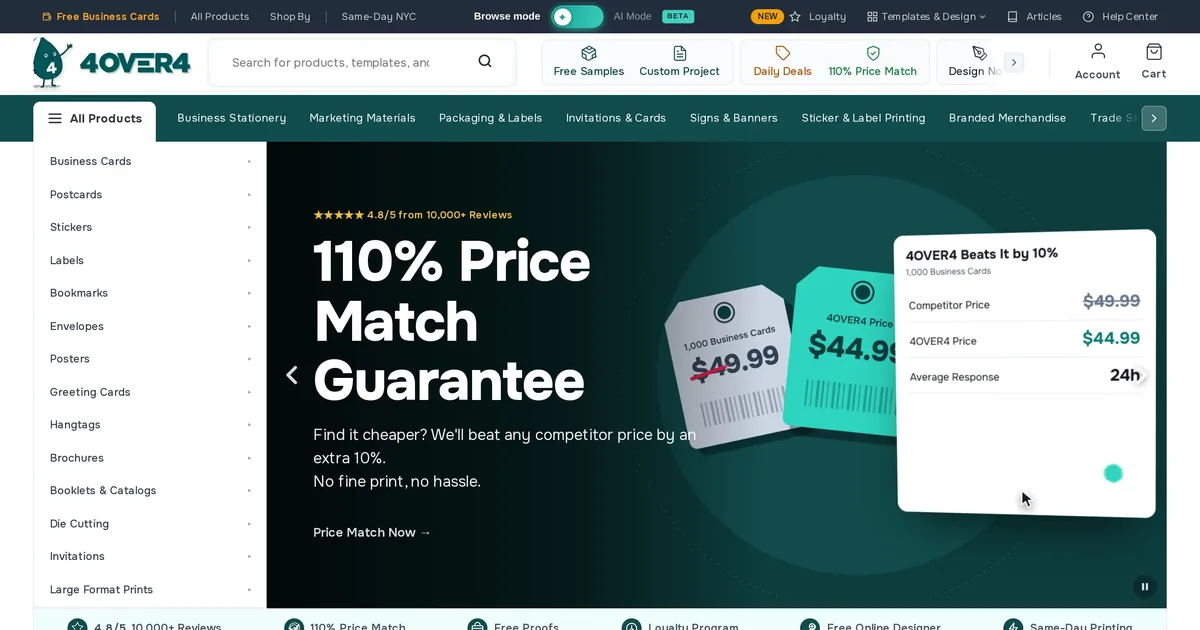
4OVER4 is a commercial print store in United States. It is a live store using web-to-print components delivered by Netbase JSC, checked 2026-10-14. The store is a custom storefront (not identified further), in English. Netbase JSC's project index has no row for it, so this page rests on the client wall and the public store.
Learn More
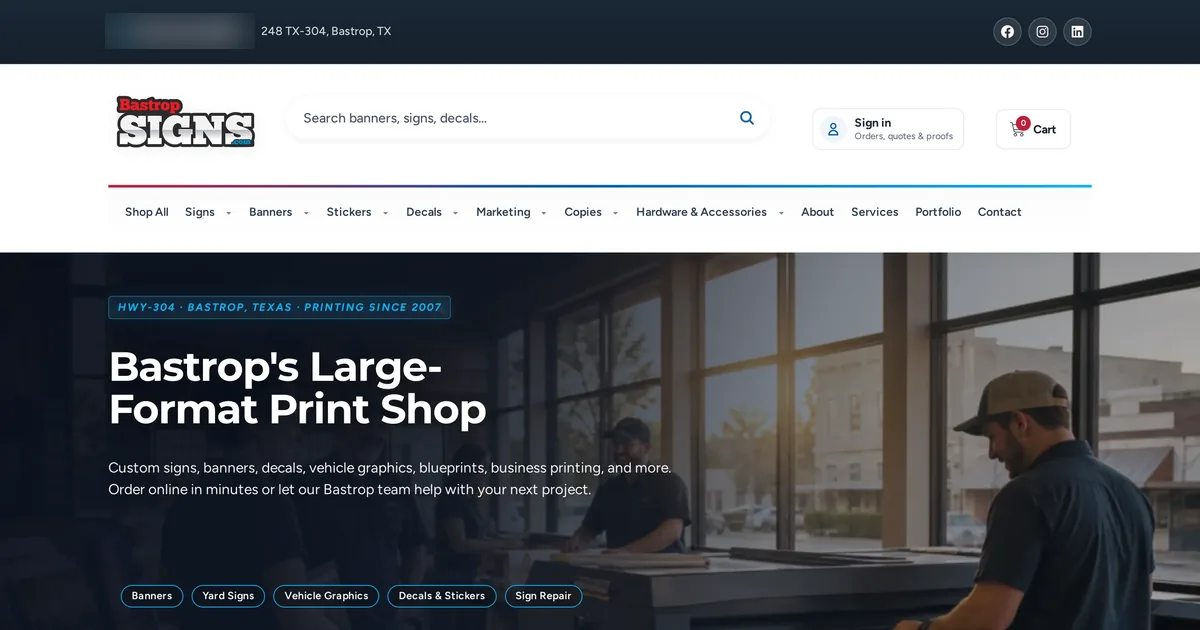
Bastrop Signs is a wide format signage store in United States. Netbase JSC's project records hold a custom web-to-print engagement for it from 2024-08 to 2024-11, with 7 recorded tasks and 3 milestones. The store runs on WooCommerce and is a live store, checked 2026-10-12.
Learn More
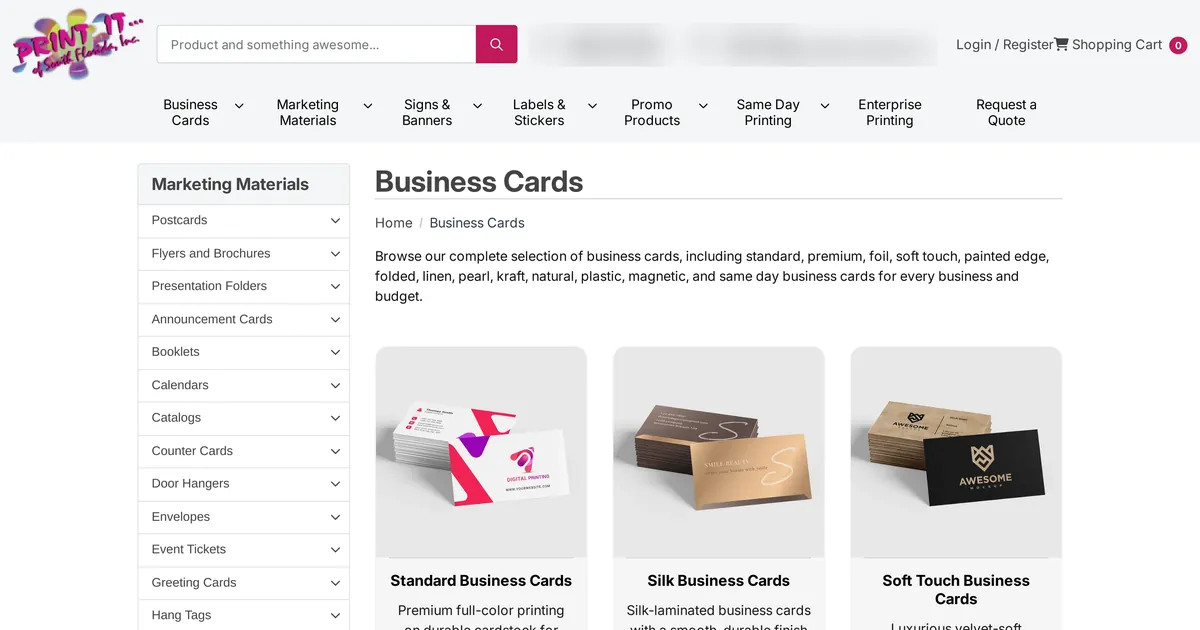
Print It of South Florida is a US commercial printer whose online storefront sells business cards, marketing materials, signs and banners, labels, promotional products and same-day printing. Netbase JSC customised the store's web-to-print ordering for canvas, apparel, signage and promotional products in a custom project. The store was live when checked on 2026-09-30.
Learn More
ADPOP Design is a US business for which Netbase JSC delivered a web-to-print setup and customisation for general print products, with project records from November 2023 to June 2026. No public store address is on record, so a buyer cannot open anything today; the record is labelled Delivered (store no longer online) and makes no outcome claim.
Learn More
ID art is a graphics business in the United States for which Netbase JSC delivered a web-to-print store setup and customisation, with project records from December 2021 to June 2026. On 2026-09-30 the store address, idart.shop, forwarded to a coming-soon page, so this record is labelled Delivered (store no longer online) without a link.
Learn More
References (5)
- Supreme Court of the United States, South Dakota v. Wayfair, Inc. (2018), accessed 2026-09-30.
- California Department of Tax and Fee Administration, Your California Seller's Permit (resale certificates), accessed 2026-09-30.
- California Office of the Attorney General, California Consumer Privacy Act (CCPA), accessed 2026-09-30.
- US Department of Justice, ADA web accessibility guidance, accessed 2026-09-30.
- United States Postal Service, Postal Addressing Standards (Publication 28), accessed 2026-09-30.