

Web-to-print for Australian print businesses
Web2Print Solutions has no Australian office, staff or entity; every engagement for an Australian print business is delivered remotely from Hanoi, Vietnam by Netbase JSC. For Australian buyers this means configuring a storefront's GST tax invoices with an ABN, A-series sizes, state and postcode addresses, and export to Xero or MYOB, not adding an Australian team.
Start a project brief See client projectsReviewed by CEO, Netbase JSC · Published 30 Sep 2026 · Updated 30 Sep 2026

What is web-to-print for Australian print businesses?
Netbase JSC, which operates Web2Print Solutions, configures web-to-print storefronts for print businesses selling into Australia. All engineering and delivery for Web2Print Solutions is performed remote-first from Hanoi, Vietnam. Web2Print Solutions has no office, legal entity, employee base, representative or local support window in any other location. An Australian engagement configures a storefront's GST tax invoices, units, address formats, carriers, payment methods and accounting export for that market, delivered remotely from Hanoi.
This page is one of the markets Web2Print Solutions configures for. The distinguishing detail for Australia is less the GST rate itself than the tax-invoice fields the Australian Taxation Office requires and the export format a Xero or MYOB-based bookkeeping process expects on the other end.
Key takeaways
- GST applies at a single national rate, but a valid tax invoice needs specific fields, including the seller's ABN, that a generic receipt does not carry.
- Order and invoice data needs a field mapping into Xero or MYOB, the two accounting systems most Australian print businesses already run.
- Australia uses A-series paper sizes like the UK, but its own business card die, 90 by 55 millimetres, differs from the UK's 85 by 55.
- Australian addresses carry a state abbreviation and a four-digit postcode, a different shape from both the UK's alphanumeric postcode and the US ZIP+4.
- Every engagement is delivered remotely from Hanoi, Vietnam; nobody on the account is Australia-based, and no local support window is offered.
How does an order move from checkout to delivery in Australia?
The buyer configures a product and sees a GST-inclusive price. At checkout, the storefront issues a tax invoice carrying the seller's ABN, the GST amount and the other fields the ATO requires, alongside the order confirmation. The order record is exported, or synced through an accounting connector scoped as part of print MIS and ERP integration, into Xero or MYOB, matching the print business's existing bookkeeping. The order becomes a production job, and once produced it is handed to a carrier with a state and postcode address, tracked through that carrier rather than the storefront.
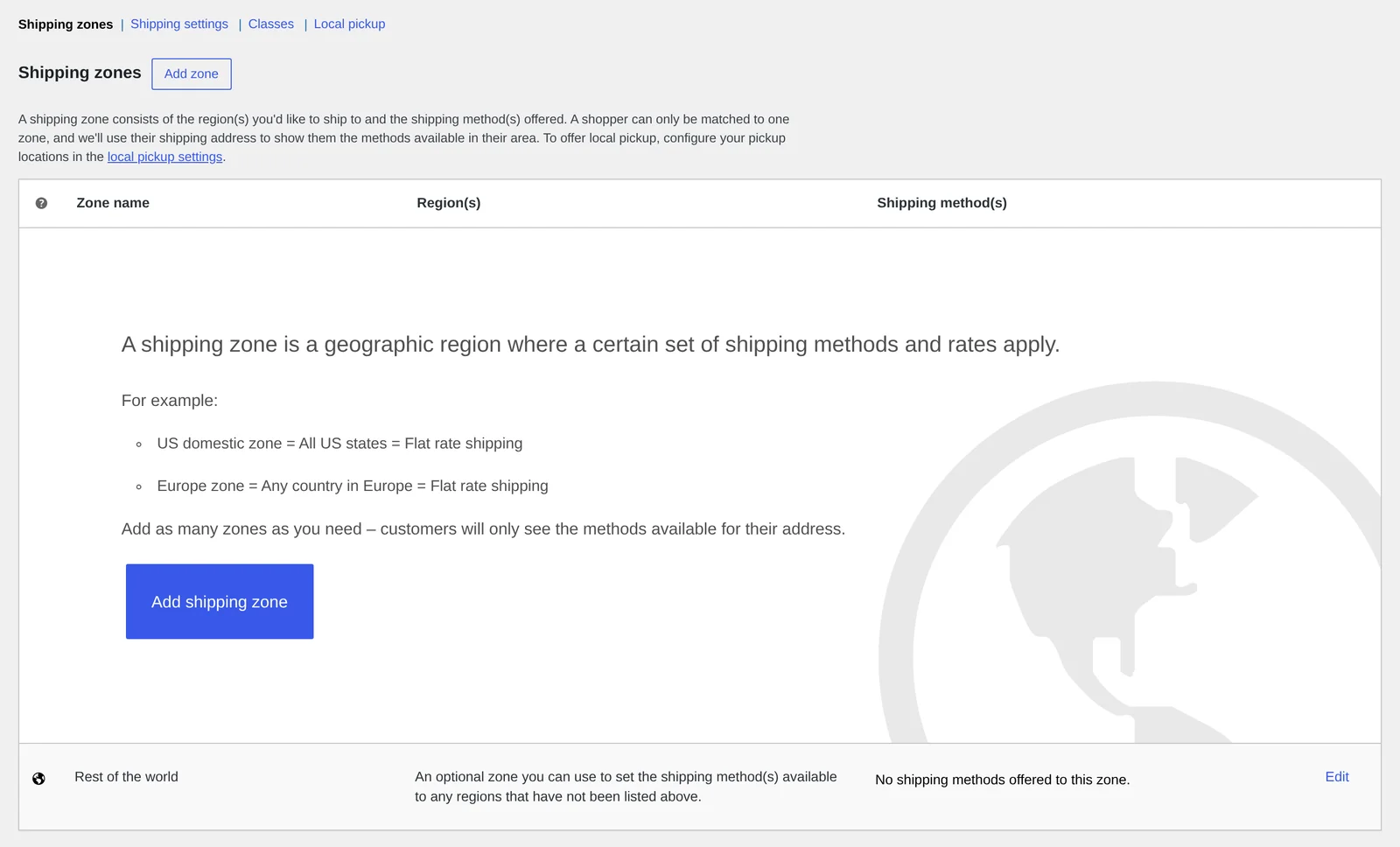
Shipping zones group destination regions and attach delivery methods to each, which is how a domestic route and an export route are kept apart at checkout.
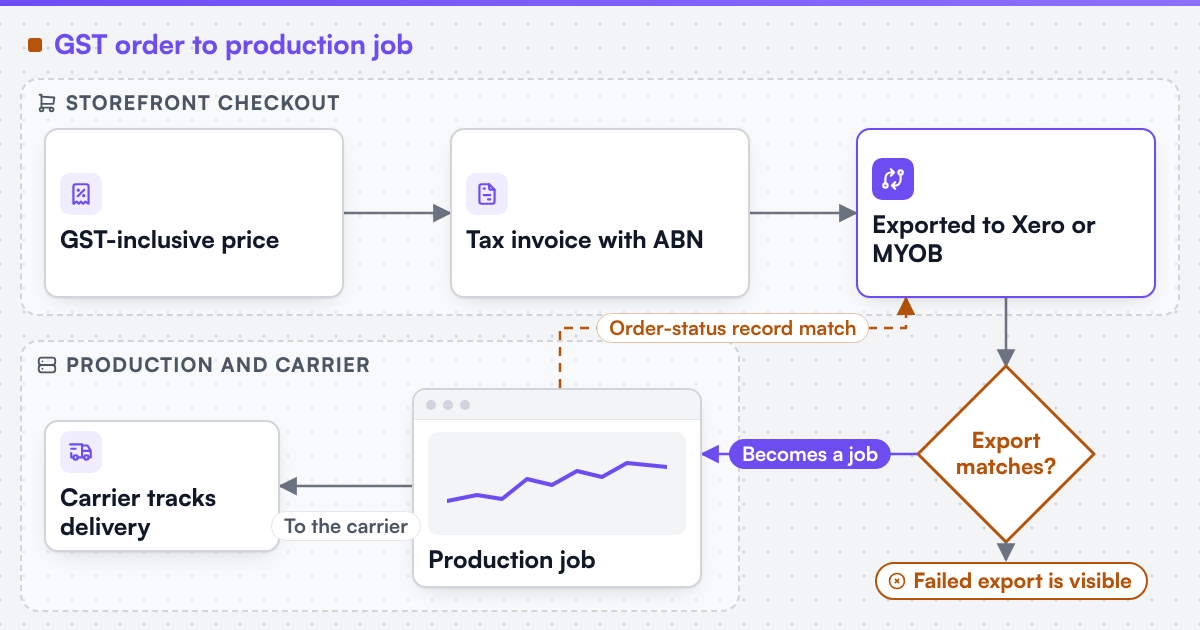 (opens the full-size diagram in a new tab)
What GST and tax-invoice rules does an Australian storefront need to apply?
-
GST
A single national rate applied to most printed products and finishing add-ons
-
Tax invoice
Must show the seller's identity and ABN, the GST amount or a statement that the price includes GST, and the other fields the ATO specifies for that sale value
-
Accounting export
Order and invoice data mapped to the chart of accounts and tax codes Xero or MYOB expects, not a generic CSV
-
Reconciliation
Exported orders need to match the storefront's own order-status record, so a failed export is visible rather than silently dropped
A storefront built for a market with no ABN concept, such as most US-first platforms, has nowhere to put the seller's ABN on the invoice by default. That field, and the export mapping behind it, is usually the actual web-to-print implementation work, not the GST calculation itself.
What units, sizes and address format does Australia use?
-
Paper sizes
A-series (A4, A5, A3), grams per square metre
-
Business card size
90 × 55 millimetres
-
Address format
Street address, suburb, state abbreviation, four-digit postcode
-
Carriers
Australia Post, StarTrack, Sendle
-
Payment
Cards, PayPal, Afterpay for consumer purchases, invoice or EFT for trade accounts
What privacy and accessibility law should an Australian engagement respect?
An Australian storefront that collects customer names, addresses and order history sits under the Privacy Act 1988 and the Australian Privacy Principles it sets out, which the Office of the Australian Information Commissioner administers. The Disability Discrimination Act 1992 has been applied to web accessibility in guidance from the Australian Human Rights Commission. Both are named as context an engagement's build must respect, confirmed with the client's own counsel; neither is a certification Web2Print Solutions holds.
What does an Australian market engagement include, and what does it not?
Included
- GST-compliant tax invoice fields, including the seller's ABN
- Xero or MYOB export mapping for orders and invoices
- A-series and Australian card-size product templates, state and postcode address validation
- Carrier integration for the client's chosen Australian courier
Not included
- Registering the client for GST or an ABN
- Filing the client's own business activity statement
- An Australian office, staff, entity or local support window
- Advice that substitutes for the client's own accountant
What proof already exists for the Australian market?
Netbase JSC, which operates Web2Print Solutions, has delivered 50+ web-to-print platforms. In group case-study evidence, Netbase JSC's named client references include MMP Craft Blanks, an Australian blanks supplier for craft and personalised products; scope, approach and deliverables for that engagement are recorded in the claim registry, without an outcome metric. No published live-store example on this site is Australia-based today; where a record does not exist, this page says so rather than implying one.
What is the time-zone difference with a team based in Hanoi?
| Factor | Detail | Applies to |
|---|---|---|
| Hours difference from Hanoi | Three to four hours behind the Australian east coast, depending on daylight saving | Australia |
| Collaboration pattern | Asynchronous work against a written change-control process; the offset is a planning fact, not a service-level commitment | Australia |
Send a project brief with your ABN and GST registration status, whether you already use Xero or MYOB, your current storefront platform, and the carrier accounts you hold.
Discuss your web-to-print project
Frequently asked questions
It calculates GST on the priced order and produces the tax-invoice fields the ATO requires; the client's own GST registration and reporting obligations stay with their business and accountant.
The mapping is built for whichever one the client actually runs; supporting both at once means maintaining two export mappings, which is scoped as two pieces of work, not one.
No. Delivery is entirely remote from Hanoi, Vietnam. The client's own Australian entity holds the ABN, GST registration, bank account and carrier contracts; the engagement configures the storefront to use them correctly.
Client profiles in Australia
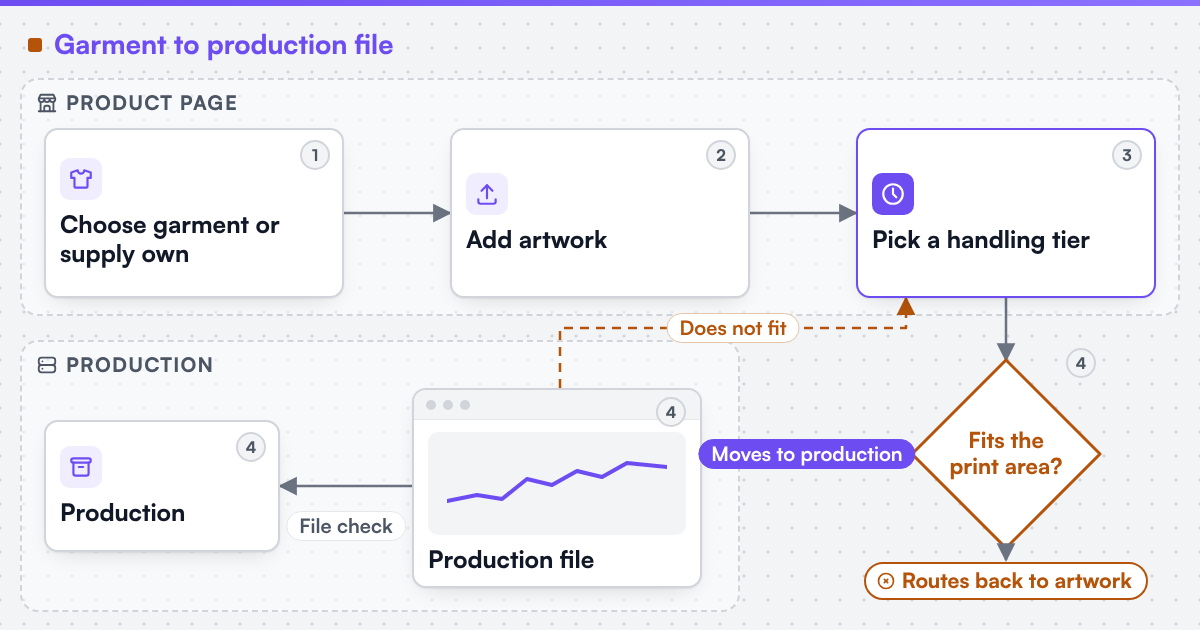
T Shirts Australia is a Brisbane apparel printer whose WooCommerce store sells custom and blank T-shirts, graphic tees and hats with an online designer, two print methods and same-day, express and standard handling. Netbase JSC's records hold a custom engagement from August 2023 to November 2025, and the store was live on 2026-10-10.
Learn More
References (5)
- Australian Taxation Office, Tax invoices, accessed 2026-09-30.
- Australian Taxation Office, Goods and services tax (GST), accessed 2026-09-30.
- Office of the Australian Information Commissioner, Australian Privacy Principles, accessed 2026-09-30.
- Australian Human Rights Commission, World Wide Web access and the Disability Discrimination Act advisory notes, accessed 2026-09-30.
- Australia Post, How to address your mail, accessed 2026-09-30.