Ready-made platform
Run it on W2P Solution
A white-label print store with a built-in designer, print pricing rules and a production queue, set up and hosted by the Netbase team on a yearly plan.


Launch is the start of a web-to-print engagement, not the end. Published case studies on this site record platforms running two to seven years after launch, with new designer releases, device and payment fixes, added languages, and two stores no longer online. The pattern recurs because catalogues, devices, browsers and payment rules keep changing.
Reviewed by CEO, Netbase JSC · Published 4 Oct 2026 · Updated 4 Oct 2026 · 11 min read

A web-to-print platform does not stop changing once it goes live. The evidence hub carries fourteen case-study records, and most of them describe a store still running years after its first launch, each with its own list of work that happened after that date: a new design-tool release, a fix a particular phone forced, a language added once the store was already live, a pricing or option change, or a platform migrated and upgraded under a catalogue that kept growing. Two of the fourteen records are labelled Delivered (store no longer online).
This article is an insight: a dated, arguable reading of what the published records show, not a service description. It does not estimate how often a given kind of post-launch work recurs across the group's full client list, because no published measurement supports a number beyond the fourteen records cited here.
Where a page names a milestone count, that is the number of dated, project-specific items in Netbase JSC's own index for that client, not a count of features or releases; E.grami's record, for example, holds seventeen further scaffold items the page excludes because they are shared project-plan entries, not delivered scope. Four of the eight records above describe only the engagement span, with no itemised count. More live stores using the same kind of components sit outside this table because their records do not break work down by date.
These seven rows are not a complete taxonomy of post-launch work; they are the kinds of work that two of the fourteen records happen to itemise by date. The rest of the set confirms the pattern at a coarser grain: a store still live and still selling, years after the engagement that built it, with no itemised breakdown of what changed underneath it in the meantime.
E.grami's funeral plaque is a single product on a single store, and the dated part of its record shows the design step attached to that product changing on its own schedule after the creator first shipped, not as one rebuild.
None of this is a relaunch. The plaque product, and the creator behind it, kept the same shape across three years while the work underneath it changed on four separate, dated occasions that the E.grami case study records.
Two of the records above are labelled Delivered (store no longer online): ADPOP Design and ID art. ADPOP Design's project ran from November 2023 to June 2026, and no public store address is on record to check. ID art's store, idart.shop, ran from December 2021 to June 2026, and on the last check the address forwarded to a coming-soon page.
Neither page says why the business stopped trading, and this page makes no causal claim either: a store can close, rebrand, merge into a wider site or pause selling for reasons that have nothing to do with the platform underneath it. The honest treatment, used on both case studies, is to label the status plainly, record the check date, and publish no link that would send a buyer to a page without the work on it. A closed store is a fact about a business on the date it was checked, not a verdict on the components built for it.
The engineer who built it, working from a support log, not a guess
The business names what should change; a named engineer ships it as a scoped release
The budget holder, working from the same kind of dated record this page cites - see managed print platform operations for what a standing agreement covers
A platform budgeted only through its launch date is budgeted for a chapter the records above show does not end there. None of the three years is optional to plan for: a tool that nobody owns after year one accumulates the kind of defect E.grami's support records name, and a platform nobody reviews by year three reaches the migration decision as an emergency instead of a plan.
Three questions, asked in this order, cover every pattern the records above show.
Does one part explain it? When the problem is a slow save, a field that will not move, or a design step that breaks on one phone model, the records show the fix landing on that one part, not on the rest of the store. Extend that component and reuse the proven piece underneath it, the way E.grami's and Migvan's support fixes do, rather than touching anything else.
Is the whole stack aged, not one feature? When themes, plugins and the platform itself have all moved on together, as Botak Sign's record shows after six years, the right move is to scope a migration and upgrade: keep the ordering behaviour customers already know and change the platform underneath it. That is an upgrade, not a rebuild from zero.
Is the business still trading today? If the answer is no, as ADPOP Design's and ID art's records show, the result is a business decision, not a verdict on the components: this page does not read a closed store as proof that anything built for it was wrong.
If the business is still trading, and neither a single part nor an aged stack explains the gap, the records point to the plainest outcome: keep the platform operating, and keep evolving it, under a named owner who can say what changed and why.
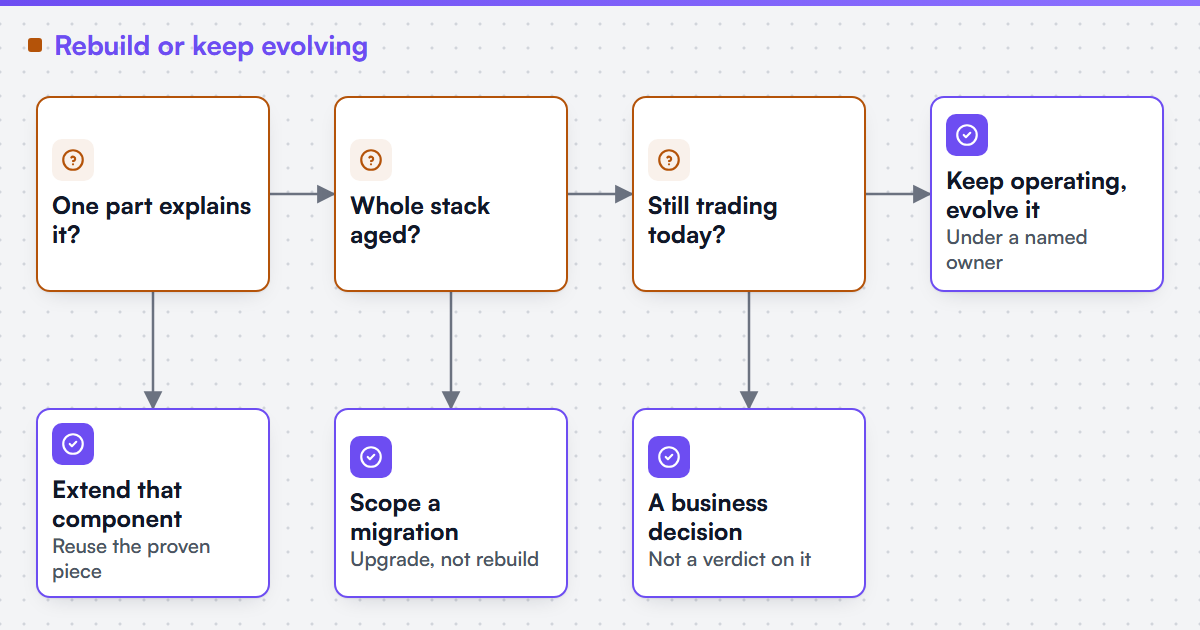 (opens the full-size diagram in a new tab)
If you are weighing what your own platform will need next, send a project brief that names your current platform and its age, the last three support issues your team fixed by hand, and whether a migration, an extension or a standing operating agreement is the question on the table. The storefront launch itself is covered separately on a go-live checklist for a web-to-print storefront launch; this page starts where that one ends.
No. JÄGER kreativ's record runs almost seven years with 23 milestones, and the page describes that as the shape a custom engagement should have: small, dated steps that each ship something, not one rebuild every few years.
Netbase JSC publishes both kinds of record. ADPOP Design and ID art are labelled Delivered (store no longer online), with the check date and no speculation about why the business stopped trading.
No. A go-live checklist for a web-to-print storefront launch covers the ten checks before an announced go-live date. This page covers the years after that date, using the pattern in the published case studies.
No. None is measured to a published method and none is claimed. Where ongoing operation is offered as a separate agreement, service levels are set in the contract, not published here.
A project brief naming your platform, its age, and the support issues your team has already fixed by hand is the fastest way to find out whether the next step is a scoped extension, a migration review, or a standing operating agreement.
The businesses named in these case studies are Netbase JSC clients; the web-to-print work described was delivered or designed by Netbase JSC, which operates Web2Print Solutions. Names, links and screenshots are shown with the operator's authorization and removed on request.
Ready-made platform
A white-label print store with a built-in designer, print pricing rules and a production queue, set up and hosted by the Netbase team on a yearly plan.
Commissioned build
When the workflow needs rules, integrations or a configurator a standard edition does not cover, the Netbase engineering team scopes and builds it.
Tell us about one product you want to sell online. A senior engineer reads every brief and replies in writing.
Tell us what you need to build, migrate or connect.
Start a project brief