What does a sign-off workflow record, and what does it not promise?
Most artwork approval failures are not design failures; they are record failures. A customer okays a version by email, a second person asks for a small change on a phone call, and the job that reaches production is nobody's fault and everybody's problem. An online proofing and artwork approval workflow replaces that with a published proof version, a place for named reviewers to annotate it, a recorded decision per approver, and a gate that only opens to production once every required sign-off is in. It is, deliberately, a content and release sign-off record. It is not a colour-managed contract proof of the kind governed by process-control standards for commercial print; nothing in this service claims that what the reviewer sees on a screen or a desktop print matches final press output to a measured tolerance.
Web2Print Solutions can build B2B and corporate print storefronts with account hierarchies, permission models, approval workflows and brand-locked template systems; this service is the sign-off layer inside that kind of approval workflow, scoped to artwork review rather than budget or purchase approval. B2B and corporate print storefronts owns the account hierarchy and the spend-approval chain; this page owns the proof, the annotation and the sign-off record that sits inside it.

Key takeaways
- Every proof is a numbered version; a new upload never silently replaces the one a reviewer already commented on.
- Annotations are tied to a version, a location on the artwork and an author, so a note survives past the conversation it came from.
- Sign-off is a recorded decision per required approver, not an inferred silence; no response is not a yes.
- The release gate to production opens only when every required sign-off for that version is recorded, and it records who opened it and when.
- A rejected version triggers a defined re-proof rule: a new version number, the same reviewers, and the prior annotations carried forward for context.
Who is this for, and when does another service fit better?
Good fit
- Orders that need a documented customer or internal sign-off before a job prints
- Several approvers, such as a designer, a brand owner and a buyer, each needing a recorded decision
- A business that has had a dispute over what was actually approved
Another route fits better
- A contract-colour proofing requirement with measured tolerances, which is a press process-control question, not a software one
- A single person who both approves and places the order, where a confirmation step is enough
- A business whose PDF generation and preflight is not yet reliable; print-ready PDF and prepress automation is the service that gets a correct file to proof in the first place
What is a proof version, and what can a reviewer do with it?
A proof version is the artwork plus the metadata that matters later: who uploaded it, when, and from which order or job. Web2Print Solutions engineers the print output that becomes a proof: PDF generation to a client-specified standard, CMYK and spot colour handling, ICC profile selection, bleed and trim geometry, imposition and automated preflight; a version that fails preflight is marked as such before a reviewer ever opens it. A reviewer adds an annotation: a note tied to a location on the page, a version, and the reviewer's identity, closer to a sticky note than a chat message. Annotations persist across the life of the job, so a dispute over what was asked for is answered by reading the record instead of reconstructing an email thread.
How does the sign-off state machine work?
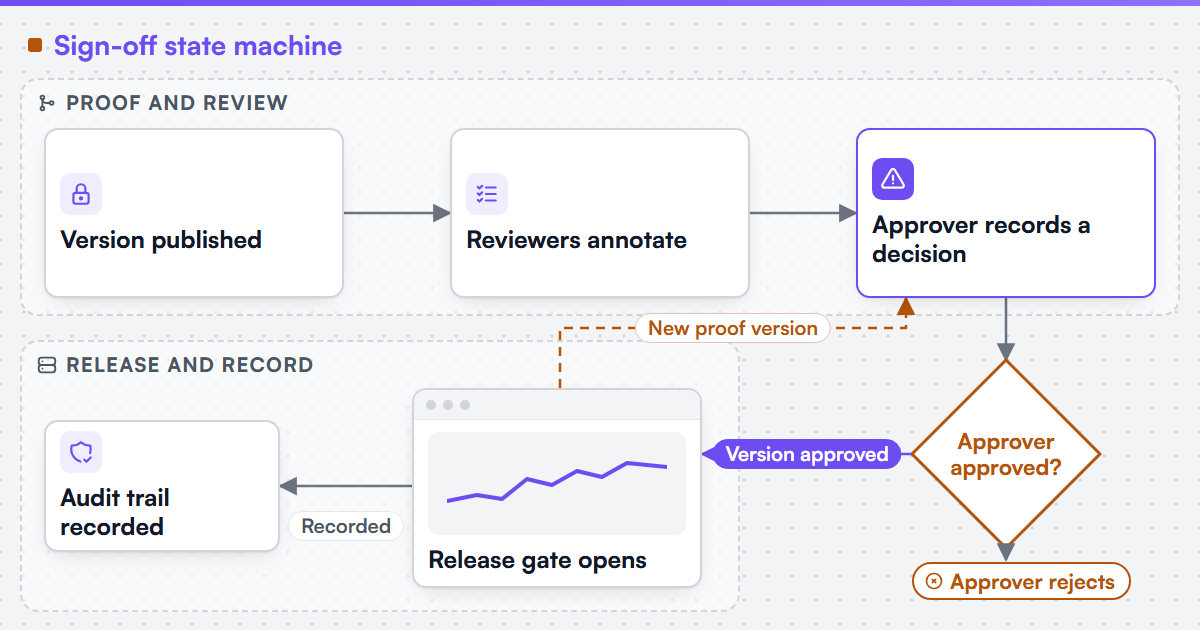
A proof moves through a small set of states, and the move from one to the next is always a recorded action by a named person, never a timeout or a default. A version is published and enters review. Reviewers annotate it, and each required approver records a decision: approved or rejected, with a reason on rejection. When every required approver has approved the current version, the release gate opens and the job moves to production, with a timestamp and the identity of whoever opened it written into the audit trail. If any required approver rejects, the version does not advance; a new proof version is prepared and review restarts on it, and the prior annotations travel forward as context rather than being discarded.
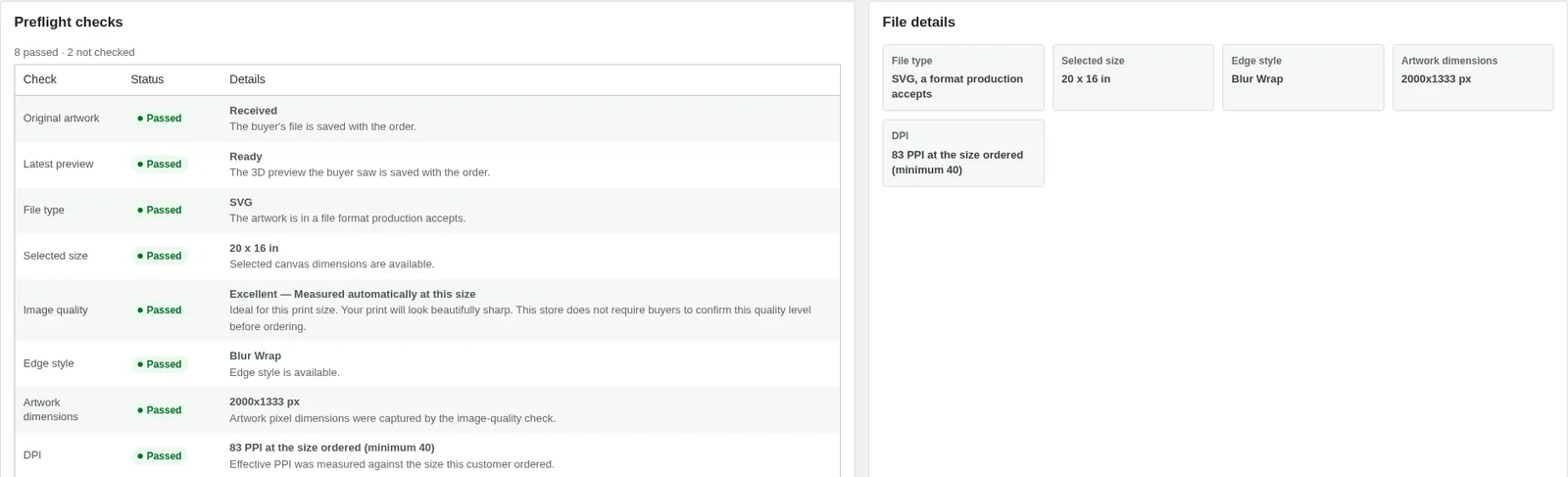
Each uploaded file carries a preflight verdict alongside its details, which gives a reviewer something concrete to sign off against.

(opens the full-size diagram in a new tab)
What happens when a proof is rejected, and who decides a re-proof is needed?
A worked example: a franchise brand orders a counter card, and the brand team rejects the first proof because a logo clearance is too tight. The rejection carries a reason and an annotation pointing at the exact element. A second proof version is generated with the correction, keeps the same required approvers, and inherits the first version's annotation so nobody has to repeat the note. Approval of version two, not version one, is what opens the release gate; the record shows both versions and both decisions, so a later question about "which logo size did we approve" has one answer, not three people's memories.
-
Published
- What moves it forward
- A new or corrected proof version is uploaded
- What it records
- Version number, source job, preflight result
-
In review
- What moves it forward
- A required approver opens the version
- What it records
- Reviewer identity, timestamp, annotations added
-
Approved
- What moves it forward
- Every required approver records approval on the current version
- What it records
- Decision, reason (if any), timestamp per approver
-
Rejected
- What moves it forward
- Any required approver records rejection
- What it records
- Rejection reason, annotation, which version it applies to
-
Released
- What moves it forward
- The gate opens once approval is complete
- What it records
- Who opened the gate, when, and the approved version id
What is included, and what is not?
Included
- Proof versioning, annotations and a recorded decision per required approver
- The release gate to production and its audit trail
- Re-proof rules, including carried-forward annotations
- A record of who approved what, and when, for later dispute resolution
Not included
- A colour-managed contract proof with a measured delta against press output
- Spend or purchase-order approval, owned by the storefront's account workflow
- File-level preflight, owned by print-ready PDF and prepress automation
- A guarantee that a reviewer responds within a given time
How does the work run?
-
Specify
Required approvers, rejection reasons and re-proof rules are agreed and written down
- Evidence you receive
- Signed state-machine specification
-
Build
Versioning, annotation, sign-off and the release gate are built and wired to production hand-off
- Evidence you receive
- State machine passing a set of real and rejected proofs on a test environment
-
Accept and hand over
Approvers run their own jobs through the workflow, including a deliberate rejection
- Evidence you receive
- Acceptance record, runbook and the audit-trail export format
Web2Print Solutions can automate the path from a web order to a production job ticket, routing and status updates, using the interfaces the client's systems sanction, with an exception queue a person owns; the release gate in this workflow is the point where that automation may take over once sign-off is complete. The default engagement is fixed-scope with written acceptance criteria and priced change control. Managed operations is a separate, opt-in agreement.
What proof sits behind this service?
Web2Print Solutions is the web-to-print engineering service of Netbase JSC. Delivery records cited on this site belong to Netbase JSC; where no delivered example of a capability is published, the page says so rather than implying a record. No artwork approval workflow delivered under the Web2Print Solutions name is published yet. Stores built by the group that are live today are listed on the live web-to-print stores evidence page; those are group records, not a published sign-off delivery under this name.
Scope this work with a project brief
Send a project brief with a recent job that needed more than one round of approval, who the required approvers were, the reason the first proof was rejected if it was, and how a dispute over "what was approved" gets resolved today. That is enough to draft the first state-machine specification. If the open question is the file itself rather than the sign-off, start with print-ready PDF and prepress automation; if it is spend approval rather than artwork sign-off, start with B2B and corporate print storefronts.
Frequently asked questions
No. This is a content and release sign-off record. A colour-managed contract proof is a separate, press process-control question with its own standards and equipment.
Yes. The state machine supports a list of required approvers; the release gate opens only once every one of them has recorded approval on the current version.
They carry forward as context on the new version rather than being discarded, so a reviewer is not asked to repeat a note already made.
Yes. Every decision is recorded with the approver's identity, a timestamp and the version it applied to, exportable for a later dispute or an audit.
References (5)
- W3C, Web Annotation Data Model, accessed 2026-10-04.
- W3C, Web Annotation Protocol, accessed 2026-10-04.
- NIST Special Publication 800-92, Guide to Computer Security Log Management, accessed 2026-10-04.
- Ghent Workgroup, Specifications for PDF-based print file exchange, accessed 2026-10-04.
- CIP4, Job Definition Format (JDF), accessed 2026-10-04.