

Web-to-print for Canadian print businesses
Web2Print Solutions has no Canadian office, staff or entity; every engagement for a Canadian print business is delivered remotely from Hanoi, Vietnam by Netbase JSC. For Canadian buyers this means configuring a storefront's GST, HST or PST by province, Quebec's French-language product-page rule, and Canada Post or Purolator dispatch, not adding a Canadian team.
Start a project brief Explore servicesReviewed by CEO, Netbase JSC · Published 1 Oct 2026 · Updated 1 Oct 2026

What is web-to-print for Canadian print businesses?
Netbase JSC, which operates Web2Print Solutions, configures web-to-print storefronts for print businesses selling into Canada. All engineering and delivery for Web2Print Solutions is performed remote-first from Hanoi, Vietnam. Web2Print Solutions has no office, legal entity, employee base, representative or local support window in any other location. A Canadian engagement configures a storefront's tax invoices, units, address formats, carriers and payment methods for that market.
For a Canadian buyer, "market-correct" means the right GST, HST or PST for the buyer's province on the invoice, a French-language product page in Quebec, a Canadian postal-code address format, and a carrier the buyer recognises. This page is one of the markets Web2Print Solutions configures for.
Key takeaways
- Canada has no single national sales-tax rate: a storefront must apply GST alone, or GST blended into HST, or GST plus a separate PST or QST, keyed to the buyer's province.
- Quebec adds a second requirement beyond tax: its Charter of the French Language sets out when a product page and checkout need to be available in French for a Quebec buyer.
- Canadian addresses use a six-character postal code in an A1A 1A1 pattern, not a US ZIP code, and trade specifications mix metric and imperial units.
- Ontario's accessibility law, AODA, adds a layer of accessibility obligations beyond the federal privacy law that applies everywhere in Canada.
- Every engagement is delivered remotely from Hanoi, Vietnam; nobody on the account is Canada-based, and no local support window is offered.
How does an order move from checkout to delivery in Canada?
The storefront determines tax from the shipping or billing province: GST alone, GST blended into HST, or GST alongside a separately stated provincial or Quebec sales tax. A Quebec buyer sees a French-language product page and checkout, as the Charter of the French Language requires for product information offered to Quebec consumers. The order becomes a production job and is handed to a carrier with a Canadian-format address.
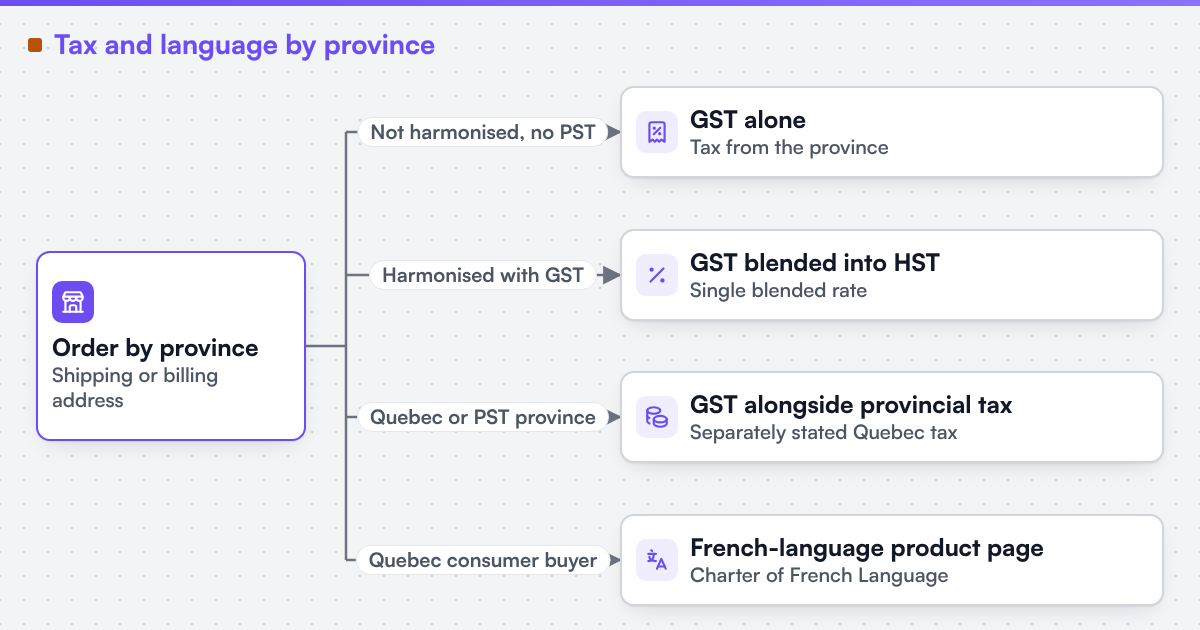 (opens the full-size diagram in a new tab)
What GST, HST and PST rules does a Canadian storefront need to apply?
-
GST
Canada's federal goods and services tax, applied nationally
-
HST
In provinces that have harmonised their sales tax with GST, a single blended rate applies instead of GST plus a separate provincial tax
-
PST / QST
In provinces that have not harmonised, a separate provincial sales tax, or Quebec's own QST, is calculated and shown alongside GST
-
Tax invoice
Shows the tax components applicable to the buyer's province, not one fixed national rate
A storefront that charges one blended rate nationally gets every non-harmonised province wrong. The tax engine needs a rate table keyed to the buyer's province and reviewed against the Canada Revenue Agency's current rate list, as part of the broader web-to-print ecommerce integration work.
What units, address format and language rule does Canada use?
-
Paper sizes
Letter-size templates are standard, alongside metric stock weights; a catalogue built only for A-series sizes needs a Letter-size variant
-
Address format
Street address, city, two-letter province code, postal code in an A1A 1A1 pattern
-
Language for Quebec
A product page and checkout offered to a Quebec consumer needs a French-language version under the Charter of the French Language
-
Units in practice
Metric and imperial units both appear in Canadian trade print specifications, depending on the supplier and the product
Which carriers and payment methods do Canadian buyers expect?
Canada Post and Purolator are the carriers a Canadian checkout and order-status page most often integrate against, by API, manifest file or a fulfilment platform. Canadian buyers commonly expect card payment and Interac for consumer purchases, with a trade account ordering on terms agreed directly with the seller rather than paying at checkout.
What privacy and accessibility law should a Canadian engagement respect?
A Canadian storefront that collects customer names, addresses and order history sits under the federal Personal Information Protection and Electronic Documents Act (PIPEDA), and a Quebec-facing storefront sits additionally under Quebec's own private-sector privacy law. Ontario's Accessibility for Ontarians with Disabilities Act (AODA) adds accessibility obligations for organisations doing business with Ontario customers, on top of whatever baseline accessibility practice a build already follows. Confirm both with the client's own counsel; neither is a certification Web2Print Solutions holds.
What proof already exists for the Canadian market?
Netbase JSC, which operates Web2Print Solutions, has delivered 50+ web-to-print platforms. Among the live web-to-print store examples, Ton Atelier is a Canadian apparel and transfers storefront that lets a buyer choose between uploading finished artwork and building a gang sheet online. Live store using web-to-print components delivered by Netbase JSC, which operates Web2Print Solutions. No Canadian GST/HST, PST or Quebec-language case study is published under the Web2Print Solutions name yet; where that record does not exist, this page says so.
What is the time-zone difference with a team based in Hanoi?
| Factor | Detail | Applies to |
|---|---|---|
| Hours difference from Hanoi | Eleven to fifteen hours ahead of Canada, depending on the buyer's time zone and daylight saving | Canada |
| Collaboration pattern | Asynchronous work against written change control, not a promised response window | Canada |
Send a project brief with the provinces you sell into, whether any Quebec buyers are in scope, your carrier accounts, and the platform your storefront runs on. For a comparison with a neighbouring market, see web-to-print for US print businesses.
Discuss your web-to-print project
Frequently asked questions
No. The Charter of the French Language requirement is specifically about product information and commercial activity directed at Quebec consumers; a storefront with no Quebec buyers in scope does not need a French build, and one with Quebec buyers needs French for that audience, not a bilingual site everywhere.
Yes, when the tax engine is built against a provincial rate table rather than a single rate, with GST, HST and PST or QST applied by the buyer's province and kept current against the Canada Revenue Agency's published rates.
No. Delivery is entirely remote from Hanoi, Vietnam; the client's own entity holds the tax registrations, bank account and carrier contracts.
The rate table is client-updatable configuration; a scoped change request covers a rule change needing new logic, such as a province changing how it harmonises with GST.
Client profiles in Canada
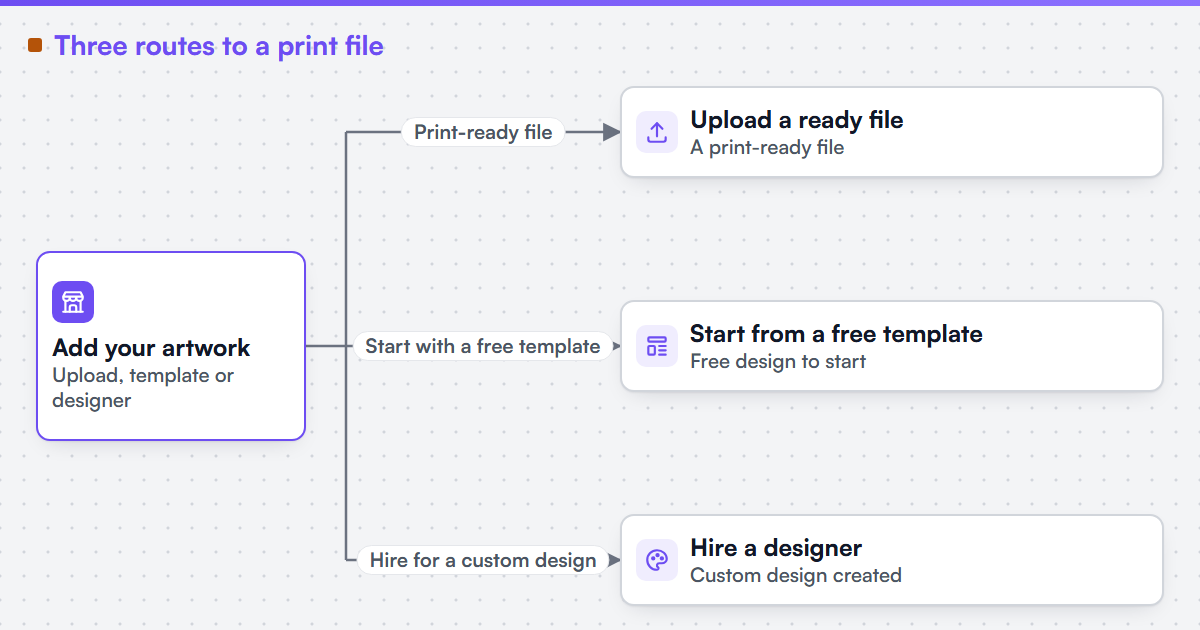
Printomatic is a large-format and real-estate print shop in Concord, Ontario, selling signs, banners and vehicle wraps with an option-driven configurator, three artwork routes and a file check before print. Netbase JSC's records hold a custom web-to-print engagement from June 2021 to February 2025, and Netbase JSC checked the store live on 2026-10-03.
Learn More

Ton Atelier is a heat transfer and custom apparel store in Canada. It is a live store using web-to-print components delivered by Netbase JSC, checked 2026-10-14. The store runs on WooCommerce, in English, with a French version. Netbase JSC's records hold a project record opened in 2021-12 with 2 recorded tasks.
Learn More
References (4)
- Canada Revenue Agency, GST/HST for businesses, accessed 2026-10-01.
- LégisQuébec, Charter of the French Language (chapter C-11), accessed 2026-10-01.
- Office of the Privacy Commissioner of Canada, the Personal Information Protection and Electronic Documents Act (PIPEDA), accessed 2026-10-01.
- Government of Ontario, Accessibility for Ontarians with Disabilities Act, 2005, accessed 2026-10-01.