

Web-to-print for apparel and promotional print
Apparel and promotional print on demand is high volume and low value per unit, so routing decides the economics more than design does. Each order needs a decoration method, DTG, screen printing, DTF, embroidery or sublimation, chosen by artwork, quantity and item, a minimum that matches that method's setup cost, and a producer able to run it without manual triage.
Start a project brief See client projectsReviewed by CEO, Netbase JSC · Published 3 Oct 2026 · Updated 3 Oct 2026

What makes apparel and promotional print its own segment?
Apparel and promotional print is high volume and low value per unit: a single order is rarely worth much, and the business only works if a large number of small orders route correctly with no manual triage. The segment covers garments printed to order and promotional items, mugs, pens, bags, decorated at low minimums for one buyer at a time, rather than a factory run for one client's inventory. The engineering problem is not the design tool; it is the routing decision behind it: which method an order needs, which producer can run it at that quantity, and what happens when an order does not fit the default path.
Key takeaways
- Apparel and promotional print on demand is a high-volume, low-value-per-unit business, so the economics depend on correct routing at scale, not any single order.
- Five decoration methods, DTG, screen printing, DTF, embroidery and sublimation, each suit a different artwork, quantity and item combination; routing to the wrong one is a cost, not a cosmetic mismatch.
- Minimums exist because screen printing and embroidery carry a fixed setup cost per design that only amortises over quantity; DTG, DTF and sublimation carry little setup cost and support single-unit orders.
- A size and colour matrix multiplies fast: one design across several styles, sizes and colours is a catalogue problem before it is a design problem.
- Fulfilment routing, sending the right order to the right producer by method, item and location, is the genuine engineering requirement a design tool alone does not solve.
How does an order get routed to a decoration method?
| Method | Typical minimum | What favours it |
|---|---|---|
| DTG (direct-to-garment) | Single unit | Full-colour or photographic art, low quantity, cotton-heavy garments |
| Screen printing | Dozens or more | Flat, limited colour count, high quantity, lowest per-unit cost at scale |
| DTF (direct-to-film) | Single unit, sometimes small batch | Full-colour art on fabrics DTG struggles with, including dark or synthetic blends |
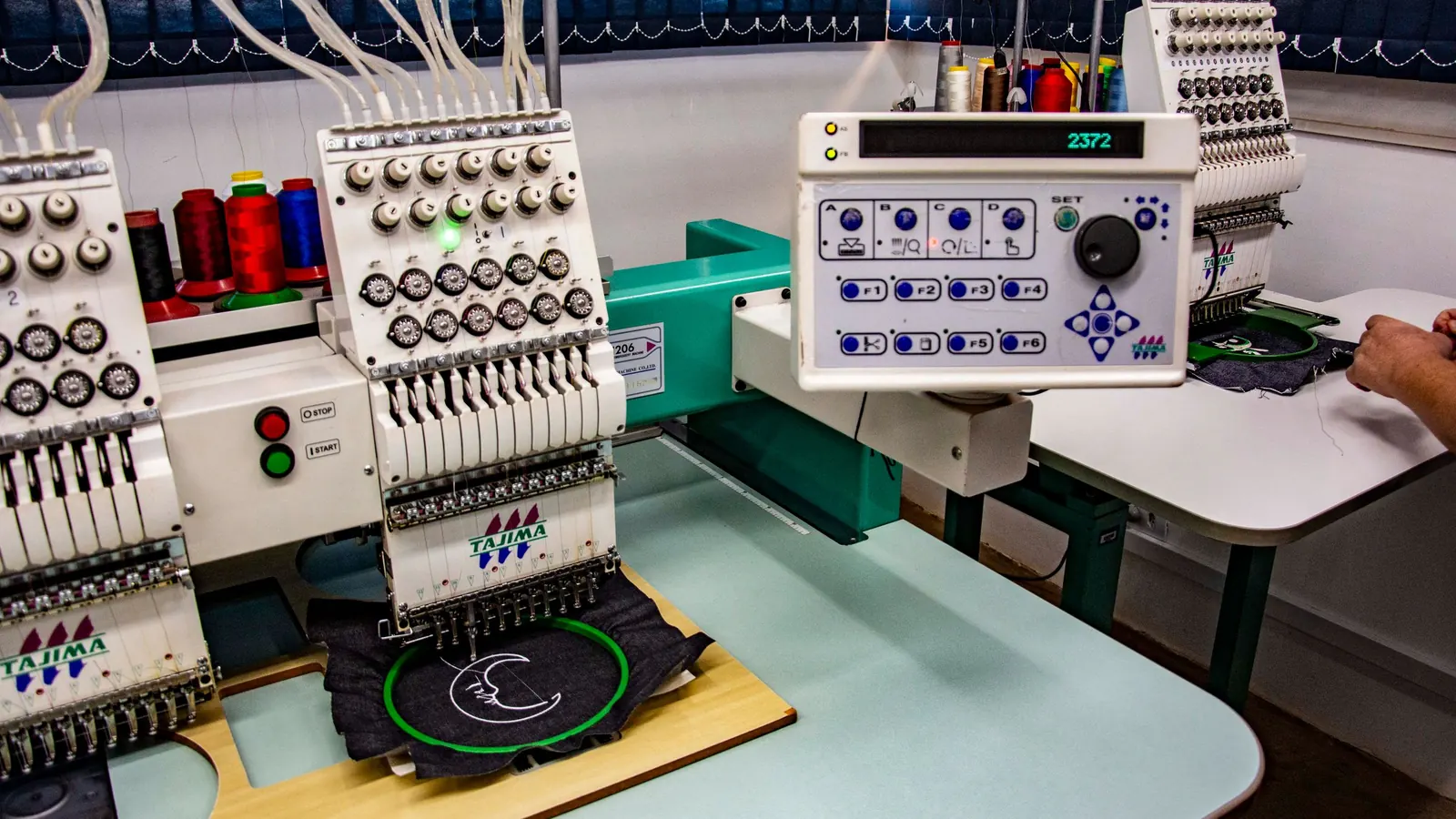
| Embroidery | Single unit to small batch | Logos and text, a stitched finish, left-chest and cap placements |
| Sublimation | Low to moderate, item-dependent | All-over or wrap-around print on polyester or coated hard goods |
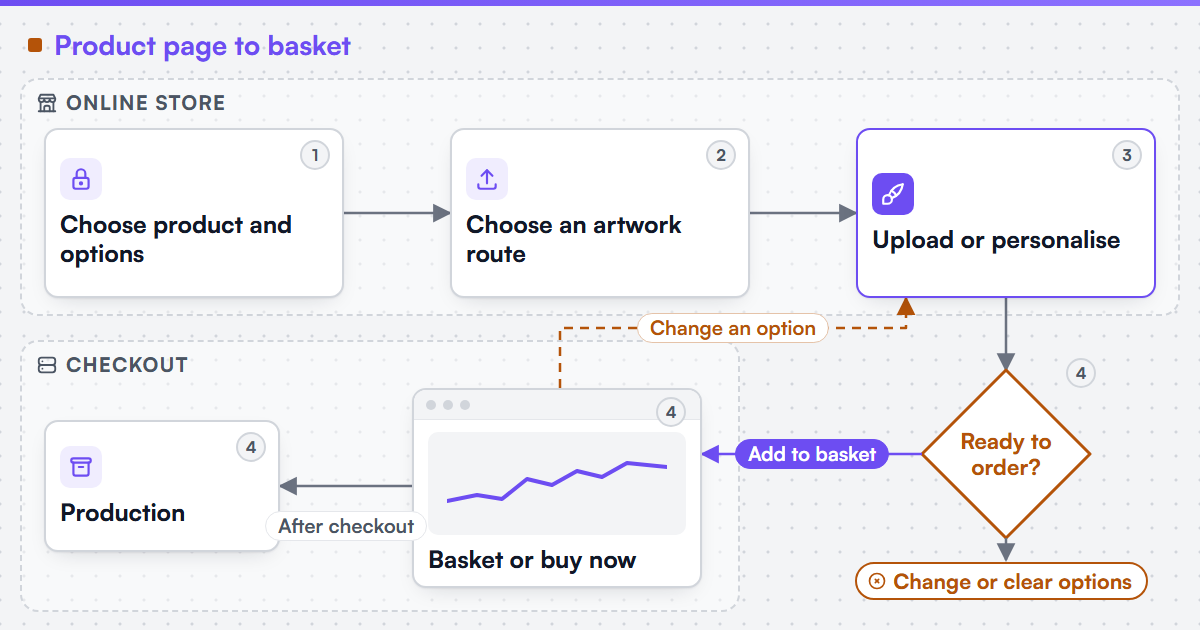
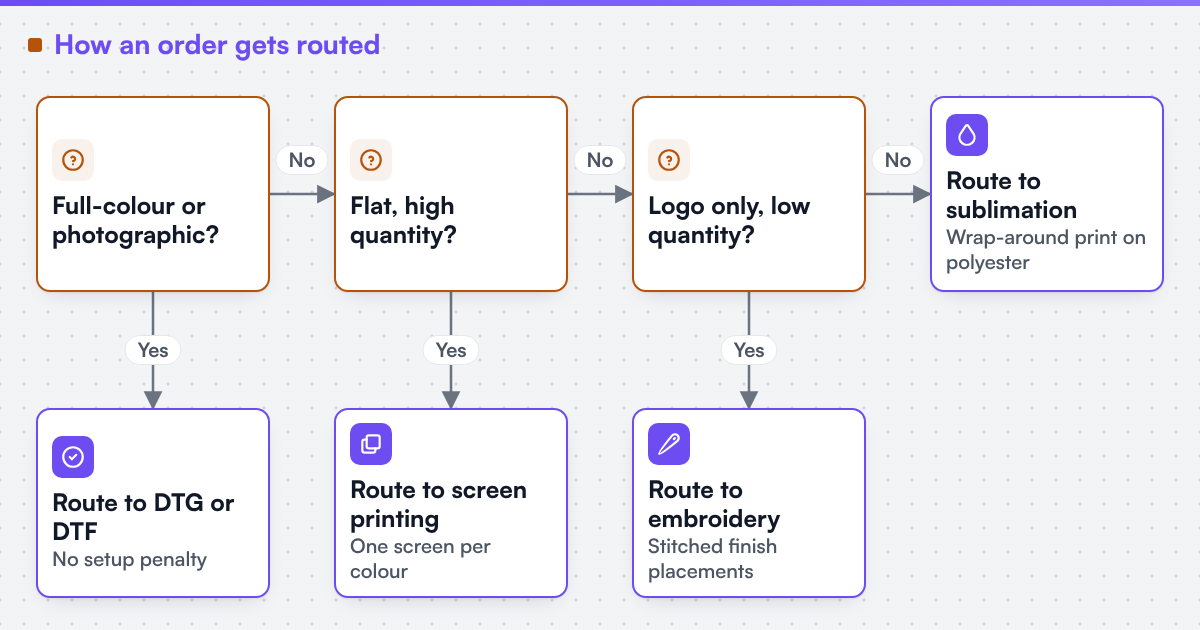 (opens the full-size diagram in a new tab)
Why do minimums differ so much between methods?
Screen printing and embroidery both carry a fixed setup cost per design: a screen is burned per colour, and an embroidery machine programmed with a stitch file, before a single unit prints. That cost only makes sense spread across a run, which is why both carry real minimums. DTG and DTF print directly from a digital file with no per-design setup beyond loading the artwork, so both support an order of one at close to the per-unit cost of an order of fifty. Sublimation sits in between: no screens or stitch files, but item size still favours a minimum high enough to make press time worthwhile. A storefront offering every method at the same minimum either overprices the low-setup methods or underprices the ones needing a real run.
What does a size and colour matrix actually commit a business to?
A single design sold across five garment styles, six sizes and four colours is already 120 combinations before quantity is considered, and each needs its own stock position or production path, its own price if costs differ by size or colour, and its own routing if not every producer carries every combination. Promotional items add imprint-area variation on top: a mug and a tote bag do not share a print area, so the same artwork needs a different placement rule per item, covered on the promotional product and gift designer and t-shirt and apparel designer pages. This page covers the business decision behind the matrix; placement and file mechanics live on those product pages.
What does a worked example look like?
An order comes in for fifteen units of one design: a full-colour photographic print on a cotton t-shirt, in three sizes and two colours. Routed to screen printing, it would need posterizing into flat colour bands and a minimum well above fifteen units to justify setup, so the routing logic sends it to DTG instead, where quantity and colour complexity carry no setup penalty. A second order for 200 units of a two-colour logo on a polo shirt's left chest routes the opposite way: at that quantity, screen printing's per-unit cost undercuts DTG, and the flat design separates cleanly into two screens. The storefront carries both rules and applies them automatically, not leaving the choice to whichever producer picks up the order.
Who is this not for?
A business selling one decoration method, one item and a short size run does not need routing logic; a single-path configurator serves that catalogue well. Routing engineering pays off once a catalogue spans more than one method or producer, the scope covered in print fulfilment network integration.
What breaks when routing is left to manual triage?
-
Decoration method chosen by habit, not by order
A photographic design is quoted for screen printing and needs simplification the customer never agreed to
-
No minimum enforced per method
A five-unit screen-printed order is accepted below setup cost, and the loss is absorbed quietly
-
Size and colour matrix not modelled explicitly
A combination with no stock or producer is sold anyway, and the order stalls in fulfilment
-
Producer routing decided after the order is placed
An order sits unassigned while someone checks which producer can run it
What evidence exists for apparel and promotional work?
We can build order routing and artwork handoff to print-on-demand providers and fulfilment networks, with per-producer specifications and exception handling. Netbase JSC, which operates Web2Print Solutions, has delivered 50+ web-to-print platforms. Delivery records cited on this site belong to Netbase JSC; where no delivered example is published, the page says so rather than implying a record. No apparel or promotional fulfilment-routing build delivered under the Web2Print Solutions name is published as a case on this site.
How does an engagement start?
An engagement starts with the routing rules your team already applies by hand. The most useful inputs are the decoration methods and minimums you offer, one order your team had to reroute manually, the producers in your network and what each can run, and the size and colour combinations your catalogue needs to carry. Those inputs show whether the first release is the routing logic, the product configurator, or both. Send them with a project brief, leaving out producer names and costs you do not want to share at this stage.
Frequently asked questions
Yes, if the routing rules are explicit: each product or order is evaluated against artwork type, quantity and item before it is assigned a method, rather than the customer guessing which method applies.
No. A mug cannot be embroidered and a cap's curved panel limits screen printing; method options should be scoped per item, not offered as if every method fits everything.
That is an exception, and the routing logic should flag it for a named person rather than silently assigning it to the nearest producer and letting a quality problem surface after delivery.
Client profiles for apparel and promotional print
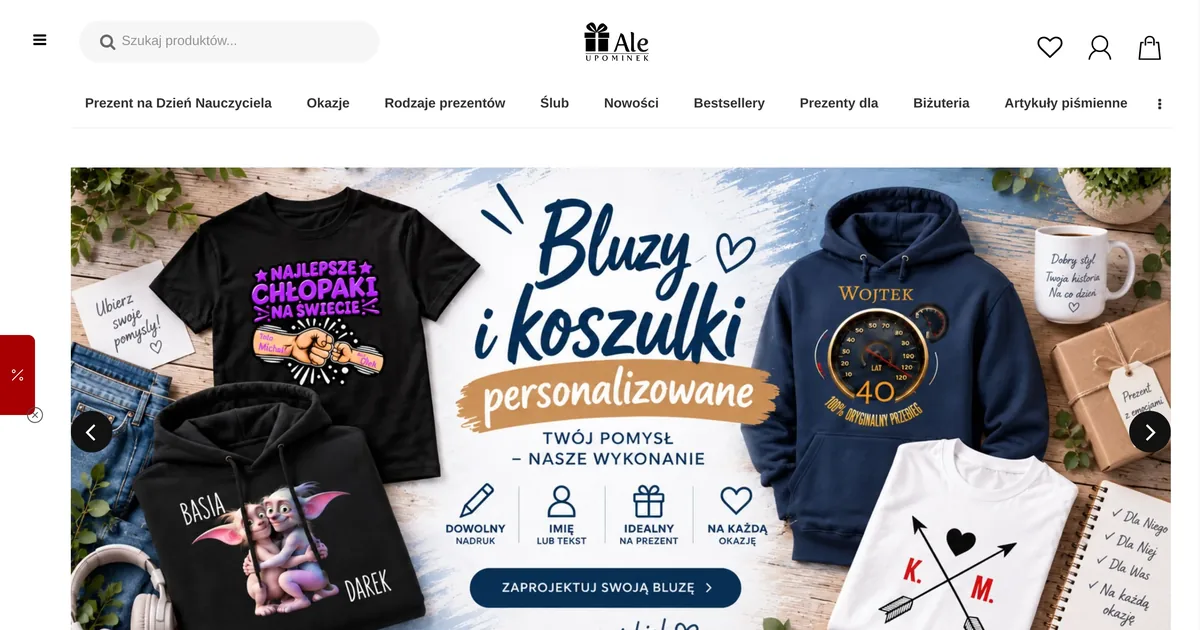
Ale Upominek is a personalised gift store in Poland. It is a live store using web-to-print components delivered by Netbase JSC, checked 2026-10-14. The store runs on IdoSell (recognised from the page code), in Polish. Netbase JSC's records hold a project record opened in 2022-01 with no individual tasks recorded.
Learn More
Copulous Media is an online print store in Ireland selling business, party, promotional and signage print, with a browser-based online designer. Netbase JSC's project records hold a custom web-to-print engagement from July to October 2024 covering checkout, storefront navigation, performance and server-runtime work. Netbase JSC checked the live store on 2026-10-10.
Learn More
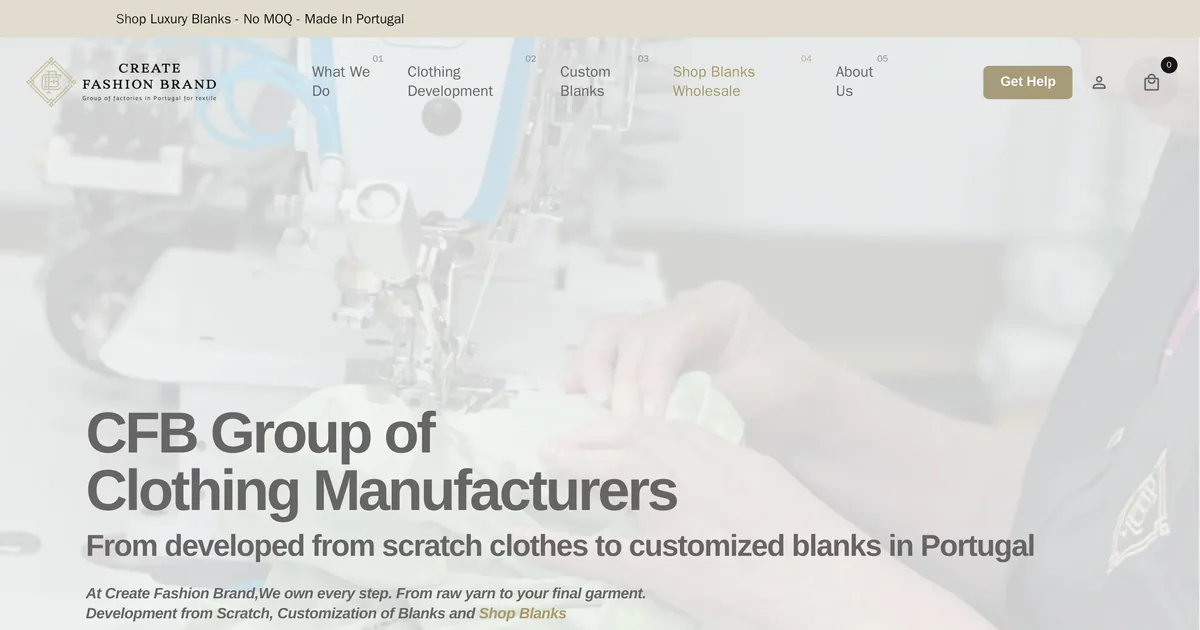
Create Fashion Brand is a clothing manufacturer's customisable blanks store in Portugal. It is a live store using web-to-print components delivered by Netbase JSC, checked 2026-10-14. The store runs on WooCommerce, in English. Netbase JSC's project index has no row for it, so this page rests on the client wall and the public store.
Learn More
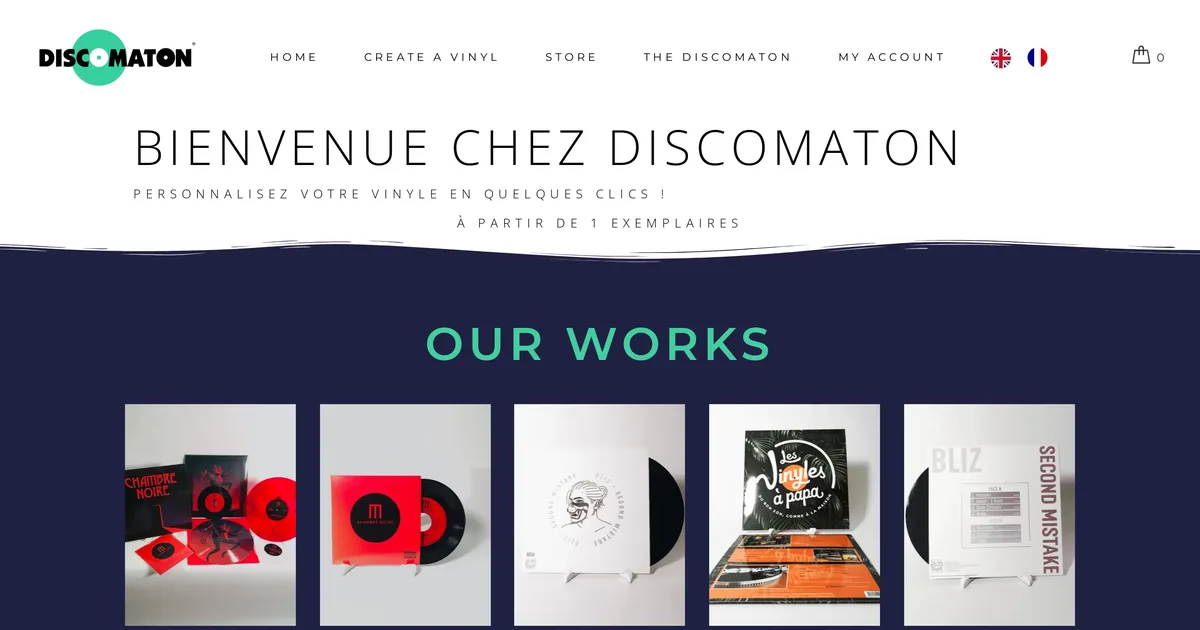
Discomaton is a personalised vinyl record store in France. It is a live store using web-to-print components delivered by Netbase JSC, checked 2026-10-14. The store runs on WooCommerce, in French and English. Netbase JSC's records hold a project record opened in 2022-01 with 5 recorded tasks and 1 milestone.
Learn More
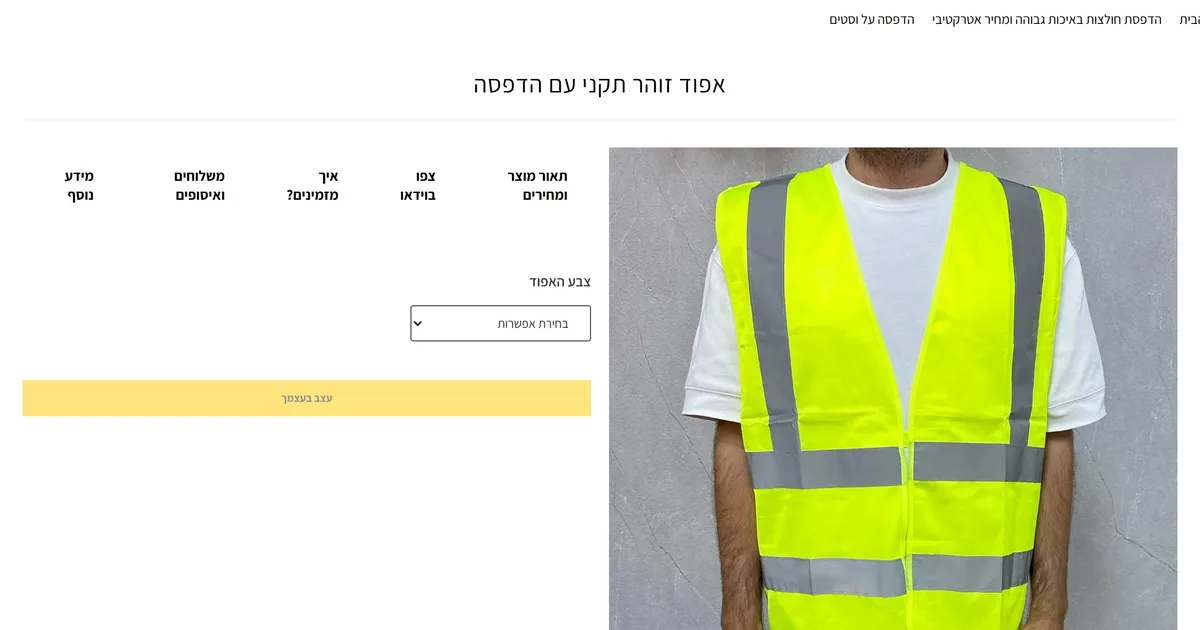
Migvan is an Israeli garment printer whose Hebrew, right-to-left store sells T-shirts, team kits and bulk DTF orders, with an online designer customers use instead of sending artwork. Netbase JSC's records hold a custom engagement from August 2021 to August 2025, with seventeen milestones across eight designer releases. The store was live on 2026-10-03.
Learn More
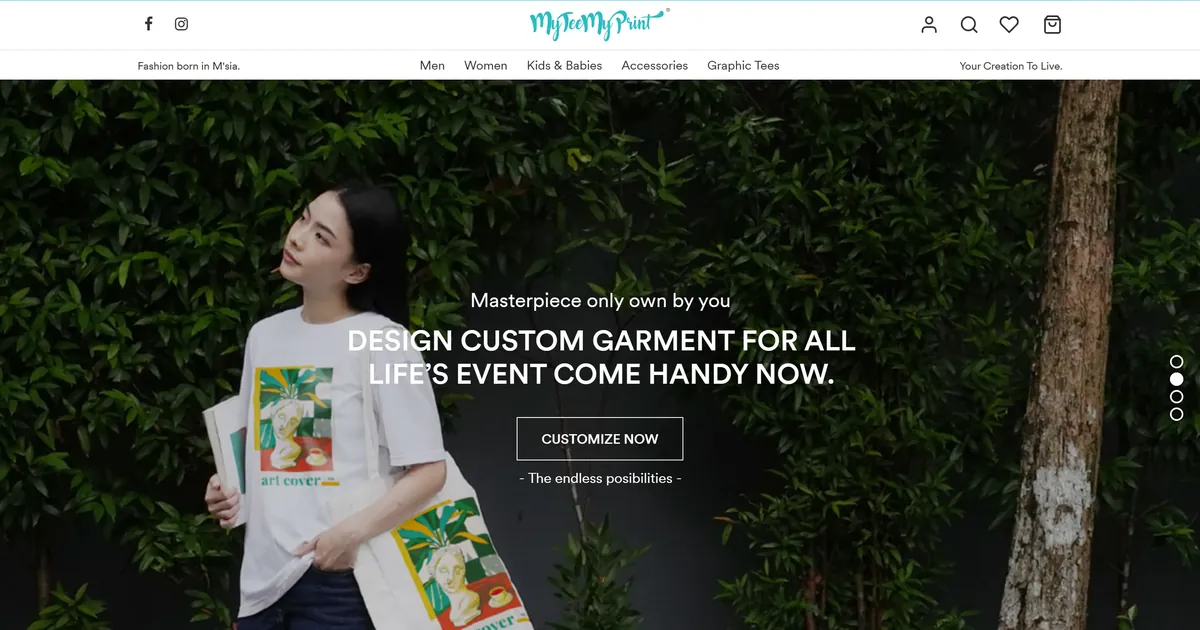
MyTeeMyPrint is a Kuala Lumpur apparel printer whose WooCommerce store sells its own tees, polos, hoodies and bags with an online customise step. Netbase JSC delivered a custom web-to-print project for the store's apparel, running from 2021 to 2026, and the store offers seven decoration methods. The store was live on 2026-09-30.
Learn More
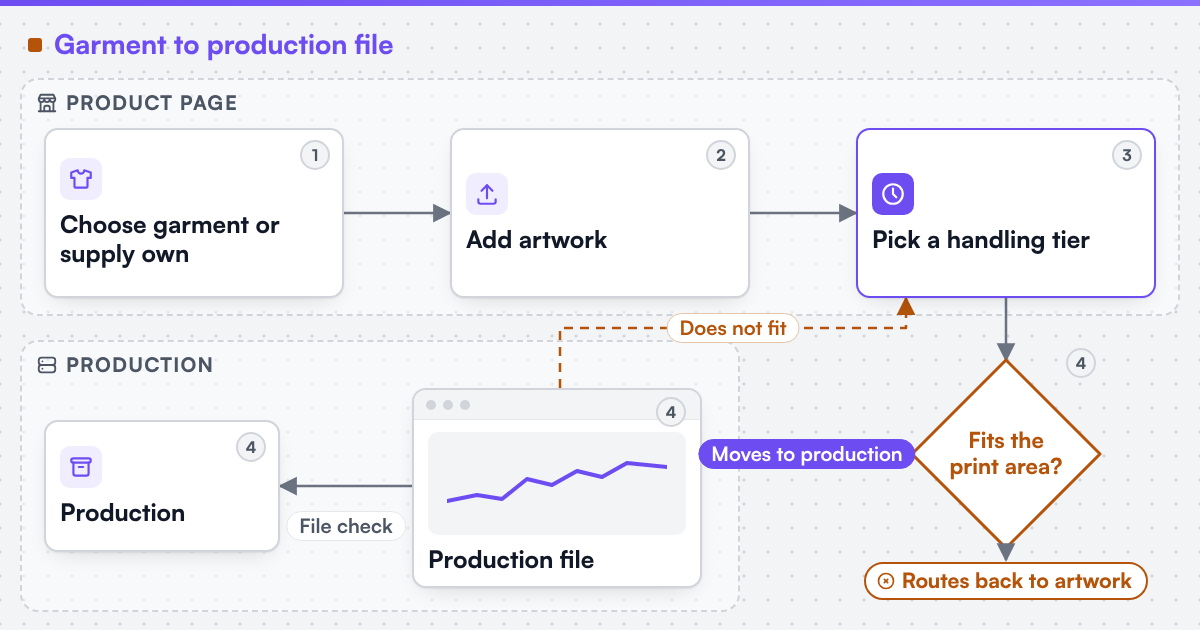
T Shirts Australia is a Brisbane apparel printer whose WooCommerce store sells custom and blank T-shirts, graphic tees and hats with an online designer, two print methods and same-day, express and standard handling. Netbase JSC's records hold a custom engagement from August 2023 to November 2025, and the store was live on 2026-10-10.
Learn More
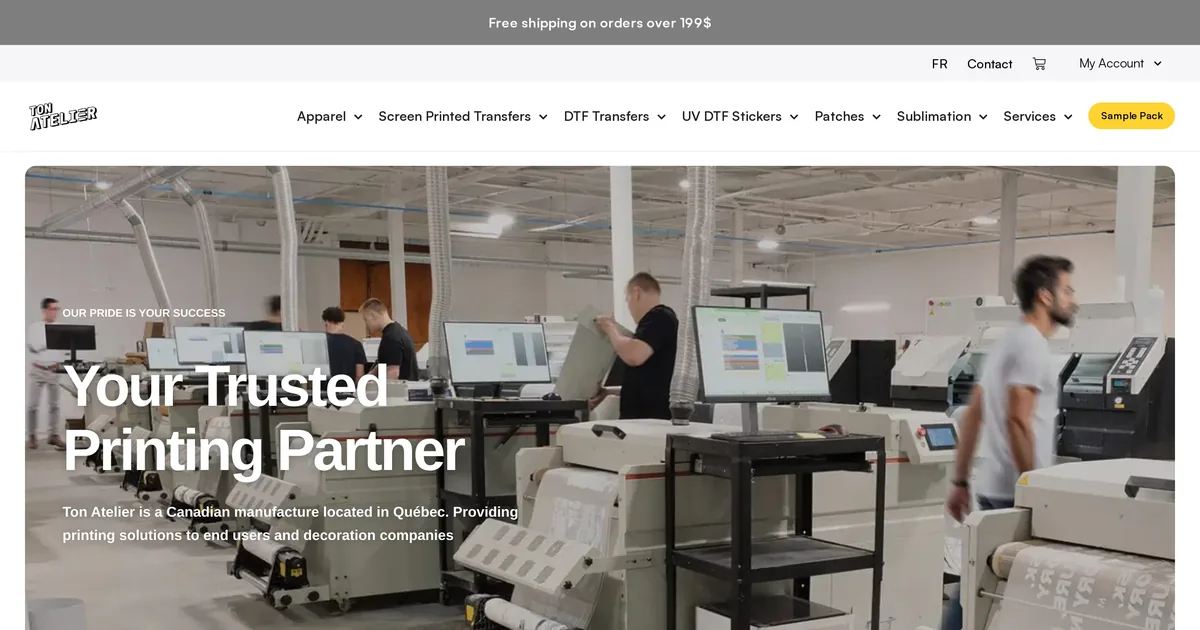
Ton Atelier is a heat transfer and custom apparel store in Canada. It is a live store using web-to-print components delivered by Netbase JSC, checked 2026-10-14. The store runs on WooCommerce, in English, with a French version. Netbase JSC's records hold a project record opened in 2021-12 with 2 recorded tasks.
Learn More
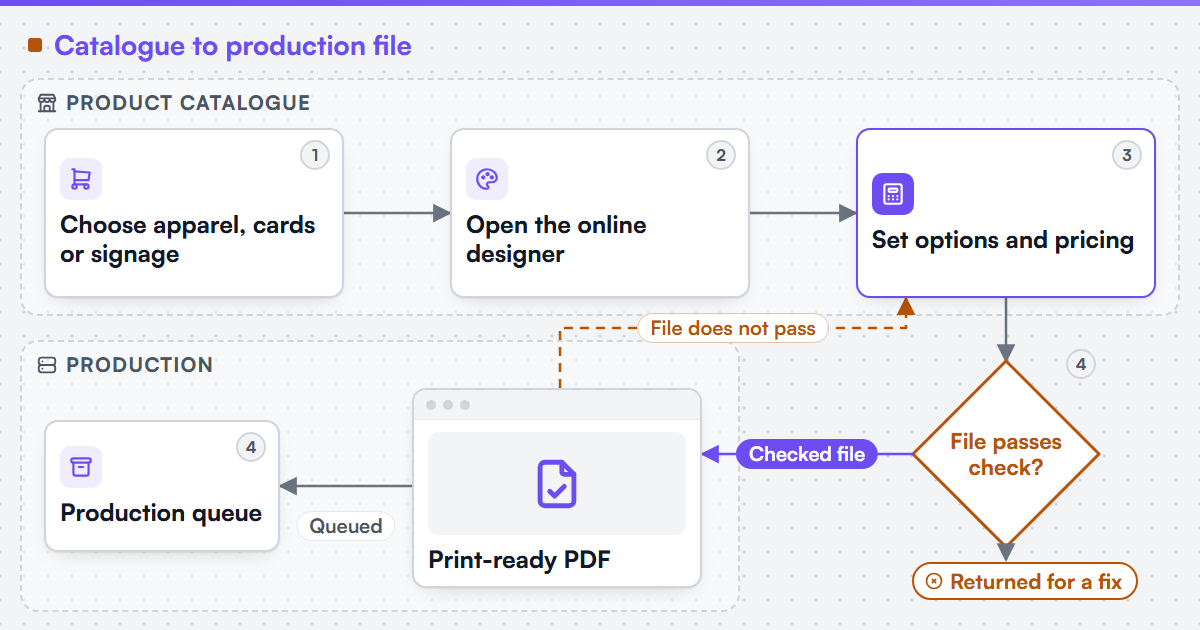
We Print All is a South African store selling apparel, business cards and signage from one catalogue. Netbase JSC's records hold a custom web-to-print engagement from October 2023 to June 2026, covering an online designer, pricing and PDF output. On 2026-10-07 the store returned a server error, so this record carries no live link today.
Learn More
References (4)
- W3C, Scalable Vector Graphics (SVG) 2, accessed 2026-10-03.
- Ghent Workgroup, PDF/X workflow, accessed 2026-10-03.
- International Color Consortium, ICC profiles, accessed 2026-10-03.
- PPAI (Promotional Products Association International), industry research on the promotional products market, accessed 2026-10-03.