What are you looking for?

Explore our services and discover how we can help you achieve your goals

Print fulfilment network integration

Print fulfilment network integration routes a web order to the producer that can make it, matched by product, region, capacity and cost, and carries an order and status contract between the two systems. Web2Print Solutions scopes the routing rules and the exception path for a rejected job, a partial shipment or an offline producer.

Request this service Ask on WhatsApp

Reviewed by CEO, Netbase JSC · Published 4 Oct 2026 · Updated 4 Oct 2026

Preview for Print fulfilment network integration
star

At a glance

Engagement type
Integration build
What you provide
One real product or workflow, plus your acceptance criteria
What you receive
Route each order to the producer that can make it, by product, region, capacity and cost, with a status contract and a named owner for every exception.
Who accepts
The system owner on each side of the integration

What you need to provide

  • One real product or workflow to scope against
  • What correct looks like for it
  • Any system that must stay in place
  • Who in your organisation confirms the result

Ready to scope this service?

What does a fulfilment network route, and why isn't one producer enough?

A print business rarely makes everything itself. Apparel goes to a decorator, wide-format to a different press, a reorder to whichever site has capacity this week. A fulfilment network integration is the layer that decides, for each paid order, which producer makes it, and then carries that order to the producer and its status back to the buyer. Most projects in this space are scoped as if the hard part were emitting one job to one producer. It isn't: the hard part is the day two producers could take the job, the day none can, and the day the one that accepted it goes quiet.

Web2Print Solutions can build order routing and artwork hand-off to print-on-demand providers and fulfilment networks, with per-producer specifications and exception handling. No producer or network is named here as a partner, and the effort to connect a specific one is unknowable before its interface is inspected: some expose a modern order API, others take a file drop and a spreadsheet, and the honest estimate comes after that inspection, not before. Buyers who want vendor routing as a packaged subscription feature rather than custom engineering can review the multi vendor print marketplace edition of W2P Solution.

Key takeaways

  • Routing assigns an order to a producer by product, region, capacity and cost, as a written rules table, not logic buried in code.
  • The order and status contract is the same shape regardless of which producer is behind it, so the buyer-facing status never depends on which producer took the job.
  • A rejected job, a partial shipment and an offline producer are three different exception states, each with a named owner and a next action.
  • File hand-off follows the format and delivery method each producer's own interface accepts; nothing is assumed until that interface is inspected.
  • This service is distinct from integrating one production system of record and from the storefront architecture that sits in front of it.

Who is this for, and when does another service fit better?

Good fit

  • Orders that can be made by more than one producer, chosen by region, product or current capacity
  • A print-on-demand or dropship model where producers change or get added over time
  • A business that needs one buyer-facing status regardless of which producer fulfils the order

Another route fits better

What is the order and status contract?

Every producer receives the same shape of order: product and option codes, quantity, ship-to region, artwork references and a ship-by date. What a producer sends back is reduced to a small set of buyer-facing states: accepted, in production, shipped, exception. A producer's own vocabulary, whether that is a webhook, an email, or a status field in a portal, maps onto that small set so the buyer sees one consistent story no matter which producer is behind an order. The same discipline carries the file hand-off: artwork and a print-ready specification travel in the format and delivery method the receiving producer's own interface accepts, whether that is an API upload, a hot folder or JDF as defined by CIP4.

How does an order reach the right producer?

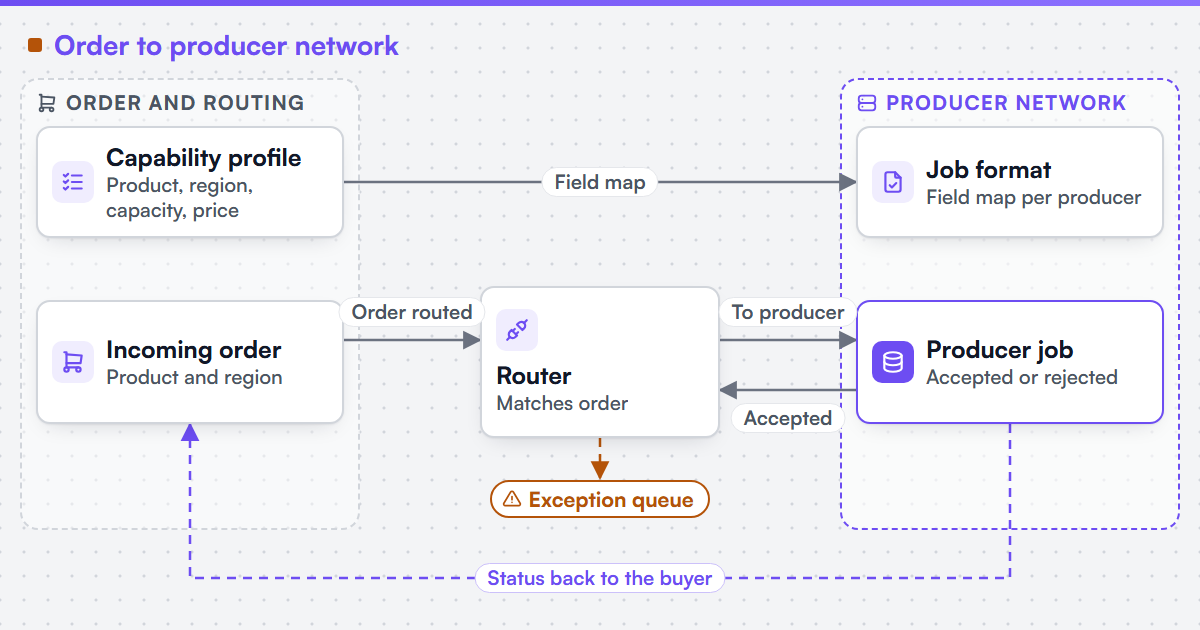
Two systems meet at this boundary: the order and routing side that this service owns, and the producer network, each producer with its own capacity, product range and interface. A capability profile, built from each producer's product list, regions served, capacity and price, sits beside the field map that turns an order into that producer's own job format. A router reads an incoming order and matches it against the capability profile to pick a producer, sends the routing request, and receives an accept or reject in return. An order the router cannot place, because no producer matches or because the chosen producer rejects it, goes to a named exception queue instead of a guess. Once a producer accepts the job, a status loop carries its updates back to the buyer on the same cadence the rest of the order experience uses.

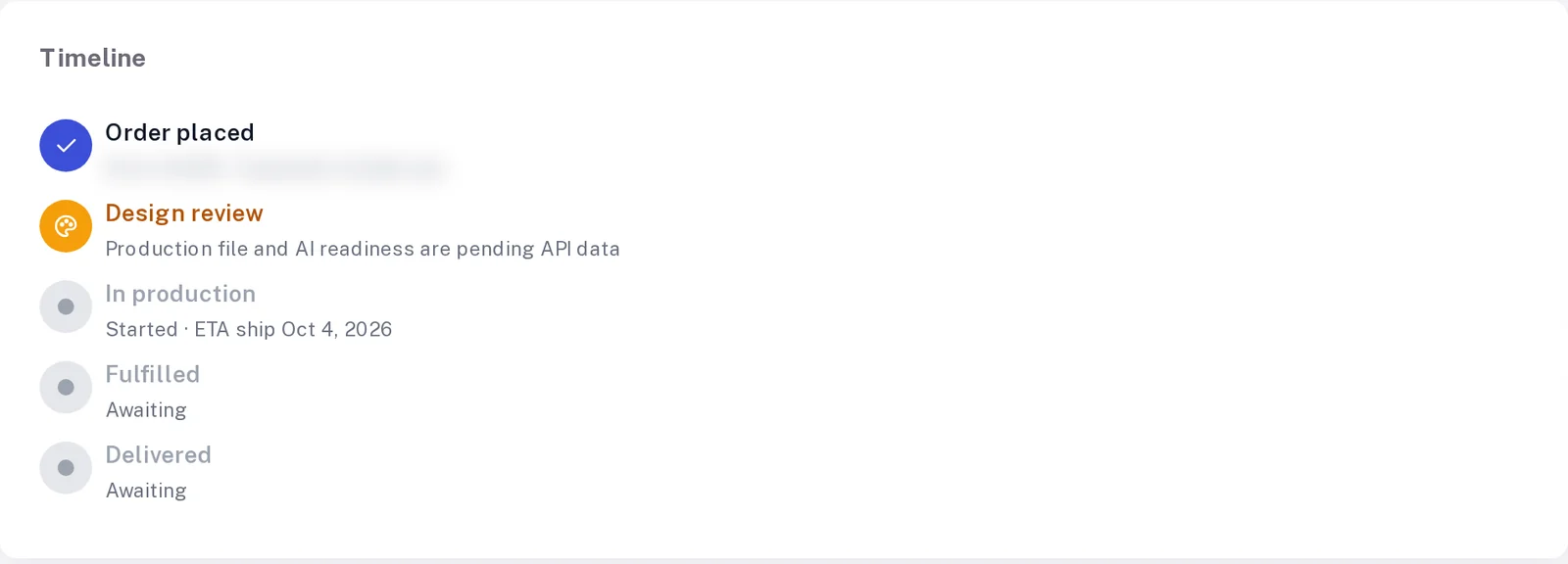
Status steps like these are the buyer-visible result of routing an order to a producer.

Order timeline listing order placed, design review, in production, fulfilled and delivered steps

What happens when a job cannot go through as planned?

A worked example makes the routing rules concrete. Take a 500-unit run of printed tote bags for a regional retailer: the rule set checks product (tote bags, two colours), region (the retailer's distribution centre), capacity (the apparel decorator's current queue) and cost (the decorator's rate card against a cost ceiling). If the preferred decorator is at capacity, the rule set tries the next producer in the same region before falling back to a named owner.

What happens when a job cannot go through as planned?
Failure mode What the contract does Who sees it next
Rejected job The producer's reject reason is captured and the order returns to routing with that producer excluded A named router owner, who reassigns or escalates
Partial shipment Each shipped unit is tracked against the ordered quantity; the buyer-facing status reflects the partial state honestly The buyer, with an accurate status, and the order owner for the remainder
Producer offline A health check or a missed status update marks the producer unavailable for new routing until it clears The router owner, who reassigns pending orders manually or by rule
No producer matches The order halts before any hand-off, rather than going to a producer that cannot make it A named planner, who resolves the gap in the capability profile

What is included, and what is not?

Included

  • Routing rules by product, region, capacity and cost
  • Order and status contract across every connected producer
  • File hand-off in each producer's accepted format
  • Exception queue for rejected, partial and offline cases

Not included

  • Negotiating rates or contracts with any producer
  • Owning or operating a production facility
  • Replacing a producer's own production scheduling
  • A promised response time from any third-party producer

How does the work run?

  1. Inspect

    Each candidate producer's interface, product range and status model is inspected before effort is sized

    Evidence you receive
    A capability profile per producer and a written routing rule set
  2. Build

    The router, the order and status contract, and the exception queue are built against the rule set

    Evidence you receive
    Routing passing a test set of orders on a test environment
  3. Accept and hand over

    Real orders are traced from routing decision to producer acceptance to buyer status, including planned failures

    Evidence you receive
    Acceptance record, runbook and the rule-change procedure

The default engagement is fixed-scope with written acceptance criteria and priced change control. Managed operations is a separate, opt-in agreement.

What proof sits behind this service?

Web2Print Solutions is the web-to-print engineering service of Netbase JSC. Delivery records cited on this site belong to Netbase JSC; where no delivered example of a capability is published, the page says so rather than implying a record. No fulfilment-network routing delivered under the Web2Print Solutions name is published yet. Stores built by the group that are live today are listed on the live web-to-print stores evidence page; those are group records, not a published routing delivery under this name.

Who delivers this service?

The Hanoi team of Netbase JSC scopes, builds and hands over this service. The figures below are records of the wider Netbase group.

Company profile

Netbase JSC

Operator
Netbase JSC, Hanoi, Vietnam
Founded
Registered and operating since July 2012

Netbase group figures

  • 4,600+ web-to-print and e-commerce projects delivered since 2012
  • 500+ clients served since 2012
  • 80+ countries with delivered client projects
  • 2,000+ stores run on the group hosted web-to-print platform
Read the Netbase JSC company profile
How we develop your project

Five stages, each with a written check

  1. Brief. You name one real product or order and the manual step to fix.
  2. Discovery. Architecture, rules and integrations written so any supplier could execute them.
  3. Build. Fixed scope with written acceptance criteria and priced change control.
  4. Launch. Ships only after the written acceptance test passes on representative orders.
  5. Operate. An optional, separately agreed scope, assessed before it starts.
How we run a web-to-print engagement
The team

People who run your project

  • Portrait of Nguyen Quang Huy, CEO Nguyen Quang Huy CEO Leads Netbase JSC and its web-to-print engineering team.
  • Portrait of Vo Tuan Vu, Platform Developer Vo Tuan Vu Platform Developer Builds and runs the platform layer behind client stores.
  • Portrait of Nguyen Ngoc Huy, Fullstack Developer Nguyen Ngoc Huy Fullstack Developer Works across storefront and back end, from designer to order handoff.
  • Portrait of Vu Duy The, Fullstack Developer Vu Duy The Fullstack Developer Builds storefront features and the integrations behind them.
See web-to-print client projects
Real numbers, real clients

Trusted by print businesses in 80+ countries

What the Netbase group has delivered since 2012, and what clients say about working with the team.

  • 6,300+ client projects since 2012
  • 4,600+ projects delivered since 2012
  • 1,800+ live stores online, Sep 2026
  • 80+ countries clients worldwide
  • 500+ custom web-to-print projects project records
  • 120+ engagements running 5+ years ongoing support

Netbase group figures · since 2012 · operated by Netbase JSC · as of September 2026 · source: company project records

Rated by clients of Netbase JSC on third-party sites (as of September 2026)

  • Trustpilot 4.2 / 5 404 reviews
  • Facebook 96% recommend 778 reviews
  • 4OVER4 logo, United States
  • Botak Sign logo, Singapore
  • BannerKoenig logo, Germany
  • Printomatic logo, Canada
  • BoxProtec logo, France
  • Reprotel logo, Spain
  • LynxDigiPrint logo, Netherlands
  • Migvan logo, Israel
  • INKRE logo, Mexico
  • NekedStore logo, Hungary
  • We Print All logo, South Africa
  • ★★★★★
    “The technical support has been amazing, … always are ready to solve any problem, despite time zone, my company are Located in USA (11 hrs difference) and they response pretty fast. Thanks Guys”

    Mario Galindo · Fast2press LLC, United States · Marketplace review

  • “We've been using … over the last few years and had nothing but rave reviews from customers who use it. We've also received excellent and timely support from the team at Netbase. Thanks guys”

    Sam Coldwell · United Kingdom · Trustpilot review

  • ★★★★★
    “I would like to thank … for his speedy reply and assistance in installation. Great service provided!”

    Botak Sign · Singapore · Marketplace review

Quoted word for word from client reviews; “…” marks a removed product or person name.

Scope this work with a project brief

Send a project brief listing the producers you already use or are evaluating, what each one's interface actually offers (API, file drop, portal, email), the rule you use today to choose between them, and the last few orders that needed a person to intervene, with the reason. That is enough to draft a capability profile and say which exceptions matter first. If the open question is which production system stays the system of record, read print MIS and ERP integration first; if it is how the storefront itself is built, read headless and custom print storefronts.

  1. Tell us the product or workflow you want to change.
  2. A senior engineer reads your request and replies in writing.
  3. You get a scoped next step: a discovery, a fixed-scope build or a plain "not a fit".

Frequently asked questions

No. Print MIS and ERP integration keeps one production system as the system of record. This service decides which external producer an order goes to and carries its status back; the two can sit side by side.

Yes. The routing rules read from the capability profile, so adding a producer, retiring one, or changing a region or capacity limit is a change to that profile and a tested release, not a rewrite.

It is held in the exception queue rather than sent to a producer that cannot currently confirm capacity. The router owner reassigns it once another producer matches or the original one clears.

No. A producer's own service levels are its own; this service represents the status it reports honestly and escalates when it does not report at all.

Yes. Web2Print Solutions delivers remote-first from Hanoi, Vietnam, and Netbase JSC has delivered web-to-print projects for clients in 80+ countries.

Send a project brief at /project-brief, email project@netbasejsc.com or message us on WhatsApp at +84 937 869 689. A senior engineer reads every brief and replies in writing.

Have a web-to-print project in mind?

Tell us about one product you want to sell online. A senior engineer reads every brief and replies in writing.

Tell us what you need to build, migrate or connect.

Start a project brief