

Web-to-print for print software vendors
Print-adjacent software vendors embed a design editor or print capability inside their own product rather than running a storefront. Web-to-print engineering for this segment means a stable, versioned API or SDK, tenant-level data isolation, branding with no visible platform trace, and print-ready output that holds regardless of which customer's workflow created the design.
Start a project brief See client projectsReviewed by CEO, Netbase JSC · Published 3 Oct 2026 · Updated 3 Oct 2026

What does a print-adjacent software vendor actually need?
A print-adjacent software vendor is not a printer, and does not want to look like one. It is a SaaS platform, marketplace or agency tool that needs a "design and order print" feature inside its own product, under its own brand, for its own customers. Think of a page builder adding a merchandise store, a franchise management tool adding branded signage reorders, or a marketing platform adding a print-on-demand mailer. The buyer here is an engineering or product team, not a print buyer, and the thing they are evaluating is an interface, not a storefront.
That changes the shape of the problem. A commercial printer's build serves its own customers through one front end it controls end to end. A software vendor's build works inside somebody else's product, under somebody else's session and branding, and has to keep working when that somebody else ships its own next release. We describe our services against named print segments, and this one sits apart from the others because the buyer's product is the surface, not the print catalogue.

Key takeaways
- A print-adjacent software vendor buys an interface, not a storefront: an editor or print API living inside its own product and brand.
- The three routes, embed an editor, call a print API, or white-label a full platform, trade control for ownership in a different order.
- A breaking API or SDK change fails every tenant's customers mid-session at once, not one order at a time.
- Tenant data isolation is the vendor's own liability surface first; the platform work only makes isolation testable.
- Output must be identical no matter which embedding host produced the design, or support inherits every discrepancy.
Which route fits a print-adjacent software vendor?
Three structurally different routes answer "how much print engineering do we build versus buy," and the right one depends on how much of the UI and the data the vendor needs to keep as its own.
| Route | What it is | Who owns the UI | What the vendor still owns |
|---|---|---|---|
| Embed a design editor | A design surface runs inside the product, usually an iframe or mounted component | The vendor's own screen | Session handling, the embed boundary, reconciling saved designs with the vendor's own records |
| Call a print API | The vendor keeps its own editor and calls out only for pricing, file generation or routing | The vendor, fully | The entire front-end experience and artwork validation before the call |
| White-label a full platform | Customers use a complete storefront carrying the vendor's brand throughout | The platform, themed | Less day-to-day engineering, more dependence on the platform's own roadmap |
A vendor usually starts at embed or API, where the UI stays its own, and only moves toward a white-label platform once print is most of what customers pay for. A vendor building the API route with no packaged front end is closer to a headless print build, with the same event-contract requirements.
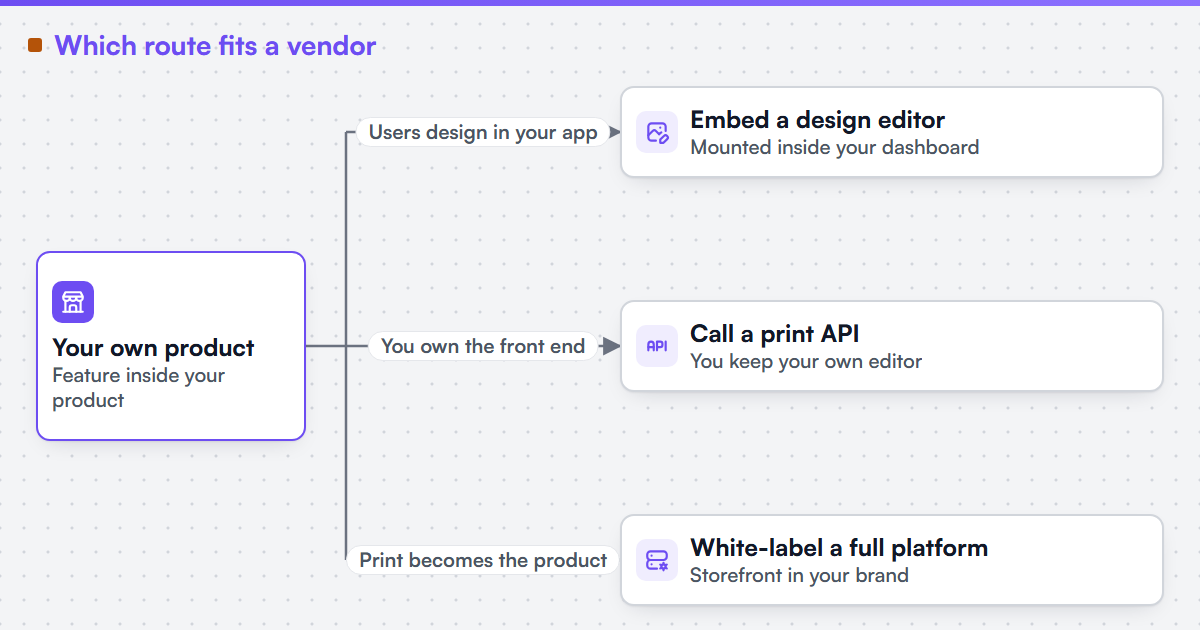 (opens the full-size diagram in a new tab)
Which questions decide the route before you build?
- Does print need to look like it was built by us, or is a visibly third-party step acceptable?
- How many customers would a breaking API or editor change affect at once, and who finds out first?
- Do we already operate multi-tenant data boundaries, or would this be the first feature that needs one?
- Is print a feature of our product, or is it becoming the product?
- Who on our side owns the API or SDK version our customers are running, six months after launch?
What does a worked example look like?
A scheduling and invoicing platform for small trades businesses lets its customers order branded van signage and workwear without leaving the app. It embeds a design editor as a mounted component inside its own dashboard, passing the logged-in business's logo and brand colour as a starting state rather than making the user upload them again.
The editor saves a design and returns an identifier to the host, not a finished image; the host stores that identifier against the business's account. On order, the host calls a print API with the design identifier, product and quantity; the API returns a price and, on payment, emits a job the vendor never touches directly. Two things make this safe at scale: every call carries the host's own tenant identifier, so one business's saved designs are never visible to another, and the print-ready output is generated to the same file specification regardless of which of the host's own white-label skins the design came through.
Who is this not for?
A vendor whose customers already buy print separately, and who only wants a referral link or a catalogue page, does not need an embedded editor or an API; a straightforward content partnership serves that case without any engineering. Embedding pays off once a vendor's own customers expect to design and order without leaving the host product.
What breaks when the integration is treated as an afterthought?
-
API or SDK versioned without a deprecation window
Every tenant mid-session loses saved work at once, not one customer at a time
-
Tenant isolation assumed, not tested
One tenant's saved designs or order history becomes visible to another tenant's account
-
Output fidelity drifts by embedding host
The same design prints differently depending on which skin generated it, and support cannot explain why
-
Fulfilment routing opaque to the vendor
An order fails at a producer the vendor has never heard of, with nothing to tell the customer
What evidence exists for software vendor integrations?
We can design and build multi-tenant, white-label and reseller print platforms with tested data isolation and a documented tenancy trade-off analysis. Netbase JSC, which operates Web2Print Solutions, has delivered 50+ web-to-print platforms. Delivery records cited on this site belong to Netbase JSC; where no delivered example is published, the page says so rather than implying a record. No print-adjacent software vendor integration is published as a case on this site; the live web-to-print store examples are client-operated storefronts, not embedded vendor integrations.
How does an engagement start?
An engagement starts with your own API surface, not the editor's look. The most useful inputs are the UI or API boundary print should sit behind, whether you already operate tenant-level isolation elsewhere, your expected call volume and growth rate, and who owns API version compatibility after launch. Those inputs show whether the first release is an embedded editor, a print API, or the comparison in design editor SDK versus a hosted customizer. Send them with a project brief, leaving out customer account details you do not want to share at this stage.
Frequently asked questions
No. The print-specific rules, price, output and routing, live behind the API or editor; your team owns the surface your customers see and the data boundary around it.
Yes. That is the print API route: your UI stays yours, and the call handles pricing, file generation or routing without a visible design surface changing.
Through a tested tenant boundary: a written isolation test exercises whether one tenant's account can read or affect another's data, rather than assuming the schema prevents it.
References (4)
- IETF, RFC 6749, The OAuth 2.0 Authorization Framework, accessed 2026-10-03.
- OpenAPI Initiative, OpenAPI Specification, accessed 2026-10-03.
- Ghent Workgroup, PDF/X workflow, accessed 2026-10-03.
- W3C, Scalable Vector Graphics (SVG) 2, accessed 2026-10-03.