Web-to-print for Dutch print businesses
Web2Print Solutions has no Dutch office, staff or entity; every engagement for a Dutch print business is delivered remotely from Hanoi, Vietnam by Netbase JSC. For Dutch buyers this means configuring a storefront's BTW invoices, iDEAL payment at checkout, PostNL or courier dispatch and AVG-compliant data handling, not adding a Dutch team.
Start a project brief Explore servicesReviewed by CEO, Netbase JSC · Published 1 Oct 2026 · Updated 1 Oct 2026

What is web-to-print for Dutch print businesses?
Netbase JSC, which operates Web2Print Solutions, configures web-to-print storefronts for print businesses selling into the Netherlands. All engineering and delivery for Web2Print Solutions is performed remote-first from Hanoi, Vietnam. Web2Print Solutions has no office, legal entity, employee base, representative or local support window in any other location. A Dutch engagement configures a storefront's tax invoices, currencies, units, address formats, carriers and payment methods for that market, delivered remotely from Hanoi.
For a Dutch buyer, "market-correct" means a BTW-correct price and invoice, iDEAL sitting alongside cards at checkout, a Dutch postcode-and-house-number address format, and a carrier the buyer already recognises. This page is one of the markets Web2Print Solutions configures for; none of it requires Dutch-based staff.
Key takeaways
- A Dutch storefront needs a BTW-inclusive consumer price and invoice, or a net EU reverse-charge invoice for a registered business buyer in another EU state.
- iDEAL, the Dutch bank-transfer payment method, has to sit at the top of a Dutch checkout; a card-only checkout reads as built for a different market.
- Dutch addresses pair a four-digit-plus-two-letter postcode with a house number and a common house-number addition, which a generic address form often drops.
- Belgium is a neighbouring market with its own payment habit, Bancontact, and is noted here only as context, not as part of the Dutch build.
- Every engagement is delivered remotely from Hanoi, Vietnam; nobody on the account is Dutch-based, and no local support window is offered.
How does an order move from checkout to delivery in the Netherlands?
The buyer configures a product and sees a BTW-inclusive price. At checkout, iDEAL is offered alongside card payment, and the storefront issues a BTW invoice carrying the seller's BTW number, the rate applied and the BTW amount. The order becomes a production job as in any other market. Once produced, it is handed to a carrier with a Dutch address in the format Dutch delivery networks expect, house-number addition included.
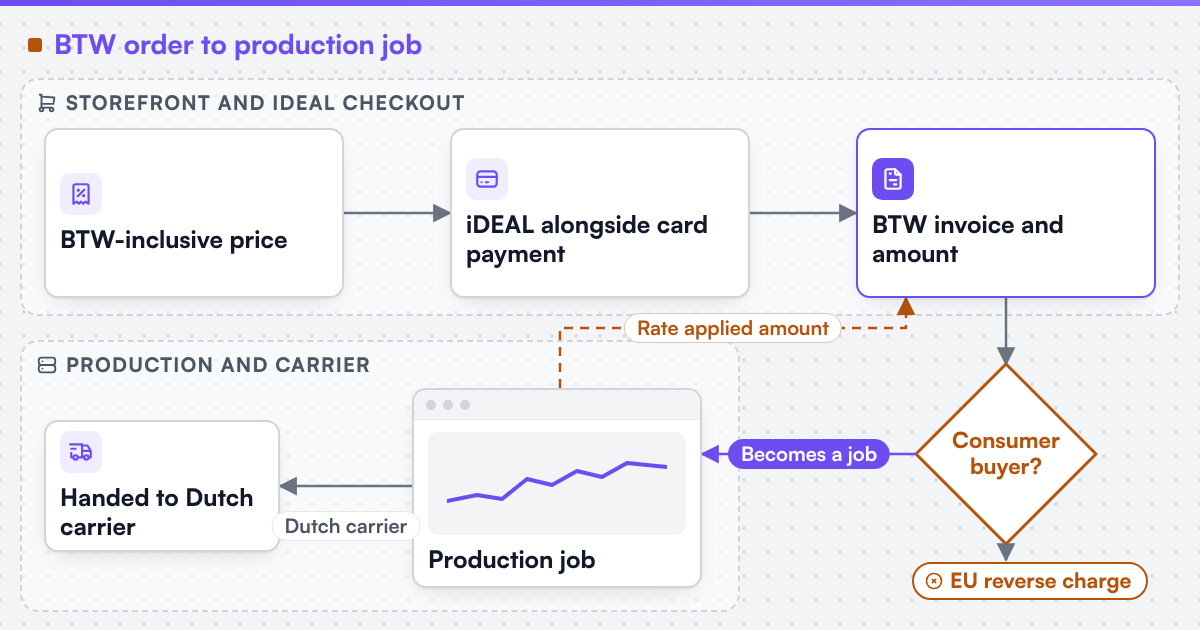 (opens the full-size diagram in a new tab)
What BTW and invoicing rules does a Dutch storefront need to apply?
-
Standard BTW rate
Applied to most printed products and finishing add-ons for Dutch consumers
-
Reduced rate
Certain product and service categories qualify for a reduced rate; the current boundary is set by the Belastingdienst, not the storefront
-
EU reverse charge
A VAT-registered buyer in another EU state is usually invoiced net, with the reverse charge stated on the invoice
-
BTW invoice
Must show the seller's BTW number, the rate applied and the BTW amount, in addition to the order detail
A storefront that only shows a card-payment button at checkout is missing the payment method most Dutch consumers reach for first. iDEAL needs to be integrated as a first-class method, not an afterthought bolted onto a US-shaped checkout, which is part of the broader web-to-print ecommerce integration work.
What units, paper sizes and address format does the Netherlands use?
-
Paper sizes
A-series (A4, A5, A3)
-
Stock weight
Grams per square metre (gsm)
-
Address format
Street name and house number, with a common house-number addition such as a letter or suffix; postcode as four digits and two letters
-
Payment at checkout
iDEAL offered alongside cards, with iDEAL often the default for Dutch consumer buyers
Which carriers and payment methods do Dutch buyers expect?
PostNL, DHL and DPD are the carriers a Dutch checkout and order-status page most often integrate against, by API, manifest file or a fulfilment platform. iDEAL is the payment method Dutch consumer buyers expect to see first, alongside card payment; a business account ordering on agreed terms is typically invoiced rather than charged at checkout. Belgium, as a neighbouring market, more commonly expects Bancontact instead of iDEAL, which matters only if a client's catalogue also ships there.
A parcel is sealed and labelled before a carrier collects it.

What privacy and accessibility law should a Dutch engagement respect?
A Dutch storefront that collects customer names, addresses and order history sits under the EU General Data Protection Regulation, implemented in the Netherlands as the AVG and supervised by the Autoriteit Persoonsgegevens. The EU Accessibility Act sets accessibility requirements that are being phased in for consumer-facing online shops across the EU, the Netherlands included. Both are named as context an engagement's build must respect, confirmed with the client's own counsel; neither is a certification Web2Print Solutions holds.
What does a Dutch market engagement include, and what does it not?
Included
- BTW rate logic, reverse-charge handling and BTW-invoice fields
- iDEAL integration alongside card payment at checkout
- Dutch address and postcode validation, house-number addition included
- Carrier integration for the client's chosen Dutch courier
Not included
- Filing the client's own BTW return
- Sourcing Dutch stock, print or finishing suppliers
- A Dutch office, staff, entity or local support window
- Advice that substitutes for the client's own accountant or solicitor
What proof already exists for the Dutch market?
Netbase JSC, which operates Web2Print Solutions, has delivered 50+ web-to-print platforms. Among the live web-to-print store examples, Bestelprint is a Dutch photo, canvas and wall-art storefront offering a path to design a canvas print online instead of only uploading a finished file, and MeerStickers is a Dutch stickers, labels and decals storefront with an online-design step inside a four-step order flow. Live store using web-to-print components delivered by Netbase JSC, which operates Web2Print Solutions. No Dutch BTW or iDEAL case study is published under the Web2Print Solutions name yet; where that record does not exist, this page says so.
What is the time-zone difference with a team based in Hanoi?
| Factor | Detail | Applies to |
|---|---|---|
| Hours difference from Hanoi | Five to six hours ahead of the Netherlands, depending on daylight saving | Netherlands |
| Collaboration pattern | Asynchronous work against a written change-control process; the offset is a planning fact, not a service-level commitment | Netherlands |
Send a project brief with your BTW registration status, whether iDEAL is already contracted with a payment provider, your carrier accounts, and the platform your storefront runs on.
Discuss your web-to-print project
Frequently asked questions
Most Dutch-facing builds reach iDEAL through a payment service provider that already supports it, so the storefront integrates one provider rather than the bank-transfer network directly; which provider depends on the client's existing payment contract.
Yes, with the invoice, currency and payment logic keyed to the buyer's country rather than one fixed configuration, so a Belgian buyer sees Bancontact where a Dutch buyer sees iDEAL; Belgium is not otherwise covered on this page.
No. Delivery is entirely remote from Hanoi, Vietnam. The client's own entity holds the BTW registration, the payment-provider contract and the carrier accounts; the engagement configures the storefront to use them correctly.
The rate table is built as configuration the client can update, and a scoped change request covers a rule change that needs new logic rather than a new value.
Client profiles in Netherlands
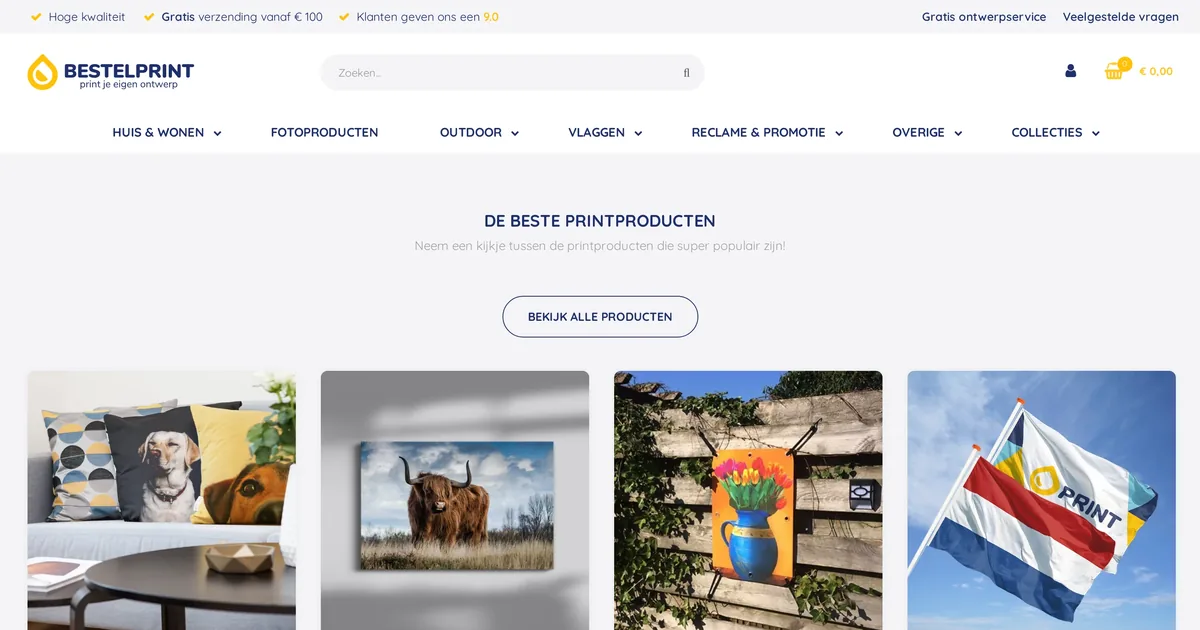
Bestelprint is a photo and wall decoration print store in Netherlands. It is a live store using web-to-print components delivered by Netbase JSC, checked 2026-10-14. The store runs on WooCommerce, in Dutch. Netbase JSC's records hold two project records opened in 2021-12 with no individual tasks recorded.
Learn More
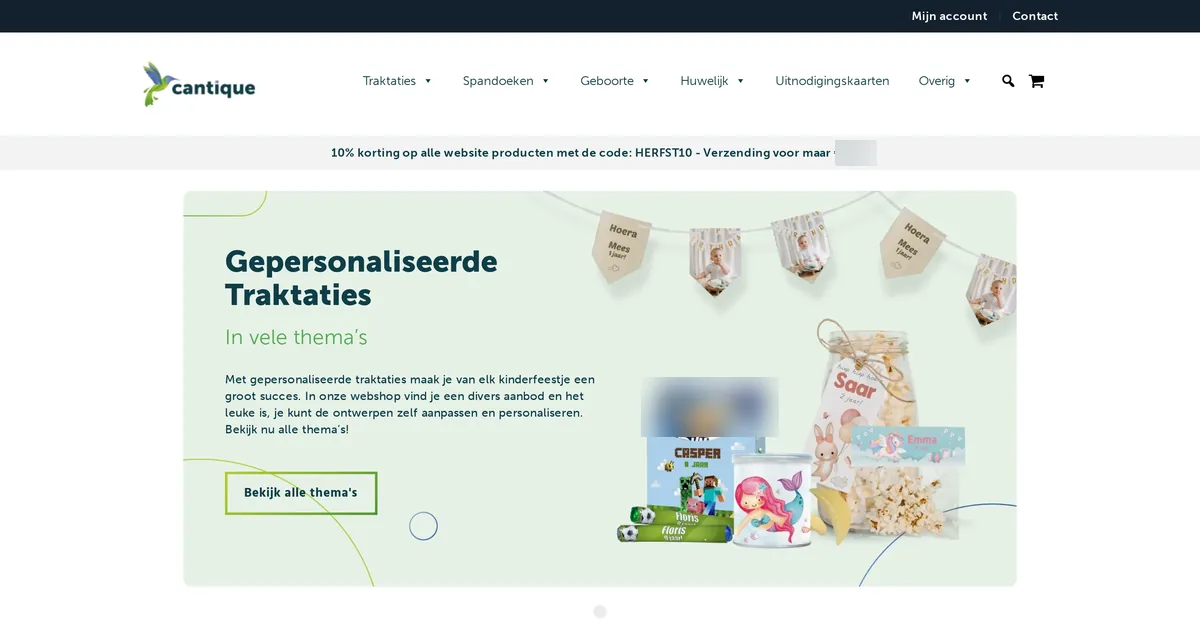
Cantique is a commercial print store in Netherlands. Netbase JSC's project records hold a custom web-to-print engagement for it from 2025-03 to 2026-01, with 12 recorded tasks and 3 milestones. The store runs on WooCommerce and is a live store, checked 2026-10-12.
Learn More
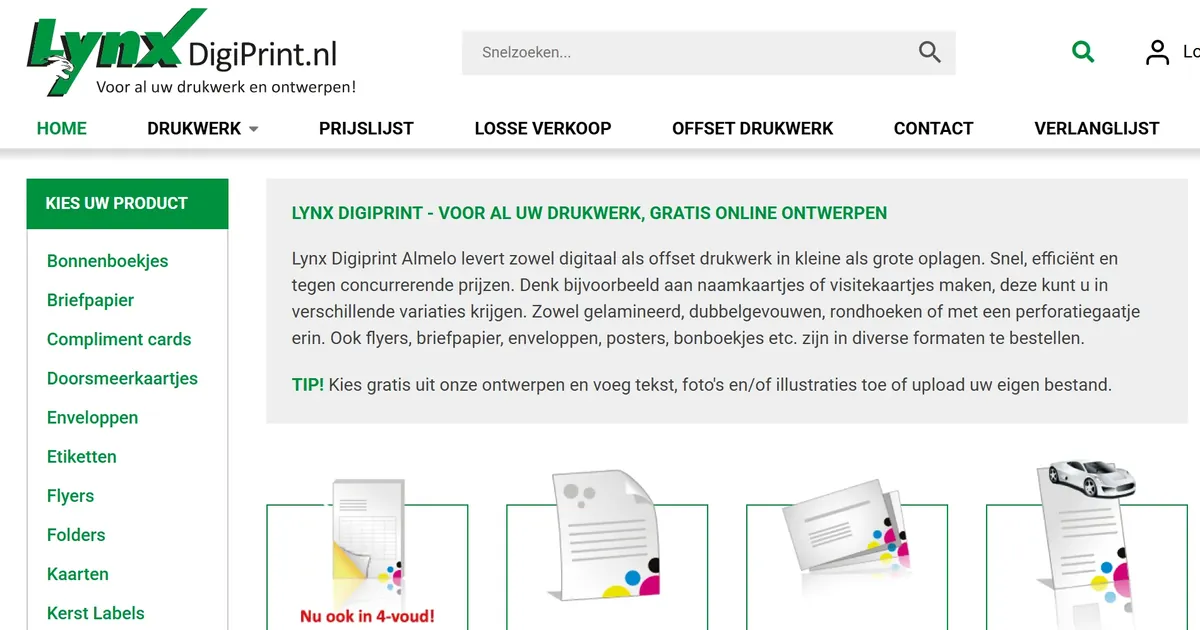
LynxDigiPrint is a print and graphic design studio in Almelo, the Netherlands, whose Dutch-language WooCommerce store sells receipt books, stationery, labels, cards, posters and flyers. Customers can design free online from templates or upload their own file, using web-to-print components delivered by Netbase JSC in a custom project. The store was live on 2026-09-30.
Learn More
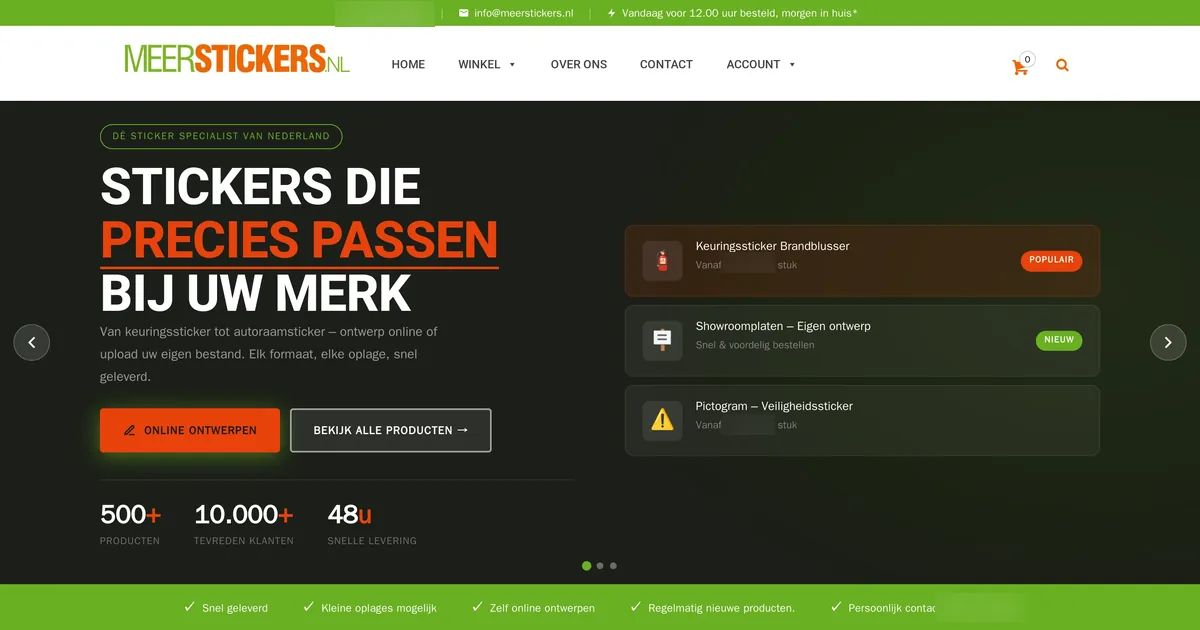
MeerStickers is a packaging labels store in Netherlands. Netbase JSC's project records hold a custom web-to-print engagement for it from 2021-12 to 2026-06, with 5 recorded tasks and 2 milestones. The store runs on WooCommerce and is a live store, checked 2026-10-12.
Learn More
References (4)
- Belastingdienst, VAT (BTW) for businesses in the Netherlands, accessed 2026-10-01.
- iDEAL, the Dutch bank-transfer payment method, accessed 2026-10-01.
- Autoriteit Persoonsgegevens, the Dutch data protection authority supervising the AVG/GDPR, accessed 2026-10-01.
- EUR-Lex, Directive (EU) 2019/882, the European Accessibility Act, accessed 2026-10-01.