AI-assisted steps in print workflows
AI-assisted print workflow features add specific, reviewed AI steps inside a web-to-print workflow, such as flagging likely artwork problems or drafting a specification from a brief. Web2Print Solutions builds these so a human reviews the result, with accuracy measured on the client's own data before acceptance. Pricing authority, artwork approval and production release stay with a person.
Start a project brief Explore servicesReviewed by CEO, Netbase JSC · Published 29 Sep 2026 · Updated 3 Oct 2026

At a glance
- Engagement type
- Build, then operate
- What you provide
- One real product or workflow, plus your acceptance criteria
- What you receive
- AI-assisted steps inside a print ordering workflow, each reviewed by a person before it affects price, artwork or production.
- Who accepts
- A named reviewer, against the client's own data
What you need to provide
- One real product or workflow to scope against
- What correct looks like for it
- Any system that must stay in place
- Who in your organisation confirms the result
Ready to scope this service?
What is an AI-assisted step in a print workflow, and what is it not?
An AI-assisted step is a specific point in a web-to-print workflow where a model produces a suggestion, a flag or a draft, and a person reviews it before it has any effect on price, artwork or production. It is not a claim that a workflow runs itself. We can build AI-assisted steps into print workflows where a human reviews the result, with accuracy measured on the client's own data before acceptance. That sentence is the boundary of the whole service: every feature on this page is built to that condition, and none is built to remove it.
Among the web-to-print engineering services, this is the one that adds judgement-assisting steps to an existing or new platform rather than owning the platform itself. It is usually commissioned alongside a new implementation or a print product configurator, because an AI-assisted step needs a workflow, a reviewer and a data set to sit inside.
Key takeaways
- An AI-assisted step produces a suggestion, a flag or a draft; a person reviews it before it affects price, artwork or production.
- The offer covers artwork quality flags, specification drafting from a brief, order and log triage, and draft product copy, each reviewed before it has an effect.
- Pricing, artwork correction and production release stay with a named person; no model sets a price or releases a job on its own.
- Accuracy is never asserted generically; each step is measured on the client's own artwork, briefs or order history before acceptance.
- A low-confidence result returns to the named reviewer as a flagged case, rather than a plausible-looking guess.
What is offered?
-
Artwork quality flags
A model checks an uploaded file against known problem patterns, such as low-resolution raster content, missing bleed, an unexpected colour mode or a font not embedded, and flags it for a person before it reaches prepress.
-
Specification drafting from a brief
A model reads an emailed or uploaded brief and drafts a structured specification, quantities, sizes, stock and finishing, for a person to check and correct against the actual order.
-
Order and log triage
A model groups related failed or flagged orders by likely cause, so a support or operations person reviews a shortlist instead of a raw queue.
-
Draft product copy
A model drafts a first pass of product descriptions or option labels from a specification, for a person to edit and approve before publication.
What is deliberately excluded?
The exclusion list is longer than the offer list on purpose. Each item below is something an AI-assisted print feature could plausibly do and that this service will not build without a named override, because it would remove the review step the whole offer depends on.
-
No autonomous pricing
A model does not set, adjust or approve a price. Pricing stays inside the print pricing engine and its own acceptance rules.
-
No autonomous artwork correction
A model flags a likely problem; it does not edit, repair or auto-correct a customer's file and pass it to production unseen.
-
No autonomous production release
A flagged or drafted item does not reach a job ticket or a press without the review step completing first.
-
No customer-facing output without review
A model's draft copy, specification or flag is never shown to the end customer as a finished answer unless a person has approved that specific use.
-
No accuracy claim without the client's own data
We do not publish a generic accuracy percentage for these features; whatever figure is agreed is measured on the client's own material before acceptance, not asserted in advance.
-
No model training on one client's data for another's benefit
Data used to check accuracy for a client's workflow stays scoped to that engagement, as set out in the contract.
-
No replacement of the reviewer's authority
The person who currently approves artwork, sets a price exception or releases a job keeps that authority; the feature narrows what they need to look at, not who decides.
Why review stays with a person
AI tools assist our own engineering work. A named human engineer reviews and remains accountable for everything we deliver, and no generated output ships unreviewed. That commitment describes how Web2Print Solutions builds these features, and it is also the design constraint the features themselves are built to enforce for the client's own team: an AI-assisted step is only accepted once it demonstrably narrows a person's work without quietly taking a decision away from them.
This matters most where a mistake is expensive to reverse. A flagged low-resolution image that a person waves through is a normal workflow event; an auto-corrected file that goes straight to a production press without anyone looking at it is a different kind of risk. The scope of each feature is set by where that line falls for the client's own process, not by what a model happens to be capable of producing.
What outcomes is the engagement accepted against?
-
Measured accuracy on real data
Each AI-assisted step is tested against the client's own artwork, briefs or order history before acceptance, with the agreed accuracy figure recorded for that data set specifically.
-
A visible review step
Every flag, draft or triage grouping the feature produces is shown to a named reviewer role before it has any downstream effect, and that review step cannot be silently bypassed.
-
A defined fallback
When the model has low confidence or the input does not match a known pattern, the feature returns that state explicitly rather than a plausible-looking guess.
How does the work run?
-
Identify the step
Name the exact workflow point, the reviewer role and the decision the step should not be allowed to make
- Evidence you receive
- A written scope for one feature, not a general "add AI" brief
-
Build against real data
Build the feature against the client's own artwork, briefs or order history
- Evidence you receive
- A working feature on a test environment, reviewed by the named role
-
Measure and accept
Run the agreed test set and record the accuracy figure the client accepts
- Evidence you receive
- An acceptance record naming the data set and the figure achieved
-
Ship with the review step intact
Release with the review step in place, monitored like any other production change
- Evidence you receive
- A release note and the reviewer's sign-off procedure
The default engagement is fixed-scope with written acceptance criteria and priced change control. Managed operations is a separate, opt-in agreement, and ongoing monitoring of an AI-assisted step in production is scoped there or as an explicit extension to this engagement, not assumed as part of the build.
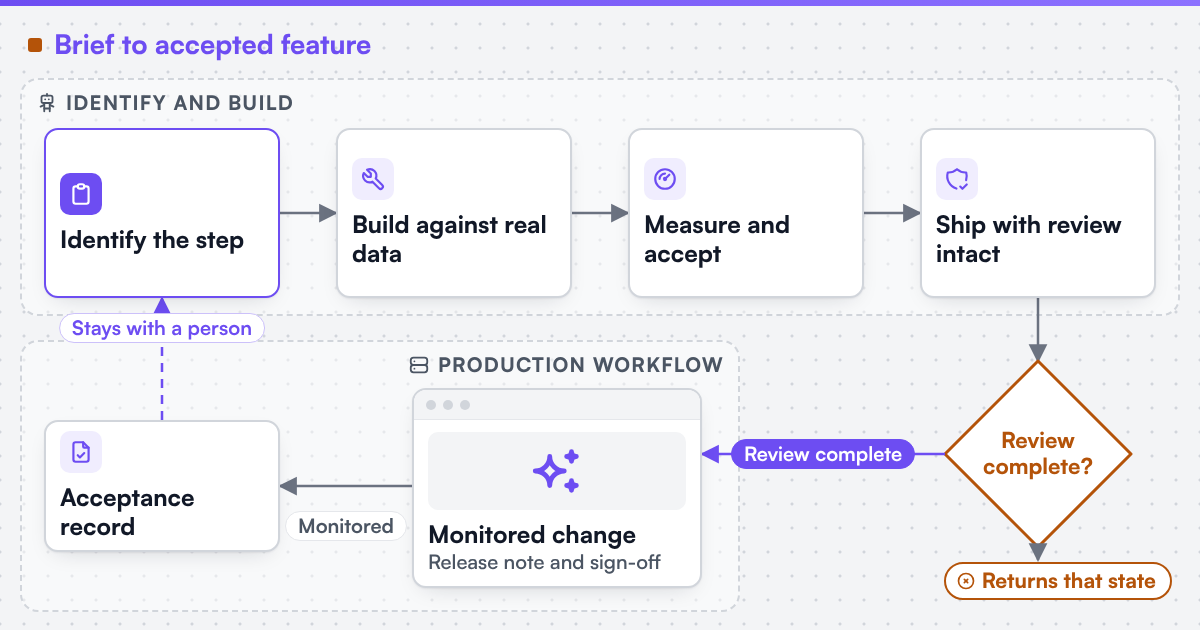 (opens the full-size diagram in a new tab)
Scope this work with a project brief
Send a project brief naming the one workflow step you want assisted, who currently reviews that step, and a sample of real briefs, artwork or order history the feature can be measured against. Web2Print Solutions has not published a delivered example of this feature under its own name; the proof offered here is the acceptance test run on your own data, not a prior case. Related work on the pricing and production side is scoped under print pricing engine, print-ready PDF and prepress automation and print production workflow automation.
Frequently asked questions
No. Pricing authority stays inside the pricing engine and its own review rules. An AI-assisted step may surface information relevant to a price decision; it does not make the decision.
No. It flags likely problems earlier so prepress spends less time on obvious issues; prepress still reviews and accepts the file.
The feature is built to say so, rather than guess. A low-confidence result returns to the named reviewer as a flagged case, not as a silent pass.
No. Any accuracy figure is measured on the client's own data during acceptance and recorded for that engagement; it is not asserted generically in advance.
Yes. Web2Print Solutions delivers remote-first from Hanoi, Vietnam, and Netbase JSC has delivered web-to-print projects for clients in 80+ countries.
Send a project brief at /project-brief, email project@netbasejsc.com or message us on WhatsApp at +84 937 869 689. A senior engineer reads every brief and replies in writing.
References (3)
- NIST AI Risk Management Framework (AI RMF 1.0), National Institute of Standards and Technology, accessed 2026-09-29.
- NIST AI Risk Management Framework Playbook, AI Resource Center, accessed 2026-09-29.
- EU Artificial Intelligence Act, Article 14, Human oversight, accessed 2026-09-29.