An AI agent for a print shop collects the specification from a quote enquiry, asks for missing details, passes the complete specification to the shop's pricing engine and answers order-status questions from the order system. Web2Print Solutions builds agents where prices come from that engine, and a named person approves quotes, commitments, refunds and exceptions.
Reviewed by CEO, Netbase JSC · Published 30 Sep 2026 · Updated 30 Sep 2026
At a glance
Engagement type
Build, then operate
What you provide
One real product or workflow, plus your acceptance criteria
What you receive
An agent that turns print enquiries into complete specifications and answers order-status questions, while prices and commitments stay with your systems and staff.
What does an AI agent for a print shop actually do?
An AI agent for a print shop handles two conversations that eat estimator and customer-service time: the incomplete quote enquiry and the "where is my order?" question. For enquiries, the agent reads an email, web form or chat message, extracts a structured print specification, and asks the buyer for whatever is missing. For status questions, it looks up the order in the shop's own system and answers from that record.
The thesis of this page: the value of a print sales agent is in the specification it hands over, not in the price it is tempted to quote. Most chat tools sold to printers try to answer everything, including prices and delivery dates, from a language model. That is exactly the part a model should never own. A printed quote depends on sheet yield, make-ready, finishing and customer terms; a delivery date depends on the production schedule. Both already have systems of record, and the agent's job is to feed them clean input.
We can build AI agents that collect print enquiry details and answer order-status questions. Prices come from the client's pricing engine, and commitments, refunds and exceptions go to a named person. Web2Print Solutions is the web-to-print engineering service of Netbase JSC. Delivery records cited on this site belong to Netbase JSC; where no delivered example of a capability is published, the page says so rather than implying a record. No AI sales or support agent delivered under the Web2Print Solutions name is published yet.
Key takeaways
A print sales agent extracts a complete, structured specification from a free-text enquiry and asks the buyer for missing fields.
Every price comes from the shop's pricing engine; the language model never calculates or invents a price.
A named person approves each quote before it is sent, and owns every commitment, refund and exception.
Order-status answers are read from the order or production system and say "not known" when the record is silent.
The model provider is chosen per project contract, and no client data goes to a third party without the client's consent.
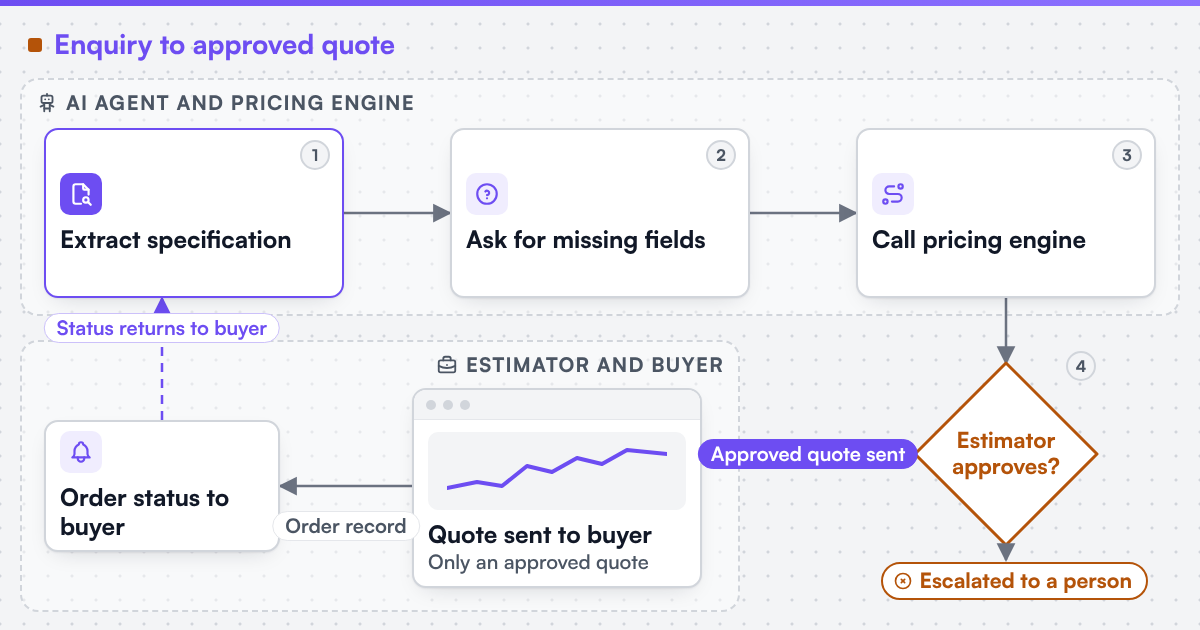
How does an enquiry become an approved quote?
A worked example on one real product shows the hand-off. A buyer writes: "Need 500 folded leaflets for an event next month, glossy, can you quote?"
01
Extract
The agent maps the message to the shop's specification schema: product leaflet, quantity 500, finish gloss, fold type unknown, flat size unknown, paper weight unknown, sides unknown, needed-by date approximate.
02
Ask
It asks the buyer only for the missing fields, offering the options the shop's catalogue actually supports, for example A4 folded to A5 or DL roll fold, and the stocks on the shop's list.
03
Price
With a complete specification, the agent calls the print pricing engine. The engine returns a price with its trace: stock, sheet yield, click or plate cost, folding and margin.
04
Approve
The draft quote goes to the estimator's queue. The estimator approves, edits or rejects it; only an approved quote is sent.
05
Escalate
A specification the catalogue cannot express, such as a custom die-cut, skips pricing and goes straight to a named person with the conversation attached.
Requests a price from the engine and shows only an approved quote
Delivery or dispatch dates
Production schedule and a named person
Reports the date the order record holds, or says it is not yet set
Refunds, reprints and credits
A named person
Records the request and escalates it with the order reference
Artwork acceptance
Prepress and preflight
Points the buyer to the upload and preflight step
Custom or out-of-catalogue products
An estimator
Hands over the conversation and the partial specification
Complaints and legal questions
A named person
Acknowledges receipt and escalates immediately
This table is written into the agent's instructions and tested. Acceptance includes adversarial prompts: a buyer demanding a discount, asking the agent to confirm a date the record does not hold, or pasting instructions into an enquiry. The agent must decline, escalate or answer "not known" in each case. The OWASP list of risks for large language model applications, including prompt injection and excessive agency, is one of the checklists used.
How are order-status questions answered?
The agent answers status questions from the order record, never from memory. It verifies the buyer against the order (for example the order number and the email address it was placed with), reads the current status, and maps it to plain words: received, artwork awaiting approval, in production, dispatched with tracking, on hold. When status updates come from print production workflow automation, the agent reads the same buyer-facing states that the storefront shows, so the two never disagree.
If the record is silent or contradictory, the agent says it does not know and escalates. A guessed "should ship Friday" is the single most damaging thing a print support agent can say.
How is buyer and client data handled?
The model provider is chosen per project contract, not by us by default. The contract names the provider, the region where processing happens, and whether conversation data may be retained. No client data goes to a third party without the client's consent. Conversation logs, specifications and order lookups stay in systems the client controls, and access to the order system is read-only for status answers.
How does this differ from AI-assisted workflow features?
AI-assisted print workflow features add reviewed AI steps inside production, such as an artwork quality flag. This page covers the buyer-facing conversation before and after the order. The same rule governs both: we can build AI-assisted steps into print workflows where a human reviews the result, with accuracy measured on the client's own data before acceptance.
AI tools assist our own engineering work. A named human engineer reviews and remains accountable for everything we deliver, and no generated output ships unreviewed.
The default engagement is fixed-scope with written acceptance criteria and priced change control. Managed operations is a separate, opt-in agreement.
What proof sits behind this service?
Netbase JSC, which operates Web2Print Solutions, has delivered 50+ web-to-print platforms. Group stores that are live today are listed on the live web-to-print stores evidence page; they are group records, not a published agent delivery under this name.
Who delivers this service?
The Hanoi team of Netbase JSC scopes, builds and hands over this service. The figures below are records of the wider Netbase group.
Company profile
Netbase JSC
Operator
Netbase JSC, Hanoi, Vietnam
Founded
Registered and operating since July 2012
Netbase group figures
4,600+web-to-print and e-commerce projects delivered since 2012
500+clients served since 2012
80+countries with delivered client projects
2,000+stores run on the group hosted web-to-print platform
These are live online stores, operated by their owners in Europe, Asia and North America, that use web-to-print components delivered by Netbase JSC, which operates Web2Print Solutions. Each card names the store, its product category and country, says what the store showed on the check date and links to it so a buyer can inspect it.
View details
Scope this work with a project brief
Send a project brief with twenty anonymised recent enquiries, the specification fields your estimators need before they can price, how prices are calculated today, where order status is recorded, and who should receive each type of escalation. Say which model providers, if any, your contracts already allow.
Tell us the product or workflow you want to change.
A senior engineer reads your request and replies in writing.
You get a scoped next step: a discovery, a fixed-scope build or a plain "not a fit".
Against the client's own enquiries: specification extraction is measured on a held-out sample, and every item in the never-decides table is tested with adversarial prompts.