

Web-to-print for wide-format and signage
Wide-format and signage orders are priced by area, not by a catalogue size, and most exceed what one print pass can produce. The engineering work is tiling an oversized size into panels, offering only the substrate and finishing combinations the shop can run, checking artwork resolution against the finished size, and carrying the install step the order still needs.
Start a project brief See client projectsReviewed by CEO, Netbase JSC · Published 3 Oct 2026 · Updated 3 Oct 2026

How does a wide-format order move from size to delivery?
Wide-format and signage work is priced and produced by area, not by a catalogue size, and nearly every job is oversized relative to what one piece of material or one print pass can produce. A customer types a width and height to fit a storefront, a trade-show stand, a vehicle or a building face; the shop then works out how many panels that size needs, which substrate and finishing combination the job can run, whether the artwork still reads at the finished size, and how the piece gets installed or delivered once the file leaves production. Custom-size pricing covers the general area and yield mechanics; this page covers what is specific to signage: tiling, finishing and the install step a flat print job never has.
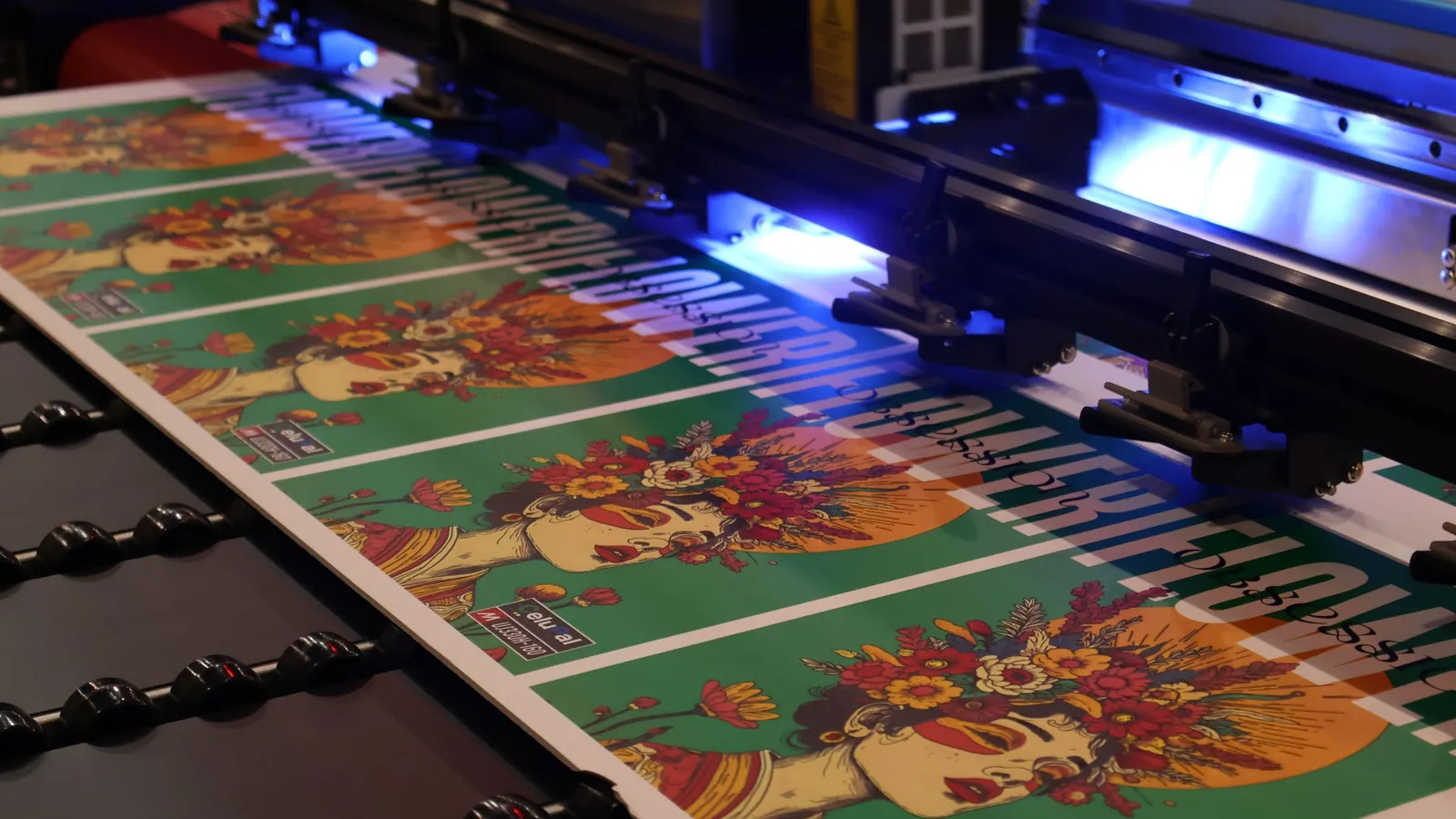

Key takeaways
- Nearly every wide-format job is a custom size, so area-based pricing and nesting efficiency, not a price list, decide what a quote costs to produce.
- A size over the printer's maximum width has to split into tiled panels before a price or a proof means anything.
- Substrate and finishing, grommets, hems, pole pockets, double-sided mounting, change which production line a job can run on.
- Artwork built for screen resolution reads visibly soft once blown up to signage size, and the risk grows with viewing distance ignored.
- Install and delivery logistics, access, mounting method and how panels travel, are part of the order, not an afterthought.
Where does a wide-format order actually get decided?
| Stage | What has to be decided | What happens if it is skipped |
|---|---|---|
| Size and nesting | Whether the size exceeds the printer's maximum width and, if so, how many panels it becomes | An oversized file reaches production with no way to output it in one pass |
| Substrate and finishing | Which material and finishing combination, grommets, hems, pole pockets, double-sided mount, the job needs | A finishing option is offered that the substrate or press cannot carry |
| Resolution check | Whether the file holds enough resolution at the finished size and intended viewing distance | A design that looked sharp on screen prints visibly soft once mounted |
| Area-based price | Area or linear measurements, substrate, finishing and tiling overlap, combined into one number | A price quoted on size alone overstates or understates the real cost |
| Install and delivery | Site access, mounting method, and how panels travel and get sequenced on site | A correctly printed job arrives with no plan for how it goes up |
The area-based price stage is where a print pricing engine earns its place: area, yield, finishing cost and overlap combine into one number an estimator would also reach by hand.
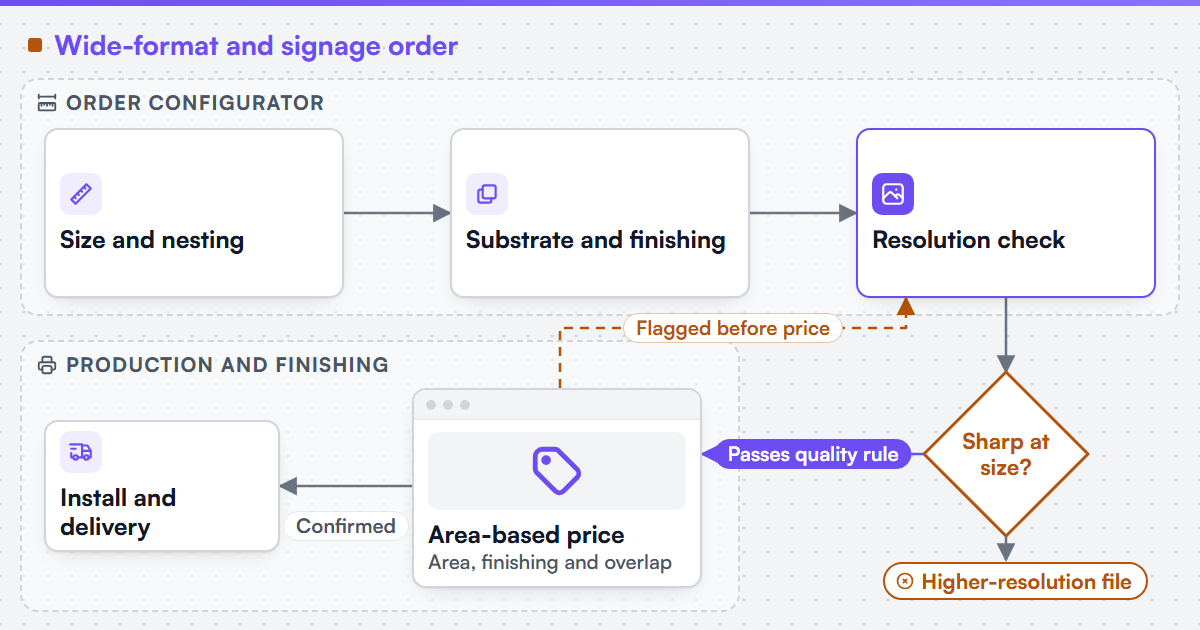 (opens the full-size diagram in a new tab)
What finishing choices actually change the job?
Finishing decides whether a flat printed panel is a usable sign rather than a sheet of printed material. A hem reinforces an edge against tearing and wind load; a grommet is an eyelet set through the hem for rope or ties, usually at every corner with closer spacing on larger pieces; a pole pocket is a sewn sleeve that lets a banner hang from a rail or pipe. These are per-edge choices that commonly mix on one order rather than one style applied to the whole piece. A configurator that treats finishing as a single dropdown, rather than a per-edge set tied to the chosen substrate, will sell a combination the production line cannot run.
Why does low resolution become a bigger risk at wide-format size?
A logo or photograph built for a web page carries far less image data per unit of finished size than a wide-format print needs. The relationship is viewing distance against required detail: fine detail legible on a banner viewed from a few metres becomes unreadable blown up for a building face viewed from fifty, and the reverse wastes paid-for space on a banner meant to be read up close. An order form that accepts any file without checking resolution against the requested size and intended viewing distance will approve artwork the shop already knows will print soft, and the complaint arrives after installation, not before payment.
What does a worked example look like?
A sign shop quotes a 4.8 metre wide outdoor banner on a printer with a 1.6 metre maximum width and a 50 mm panel overlap. Usable width per panel is 1.55 m, so the job tiles into three panels joined at two seams, the same tiling arithmetic covered on the banner and signage configurator page. The customer specifies grommets on all four edges for a fence-mounted install rather than a pole pocket, since there is no rail to hang from. The uploaded artwork is a logo exported at a resolution built for a web page; checked against the finished size and an intended viewing distance of three metres, it falls below the minimum resolution the shop's own quality rule allows, so the order is flagged for a higher-resolution file before a price is confirmed rather than after the banner is printed and found illegible on site.
Who is this not for?
A print business whose wide-format work is a short list of fixed, pre-set sizes with no custom tiling or finishing variation does not need this level of engineering; a standard configurator serves that catalogue well. Custom engineering pays off once customers routinely type a size the shop has to tile, finish per edge, or deliver and install.
What evidence exists for wide-format and signage work?
We can formalise a print pricing model into an engine the client owns, accepted against a regression suite of the client's own known-good quotes. Netbase JSC, which operates Web2Print Solutions, has delivered 50+ web-to-print platforms. Delivery records cited on this site belong to Netbase JSC; where no delivered example is published, the page says so rather than implying a record. No wide-format or signage pricing engine delivered under the Web2Print Solutions name is published as a case on this site.
How does an engagement start?
An engagement starts with the shop's own equipment limits, not the website. The most useful inputs are the printer's maximum width and overlap allowance, the substrate and finishing combinations the shop offers, the minimum resolution rule to enforce at upload, and one size the current website has priced wrongly. Those inputs show whether the first release is the tiling and finishing configurator, the pricing engine, or both. Send them with a project brief, leaving out substrate cost detail you do not want to share at this stage.
Frequently asked questions
Yes. The upload step can check a file's resolution against the requested size and a stated viewing distance, and flag it before a price or proof stage rather than after production.
No. Tile count follows the printer's maximum width and the overlap allowance, so the same oversized size can split into a different number of panels on different equipment.
Not quite. A flat rate per unit area is one input; nesting efficiency, finishing cost and any minimum charge still have to combine into the final number.
Client profiles for wide-format and signage
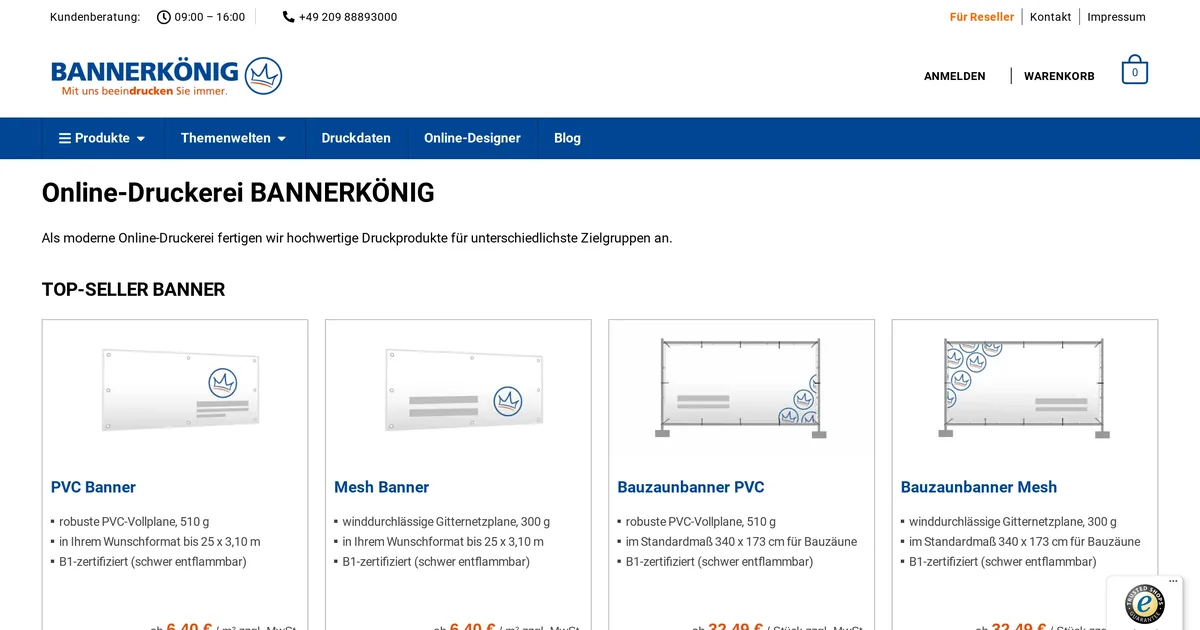
BannerKoenig is a banner and signage print store in Germany. It is a live store using web-to-print components delivered by Netbase JSC, checked 2026-10-14. The store runs on WooCommerce, in German. Netbase JSC's records hold a project record opened in 2021-12 with no individual tasks recorded.
Learn More
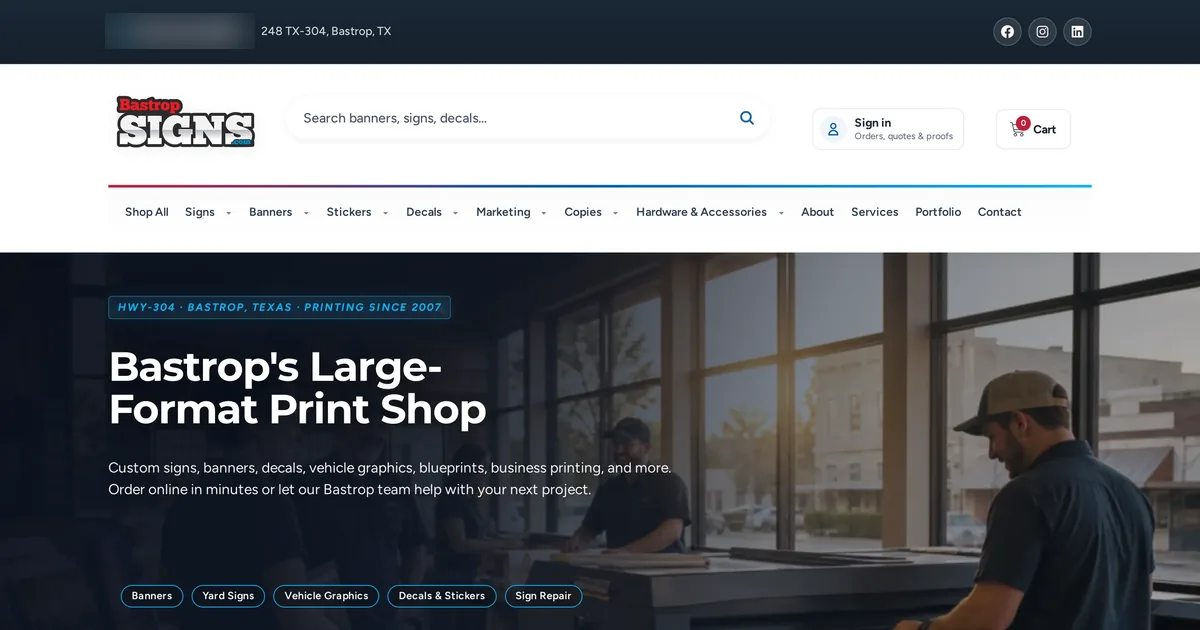
Bastrop Signs is a wide format signage store in United States. Netbase JSC's project records hold a custom web-to-print engagement for it from 2024-08 to 2024-11, with 7 recorded tasks and 3 milestones. The store runs on WooCommerce and is a live store, checked 2026-10-12.
Learn More
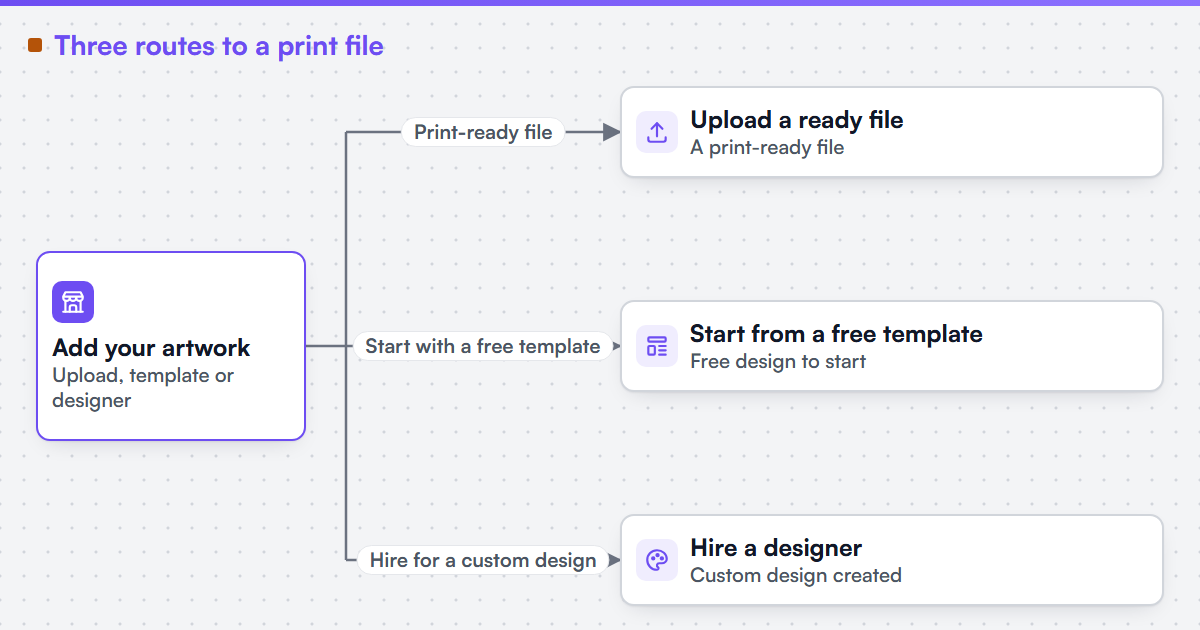
Printomatic is a large-format and real-estate print shop in Concord, Ontario, selling signs, banners and vehicle wraps with an option-driven configurator, three artwork routes and a file check before print. Netbase JSC's records hold a custom web-to-print engagement from June 2021 to February 2025, and Netbase JSC checked the store live on 2026-10-03.
Learn More
References (4)
- Ghent Workgroup, PDF/X workflow, accessed 2026-10-03.
- International Color Consortium, ICC profiles, accessed 2026-10-03.
- U.S. Access Board, Guide to the ADA Accessibility Standards, Chapter 7: Signs (character height to viewing distance), accessed 2026-10-03.
- CIP4, JDF and JMF job and messaging formats, accessed 2026-10-03.