

Web-to-print for German print businesses
Web2Print Solutions has no German, Austrian or Swiss office, staff or entity; every engagement is delivered remotely from Hanoi, Vietnam by Netbase JSC. For a German buyer this means configuring a storefront's USt invoices, XRechnung or ZUGFeRD e-invoicing, DHL or DPD dispatch and SEPA, PayPal or Klarna payment, not adding a German team.
Start a project brief See client projectsReviewed by CEO, Netbase JSC · Published 1 Oct 2026 · Updated 1 Oct 2026

What is web-to-print for German print businesses?
Netbase JSC, which operates Web2Print Solutions, configures web-to-print storefronts for print businesses selling into Germany, with Austria and Switzerland as adjacent markets covered further down this page. All engineering and delivery for Web2Print Solutions is performed remote-first from Hanoi, Vietnam. Web2Print Solutions has no office, legal entity, employee base, representative or local support window in any other location. A German engagement configures a storefront's tax invoices, units, address formats, carriers and payment methods.
For a German buyer, "market-correct" means USt shown correctly, a structured e-invoice where required, German paper and card sizes, a street-and-number address with a five-digit Postleitzahl (PLZ), and familiar carrier and payment habits. This page is one of the markets Web2Print Solutions configures for.
Key takeaways
- A German storefront must separate the consumer price, which shows USt at the standard or reduced rate, from an EU business order, usually invoiced net under the reverse-charge mechanism.
- A business or public-sector buyer can require a structured e-invoice in the XRechnung or ZUGFeRD format rather than a PDF, and the invoice generator has to produce one on request.
- Germany uses A-series paper, gsm stock weights, an 85 by 55 millimetre business card, and a street-then-number address with a five-digit PLZ, not a US-shaped form.
- Every engagement is delivered remotely from Hanoi, Vietnam, with no staff in Germany, Austria or Switzerland.
How does an order move from checkout to delivery in Germany?
The buyer sees a USt-inclusive consumer price or a net reverse-charge price for a registered EU business buyer. Checkout issues an invoice, and for a buyer that requires it the same order data also produces an XRechnung or ZUGFeRD file. The order becomes a production job handed to a carrier with a German-format address.
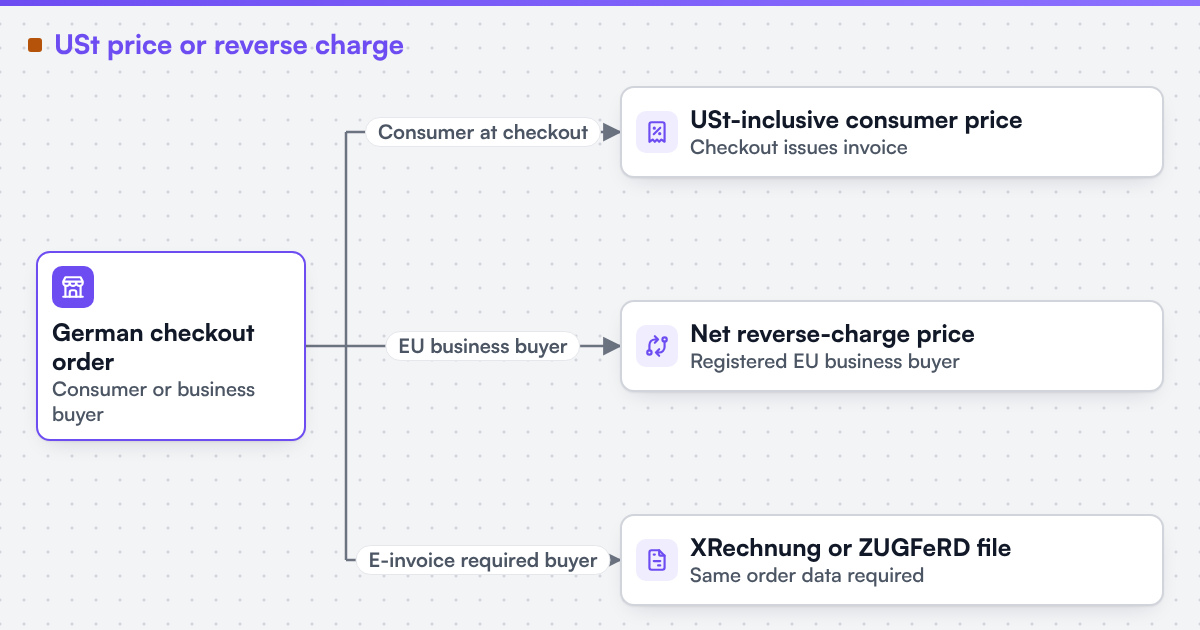 (opens the full-size diagram in a new tab)
What USt and e-invoicing rules does a German storefront need to apply?
-
Standard USt rate
Applied to most printed products and finishing add-ons for German consumers
-
Reduced rate
Certain printed-matter categories qualify; the boundary is set by German tax law, not the storefront
-
EU reverse charge
A VAT-registered buyer in another EU state is usually invoiced net, with the reverse charge stated on the invoice
-
Structured e-invoice
A business or public-sector buyer can require XRechnung or ZUGFeRD instead of a PDF
A storefront that only emails a PDF invoice fails a business buyer who needs a structured file for their accounting system; the invoice generator produces both from one order record, alongside the B2B and corporate print storefront work trade accounts usually need.
What units, paper sizes and address format does Germany use?
-
Paper sizes
A-series (A4, A5, A3)
-
Stock weight
Grams per square metre (gsm); litho specs sometimes also give lines per centimetre
-
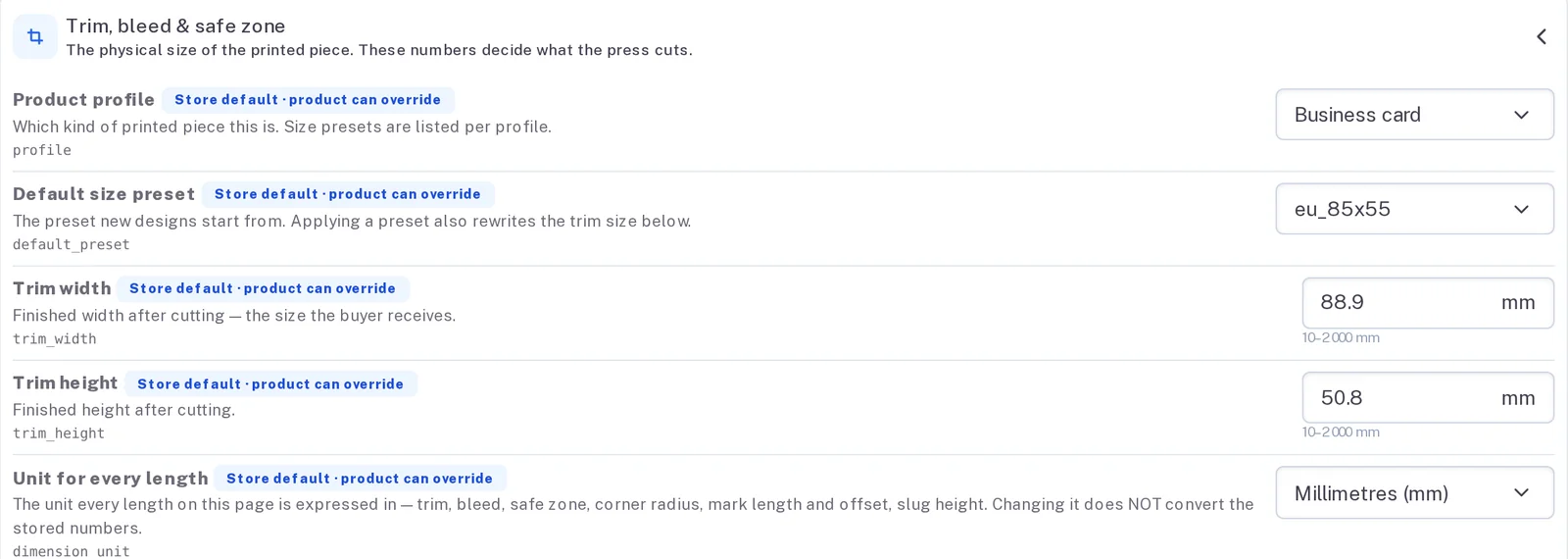
Business card size
85 × 55 millimetres
-
Address format
Street name, then house number; town; five-digit Postleitzahl
Which carriers and payment methods do German buyers expect?
DHL, DPD, Hermes and GLS are the carriers a German checkout and order-status page most often integrate against. German buyers commonly expect SEPA direct debit, PayPal and Klarna for consumer purchases, and purchase on invoice (Kauf auf Rechnung) for trade accounts ordering on agreed terms.
What privacy, Impressum and accessibility law should a German engagement respect?
A German storefront sits under the EU General Data Protection Regulation. Every commercial site also carries an Impressum duty: the information obligations once set out in the Telemediengesetz now sit in section 5 of the Digitale-Dienste-Gesetz, requiring a provider's identity and contact details to stay easily found. The Barrierefreiheitsstärkungsgesetz, Germany's implementation of the EU Accessibility Act, brings consumer-facing online shops into scope for accessibility requirements on a phased timetable. Confirm all three with the client's own counsel; none is a credential Web2Print Solutions holds.
How do Austria and Switzerland differ from Germany?
| Factor | Austria | Switzerland |
|---|---|---|
| EU VAT and reverse-charge | Shares Germany's EU VAT mechanism and reverse-charge logic, with its own 20% standard rate | Outside the EU; VAT is administered separately at its own rate, with no reverse-charge |
| Pricing, address and carrier logic | Otherwise reuses the German address, paper-size and carrier logic | Priced in Swiss francs; a shipment is declared at the border, needing customs-declaration data rather than just a converted price |
What proof already exists for the German market?
Netbase JSC, which operates Web2Print Solutions, has delivered 50+ web-to-print platforms. Among the live web-to-print store examples, BannerKoenig is a German signage storefront where a browser-based designer opens directly from a roll-up banner product page. Live store using web-to-print components delivered by Netbase JSC, which operates Web2Print Solutions. No German USt or e-invoicing case study is published under the Web2Print Solutions name yet; where that record does not exist, this page says so.
Does this page have a German translation?
Not yet. Content is published in English, German, French, Spanish and Japanese. A translated page indicates language only and never an office, entity, team or local support window. This page ships in English first; a German version is planned for a later wave.
What is the time-zone difference with a team based in Hanoi?
| Factor | Detail | Applies to |
|---|---|---|
| Hours difference from Hanoi | Five to six hours ahead of Germany, Austria and Switzerland, depending on daylight saving | Germany, Austria and Switzerland |
| Collaboration pattern | Asynchronous work against written change control, not a promised response window | Germany, Austria and Switzerland |
Send a project brief with your USt or VAT registration details, whether any buyer requires XRechnung or ZUGFeRD, your carrier accounts, and the platform your storefront runs on.
Discuss your web-to-print project
Frequently asked questions
Usually yes. Consumers get a readable invoice and a business buyer requiring a structured e-invoice gets an XRechnung or ZUGFeRD file; the invoice engine generates both from one order record.
Yes, with VAT rate, currency and customs logic keyed to the buyer's country, and Switzerland's non-EU customs step scoped separately.
No. Delivery is remote from Hanoi, Vietnam; the client's own entity holds the registrations, bank account and carrier contracts.
The invoice schema is client-updatable configuration; a scoped change request covers a specification change needing new mapping logic.
Client profiles in Germany
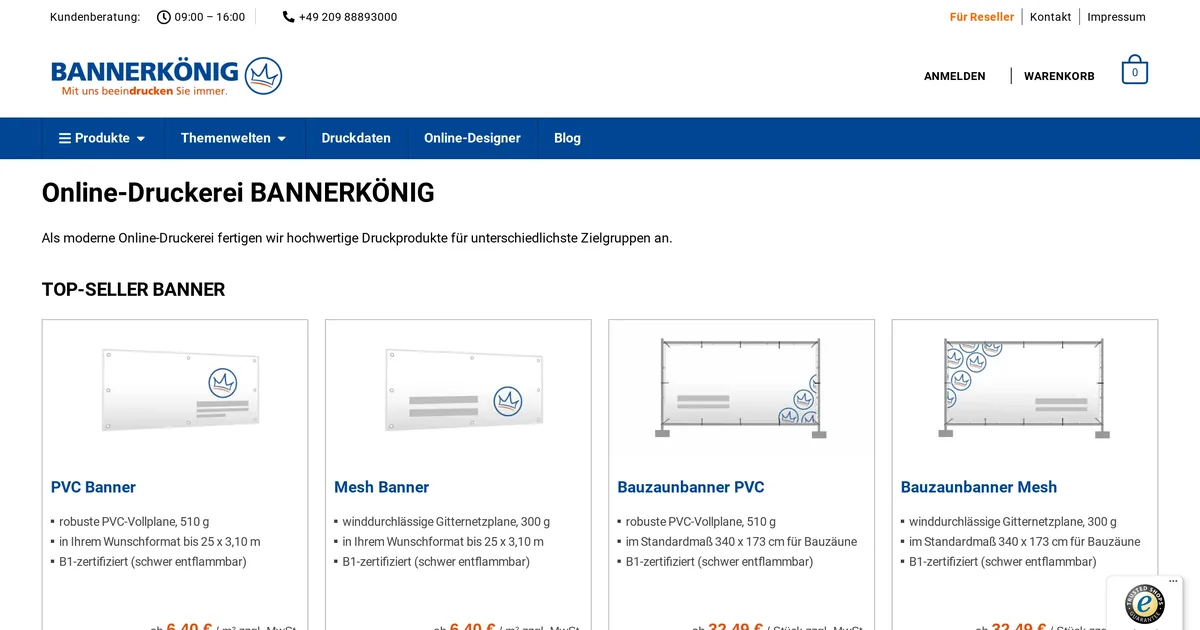
BannerKoenig is a banner and signage print store in Germany. It is a live store using web-to-print components delivered by Netbase JSC, checked 2026-10-14. The store runs on WooCommerce, in German. Netbase JSC's records hold a project record opened in 2021-12 with no individual tasks recorded.
Learn More
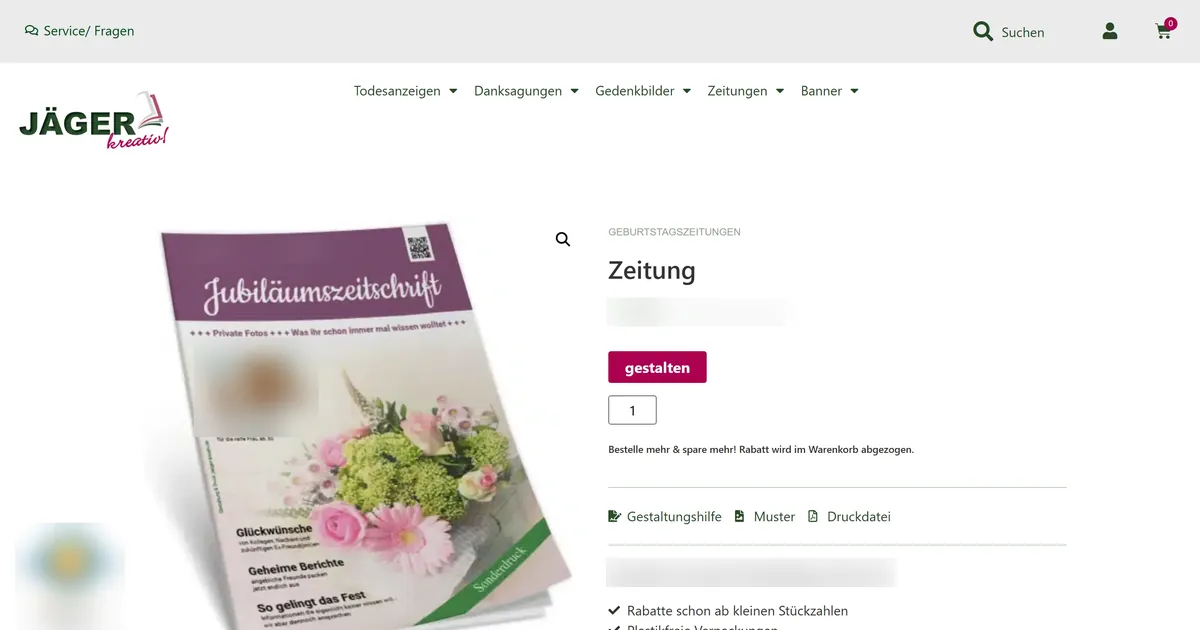
JÄGER kreativ is a print shop in the Hunsrück region of Germany whose WooCommerce store sells mourning cards, memorial pictures, personalised newspapers and banners, each designed online in the browser. Netbase JSC's records hold a custom web-to-print engagement from October 2019 to August 2026 with 23 milestones. The store was live on 2026-10-01.
Learn More
References (6)
- Gesetze im Internet, Digitale-Dienste-Gesetz, section 5, general information obligations (successor to the Telemediengesetz Impressum duty), accessed 2026-10-01.
- Bundeszentralamt für Steuern, confirmation of foreign VAT identification numbers for EU reverse-charge checks, accessed 2026-10-01.
- KoSIT, XRechnung, the German e-invoicing standard, accessed 2026-10-01.
- Bundesministerium für Finanzen (Austria), Umsatzsteuer for businesses, accessed 2026-10-01.
- Eidgenössische Steuerverwaltung, Mehrwertsteuer (Swiss Federal Tax Administration, VAT), accessed 2026-10-01.
- Gesetze im Internet, Barrierefreiheitsstärkungsgesetz (German Accessibility Act, implementing the EU Accessibility Act), accessed 2026-10-01.