What is print business reporting automation?
Print business reporting automation replaces the monthly spreadsheet export with scheduled reports built on the print business's own data. Orders come from the storefront, quotes from the pricing engine or estimating tool, and job costs, reprints and dispatch dates from the MIS or production system. A pipeline copies them into one reporting store on a schedule, and the reports read from there.
The thesis of this page: most print reporting is wrong before it is late. Two managers can both say "margin" and mean different things, one before paper waste and one after, and a dashboard that hides the definition simply automates the argument. Web2Print Solutions starts with the definitions, agrees them in writing, and only then builds the pipeline and the reports.
We can build scheduled reporting on the client's own order, quote and production data. Metric definitions are agreed in writing; we publish no benchmark. Web2Print Solutions is the web-to-print engineering service of Netbase JSC. Delivery records cited on this site belong to Netbase JSC; where no delivered example of a capability is published, the page says so rather than implying a record. No reporting system delivered under the Web2Print Solutions name is published yet, and this page states no target or industry figure for any metric.

Key takeaways
- Print business reporting automation brings storefront, quote and production data into one reporting store on a fixed schedule.
- Every metric has a written definition with its numerator, denominator, source fields and exclusions, agreed before any report is built.
- Reports are traceable: any figure can be followed back to the orders and jobs that produced it.
- The reporting store reads from source systems and never writes back to them.
- No benchmark is published; each business compares itself with its own history.
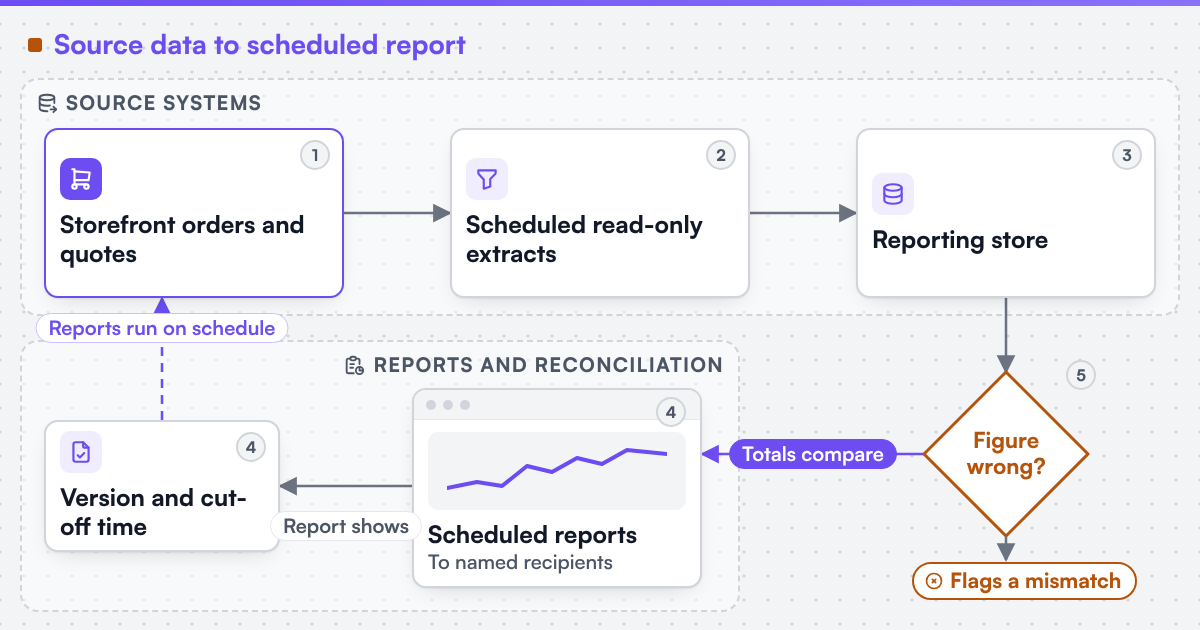
How does data flow from source systems to a scheduled report?
-
Sources
Storefront orders and line items; quotes with their status and timestamps; MIS jobs with estimated and actual costs, reprint flags and dispatch dates.
-
Extract
Scheduled, read-only extracts through each system's sanctioned interface. Timestamps are stored with their time zone offset, so a job dispatched late in the evening does not move day depending on where the report is read.
-
Reporting store
A relational store holds raw copies and a modelled layer where orders, quotes and jobs are joined on stable keys. Summary tables are refreshed after each load.
-
Reports
Scheduled reports go to named recipients, each showing the definition version, the data cut-off time and the row counts loaded.
-
Reconciliation
Each run compares totals against the source systems, for example the order count for the day, and flags a mismatch instead of publishing a wrong figure.
The joins depend on the same keys an order-to-job integration uses. Where orders are still retyped into production, reporting inherits the errors, so print MIS and ERP integration or print production workflow automation often comes first. We can integrate a web-to-print front end with an existing MIS, ERP or production scheduler where that system exposes a sanctioned interface.
Which metrics are defined, and how?
The table gives starting definitions for four common metrics. They are definitions only, not targets or benchmarks; the client edits and signs them off.
-
Margin per product
- Definition
- (Net sales value minus actual job cost) divided by net sales value, grouped by product family
- Source fields
- Order line net value; MIS actual cost for material, labour, outsourcing and waste
- Common exclusions to decide
- Shipping charges, reprint costs, internal orders
-
Quote-to-order rate
- Definition
- Quotes that became paid orders within an agreed window, divided by quotes issued in the period
- Source fields
- Quote id, issue date, status; order linked to the quote
- Common exclusions to decide
- Duplicate quotes for the same enquiry, test quotes
-
Reprint rate
- Definition
- Jobs that required a reprint, divided by jobs completed in the period, split by cause
- Source fields
- MIS reprint flag, reprint reason code, original job id
- Common exclusions to decide
- Customer-requested reruns that are new sales
-
On-time dispatch
- Definition
- Jobs dispatched on or before the promised dispatch date, divided by jobs dispatched in the period
- Source fields
- Promised dispatch date, actual dispatch timestamp
- Common exclusions to decide
- Jobs on hold at the buyer's request
A worked example on one real product, a 250-copy A4 saddle-stitched booklet, shows why exclusions matter. The job sells, is printed, and a binding fault forces a reprint. If reprint cost is included in the product's margin, booklets look less profitable; if it is excluded, the cost appears only in the reprint rate. Both choices are defensible, but only one can be in the signed definition, and the report must say which.
What happens when a definition changes?
Definitions change as the business changes, for example when outsourced finishing starts to be costed per job. Each definition carries a version number and an effective date. A change is a reviewed release: the new version applies from its effective date, earlier periods keep the version they were reported under, and any restated history is labelled as restated. A report that silently switches definitions mid-year makes the trend line meaningless, so every report prints the definition version it used.
What is included, and what is not?
Included
- Metric definitions workshop and a signed definitions document
- Read-only extracts, reporting store and scheduled reports
- Reconciliation checks with a named owner for mismatches
- Handover of the pipeline, definitions and runbook
Not included
- Industry benchmarks or target figures
- Writing corrections back into the MIS or storefront
- Forecasts presented as commitments
- Platform uptime and incident operations
Keeping the pipeline running after handover can move to managed print platform operations, which is a separate agreement. The default engagement is fixed-scope with written acceptance criteria and priced change control. Managed operations is a separate, opt-in agreement. Acceptance is a reconciliation: for an agreed past month, each report's figures are traced back to source records and match them.
Our view
Position of the CEO, Netbase JSC, 30 September 2026: a print business should not buy a dashboard before it has agreed what margin means. A published industry benchmark invites a comparison between numbers defined differently, which is why this service publishes none. The useful comparison is the business against its own last quarter, under the same signed definition. We would rather ship four trusted metrics than forty that each need an explanation in the meeting.
What proof sits behind this service?
Netbase JSC, which operates Web2Print Solutions, has delivered 50+ web-to-print platforms. Group stores that are live today are listed on the live web-to-print stores evidence page; they are group records, not a published reporting delivery under this name.
Scope this work with a project brief
Send a project brief with the reports you build by hand today, one recent month's export from the storefront and the MIS, the systems holding quotes and job costs, and the metrics your managers disagree about. Name the person who will sign the definitions.
Frequently asked questions
No. No benchmark is published or supplied. Reports compare the business with its own history under one agreed definition.
No. Extracts are read-only. Mismatches are flagged to a named person, who corrects the source system.
The definition says so. Margin is then labelled as estimated margin until actual costs are captured.
On a schedule agreed in the scope, such as daily or weekly, and each report shows its data cut-off time.
References (4)
- W3C, The RDF Data Cube Vocabulary, a model for defining dimensions, measures and attributes of statistical data, accessed 2026-09-30.
- W3C, PROV-O: The PROV Ontology, for recording data provenance, accessed 2026-09-30.
- IETF RFC 3339, Date and Time on the Internet: Timestamps, accessed 2026-09-30.
- PostgreSQL documentation, Materialized Views, accessed 2026-09-30.