

Web-to-print for UAE print businesses
Web2Print Solutions has no UAE office, staff or entity; every engagement for a UAE print business is delivered remotely from Hanoi, Vietnam by Netbase JSC. It configures a storefront's VAT tax invoices, an address format with no postal code, Aramex or Emirates Post dispatch, and card, buy-now-pay-later or cash-on-delivery payment.
Start a project brief Explore servicesReviewed by CEO, Netbase JSC · Published 1 Oct 2026 · Updated 1 Oct 2026

What is web-to-print for UAE print businesses?
Netbase JSC, which operates Web2Print Solutions, configures web-to-print storefronts for print businesses selling into the United Arab Emirates. All engineering and delivery for Web2Print Solutions is performed remote-first from Hanoi, Vietnam. Web2Print Solutions has no office, legal entity, employee base, representative or local support window in any other location.
This page is one of the markets covered by web-to-print implementation, one of our services. The distinguishing UAE detail is not the simple VAT rate but the address field: most of the UAE has no postal code, so a storefront that assumes one has a required field with nothing honest to put in it.
Key takeaways
- VAT is 5%, a single national rate, and a valid tax invoice needs specific fields rather than a generic receipt.
- The UAE has no postal code system; addresses use the emirate, the area or community name, and a Makani number (Dubai and several northern emirates) or a street-and-building reference (Abu Dhabi).
- Aramex and Emirates Post are the usual carriers; card, Tabby, Tamara and cash on delivery are all common payment routes.
- E-invoicing is rolling out in phases, so build invoice data that can be restructured.
How does an order move from checkout to delivery in the UAE?
The buyer sees a VAT-inclusive price, and checkout issues a tax invoice carrying the seller's Tax Registration Number and VAT amount. After payment by card, Tabby, Tamara or cash on delivery, the order becomes a production job handed to Aramex or Emirates Post with an area-based address.
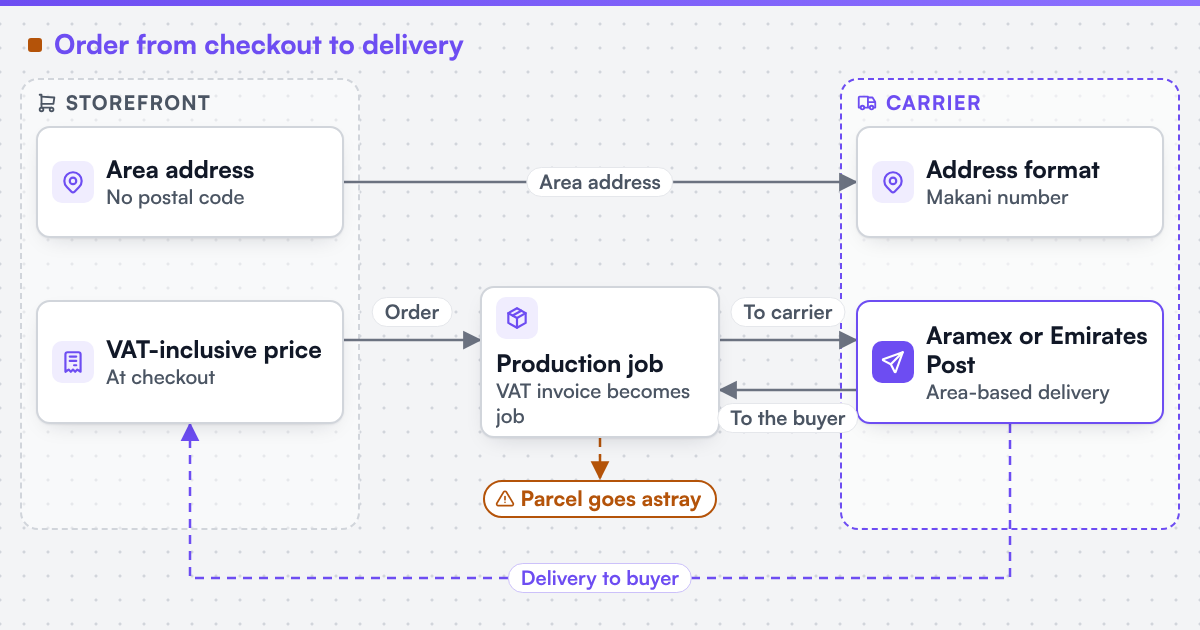 (opens the full-size diagram in a new tab)
What VAT and tax-invoice rules does a UAE storefront need to apply?
-
VAT rate
5%, a single national rate, applied to standard-rated printed products and finishing add-ons
-
Full tax invoice
Must show "Tax Invoice", the supplier's name, address and Tax Registration Number, the recipient's details, a sequential number, the date, and per line the description, unit price, quantity, VAT rate and amount, plus the total payable in AED
-
Simplified tax invoice
Permitted when the recipient is not VAT-registered, or a registered recipient's VAT-inclusive total is AED 10,000 or less; still needs the supplier's name, address, Tax Registration Number and the VAT-inclusive total
-
Electronic invoicing
A phased Peppol-based programme; confirm the current phase and go-live date for a given business directly with the Federal Tax Authority
A generic receipt headed "Tax Invoice" without the Tax Registration Number and per-line VAT has not met the requirement, even at the correct 5%.
What address format and carriers does the UAE use, and why does it matter?
The UAE has no national postal code. A Dubai, Ajman, Fujairah, Ras Al Khaimah or Umm Al Quwain address is usually built around a Makani number, a ten-digit geo-address code that identifies a building entrance to within a metre, maintained by Dubai Municipality. Abu Dhabi uses its own street-and-building-number scheme. Either way, the storefront needs an area or community name plus a Makani number or street reference, not a postal code box copied from a UK or US template.
-
Paper sizes
A-series (A4, A5, A3)
-
Postal code
None nationally; do not make this field mandatory
-
Address format
Emirate, area or community name, Makani number or street and building number, PO Box where used
-
Carriers
Aramex, Emirates Post
-
Payment
Cards, Tabby, Tamara, cash on delivery
What about Arabic and right-to-left storefronts?
Web2Print Solutions is published in English only; this site carries no Arabic locale. A client's own storefront often needs Arabic alongside English: right-to-left layout, mirrored navigation, and bidirectional text where Arabic and Latin-script product codes share a line. That is scoped storefront build work, assessed on the client's own catalogue and audience.
What privacy and accessibility law should a UAE engagement respect?
A UAE storefront that collects customer names, addresses and order history sits under Federal Decree-Law No. 45 of 2021 on the Protection of Personal Data, which applies to controllers and processors located in the UAE and excludes government data, health data and some free-zone entities such as the DIFC. The UAE has no general private-sector web-accessibility law: the Telecommunications and Digital Government Regulatory Authority's National Digital Accessibility Policy requires WCAG 2.1 AA conformance from federal government digital services. Confirm both with the client's own counsel; neither is a certification Web2Print Solutions holds.
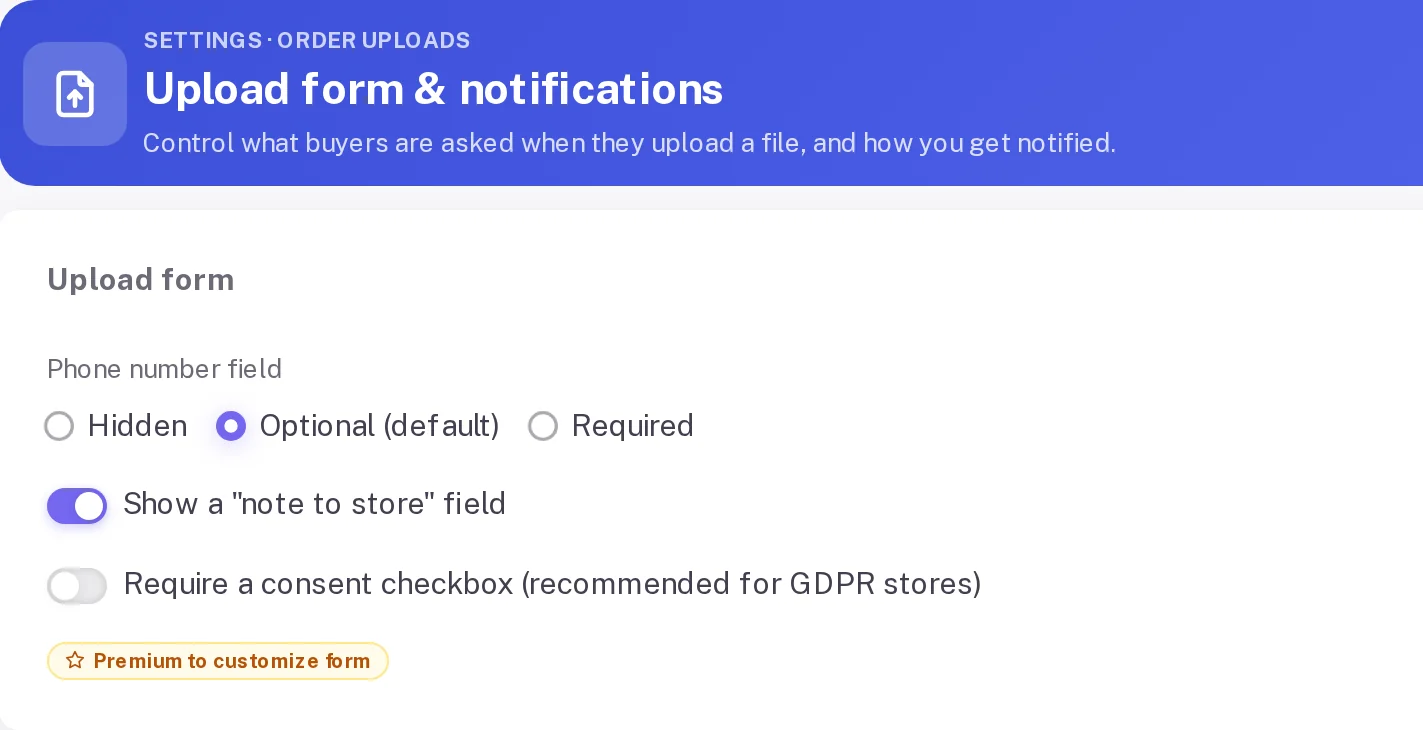
The upload form lets a store hide the phone field and require a consent checkbox before personal data is collected.
What does a UAE market engagement include, and what does it not?
Included
- VAT-compliant full and simplified tax invoice logic
- Makani-number or street-reference address capture with no mandatory postal code
- Aramex or Emirates Post integration; card, Tabby, Tamara and cash-on-delivery checkout
- Right-to-left layout for the client's own storefront
Not included
- Registering the client for VAT or a Tax Registration Number
- Filing the client's own VAT return
- A UAE office, staff, entity or local support window
- An Arabic version of Web2Print Solutions itself
What proof already exists for the UAE market?
Netbase JSC, which operates Web2Print Solutions, has delivered 50+ web-to-print platforms. No published live-store example or named client reference on this site is UAE-based today; where a record does not exist, this page says so rather than implying one.
What is the time-zone difference with a team based in Hanoi?
| Factor | Detail | Applies to |
|---|---|---|
| Hours difference from Hanoi | Three hours ahead of the UAE, year-round since neither observes daylight saving | UAE |
| Collaboration pattern | Asynchronous work against written change control, not a promised response window | UAE |
Send a project brief with your VAT registration status, whether your storefront needs an Arabic, right-to-left catalogue alongside English, your current platform, and the carrier accounts you hold.
Discuss your web-to-print project
Frequently asked questions
No, and making one mandatory is the most common address-form mistake for this market; the field that matters is the Makani number or area reference.
No. Delivery is entirely remote from Hanoi, Vietnam; the client's own UAE entity holds the Tax Registration Number, bank account and carrier contracts.
Yes, as a scoped right-to-left build on the client's own storefront; this site's pages stay English-only.
The carrier collects payment on delivery and reconciles it to the client's account, so the storefront needs a distinct payment state rather than treating every order as pre-paid.
References (6)
- Federal Tax Authority, VAT registration and the standard rate, accessed 2026-10-01.
- Federal Tax Authority, Tax invoices (VAT011), accessed 2026-10-01.
- Federal Tax Authority, UAE e-Invoicing, accessed 2026-10-01.
- U.AE, Data protection laws, accessed 2026-10-01.
- Dubai Municipality, Open data for Makani, accessed 2026-10-01.
- Telecommunications and Digital Government Regulatory Authority, National Digital Accessibility Policy, accessed 2026-10-01.