Ready-made platform
Run it on W2P Solution
A white-label print store with a built-in designer, print pricing rules and a production queue, set up and hosted by the Netbase JSC team.


Print on demand routes each order to a network of external producers chosen by product, region, capacity and cost, with no production equipment to own. Owned production keeps one in-house press as the system of record, trading that flexibility for fixed capital cost and direct control. Order volume, product range and quality control needs decide which approach fits.
Reviewed by CEO, Netbase JSC · Published 27 Oct 2026 · Updated 3 Nov 2026 · 9 min read

Both approaches answer the same question, who actually makes the product behind an order, with opposite trade-offs. Print on demand routes each paid order to one of several external producers, chosen by product type, region, capacity and cost, rather than committing to any single producer in advance. Owned production keeps one in-house press, or one contracted production system a business effectively controls, as the single system of record for every order. Neither word describes a storefront technology; both describe who holds the equipment, the capacity risk and the production schedule once an order is placed. A business can build either approach on the same web-to-print storefront, so this comparison is about the fulfilment model behind the order, not the software in front of it.
| Criterion | Print on demand | Owned production | Better fit |
|---|---|---|---|
| Capital cost | None; no press, cutter or finishing equipment to buy or house | Real and upfront; equipment, space and staff exist whether or not orders arrive | Print on demand, when there is no capital to deploy |
| Per-unit cost at volume | Flat or close to flat per unit regardless of quantity, since each order goes to whichever producer has capacity | Falls as volume rises once fixed costs are spread across more units, then flattens at a press's practical ceiling | Owned production, once committed volume justifies the fixed cost |
| Lead time control | Bounded by the chosen producer's own queue and location; the business cannot compress it directly | Directly adjustable by the business, within its own equipment's real capacity | Owned production, when a fixed delivery date matters |
| Quality control | Indirect; the business inspects outcomes after the fact and routes future orders away from a producer that under-delivers | Direct; the business can inspect, correct and reprint before an order ships | Owned production, for output that needs direct inspection |
| Product range | Wide, limited only by which producers the network includes; each producer can specialise in a different method | Limited to what the owned equipment can physically run | Print on demand, for a wide or varying catalogue |
| Capacity risk | Carried by the network; a demand spike is absorbed by routing to more producers, a slow period costs nothing idle | Carried by the business; idle equipment is a sunk cost, and a demand spike beyond capacity has to be declined or routed out anyway | Print on demand, when demand is unpredictable |
| Producer dependency | Spread across a network, with routing rules to reassign a rejected or offline producer | Concentrated on one system; an equipment failure or a production bottleneck has no internal fallback | Print on demand, for resilience to one producer's failure |
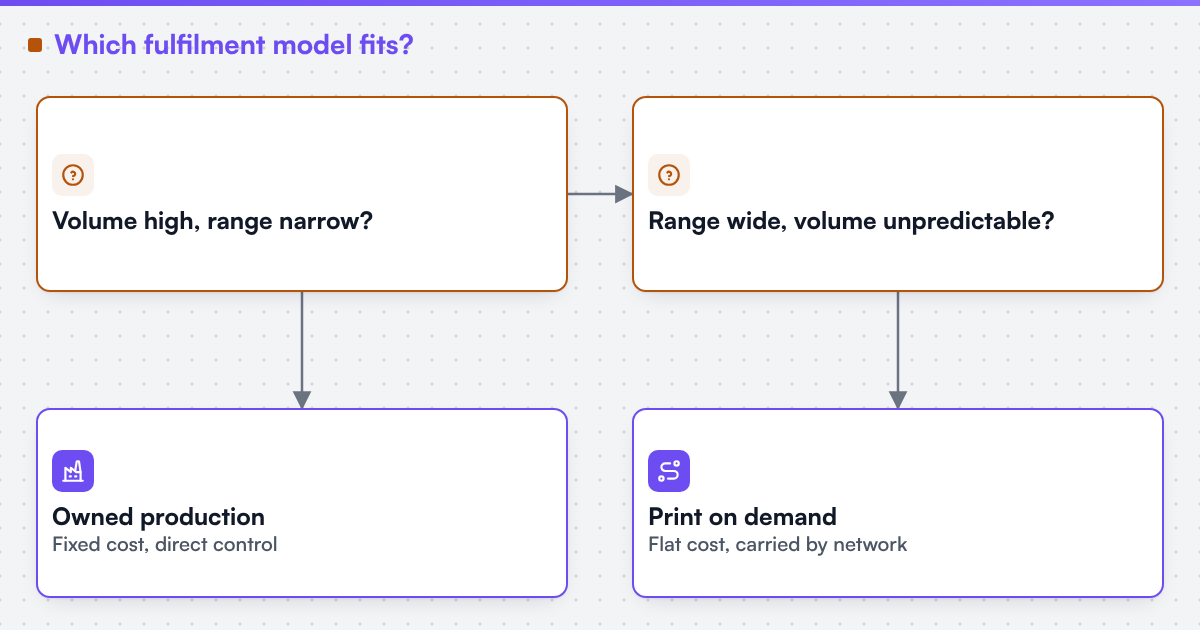
| Honest verdict | Right answer for a wide, variable product range with no capital to deploy on equipment | Right answer for a narrow, high-volume product range where fixed costs are already justified by committed order volume | Neither wins outright; it follows product range and committed volume |
 (opens the full-size diagram in a new tab)
Owned production is the right answer when order volume is high enough and predictable enough that the fixed cost of equipment, space and staff is already justified, and the product range stays narrow enough that one production line can carry it. A business printing one or two product types at real scale gets lower per-unit cost at volume, direct lead-time control and the ability to inspect and correct output before it ships, all of which a producer network cannot offer as directly. The honest cost of this route is the equipment and staff sitting there on a slow week, and a production bottleneck that has no internal fallback when it happens.
Print on demand earns its flexibility when the product range is wide, order volume is unpredictable, or the business has no capital to deploy on equipment it would need to run constantly to justify. Routing each order to whichever producer in the network can make it, by product, region, capacity and cost, lets a catalogue span more decoration methods and item types than any single production line could carry, covered in apparel and promotional print, where a single catalogue routinely spans several decoration methods with different minimums. The honest cost of this route is indirect quality control and a lead time bounded by whichever producer takes the order, not by the business itself.
Yes, and many do. A common pattern keeps owned production for the narrow set of high-volume products a business already runs at scale, and routes everything outside that range, a new product line, a regional order, or a demand spike beyond the owned line's capacity, to a print-on-demand network instead. That split is a routing decision as much as a production one: the storefront and the order logic need to know which products default to the owned line, which go to the network, and what happens when the owned line is full. Web2Print Solutions' engineering focus is web-to-print: product configurators, print pricing logic, print-ready output pipelines and integration with print production systems, and that includes building order routing and artwork hand-off to print-on-demand providers and fulfilment networks, with per-producer specifications and exception handling, alongside an owned production line rather than instead of it. Delivery records cited on this site belong to Netbase JSC, which operates Web2Print Solutions; no routing build that mixes an owned line with a print-on-demand network is published as a delivered example under this name. Print fulfilment network integration scopes the order and status contract a routing layer needs regardless of how many producers, owned or external, sit behind it. On W2P Solution, routing an order to a print network or several owned producers is the Marketplace edition; the broader buy-vs-build question behind that choice is set out in four ways to get a web-to-print platform.
Send a project brief naming the product types you carry or plan to carry, your current order volume and how much it varies, whether you already own any production equipment, and the decoration methods or output formats your catalogue needs. That is enough to say whether a routing layer, an owned-production integration, or a mix of both is the right first build.
Not at every volume. Print on demand avoids capital cost entirely, but owned production's per-unit cost falls as volume rises; at high enough committed volume, owned production typically wins on per-unit cost. The crossover point depends on the business's own volume and product range, not a fixed rule.
No. It means the business controls one production system, in-house equipment or a contracted line it effectively directs, as the system of record for an order, as distinct from routing that order out to a network of producers it does not control.
Not reliably in advance; routing can prefer a producer with a shorter queue, but the lead time is still bounded by whichever producer accepts the order. A business that needs a fixed date on every order is describing a requirement owned production meets more directly.
Send a project brief describing your product range, order volume and any production equipment you already run, or visit /contact for every way to reach the team.
Ready-made platform
A white-label print store with a built-in designer, print pricing rules and a production queue, set up and hosted by the Netbase JSC team.
Commissioned build
When the workflow needs rules, integrations or a configurator a standard edition does not cover, the Netbase engineering team scopes and builds it.
Tell us about one product you want to sell online. A senior engineer reads every brief and replies in writing.