

Migvan, Israel: a Hebrew garment designer with eight customisation releases
Migvan is an Israeli garment printer whose Hebrew, right-to-left store sells T-shirts, team kits and bulk DTF orders, with an online designer customers use instead of sending artwork. Netbase JSC's records hold a custom engagement from August 2021 to August 2025, with seventeen milestones across eight designer releases. The store was live on 2026-10-03.
Start a project brief Try the live demoReviewed by CEO, Netbase JSC · Published 3 Oct 2026 · Updated 3 Oct 2026

At a glance
- Country
- Israel
- Niche
- Apparel promotional
- Platform
- WooCommerce
Who is Migvan and what market does it serve?
Migvan is a garment and workwear printer in Israel. Its store, migvan4u.co.il, is written in Hebrew, reads right to left, and sells printed clothing to private customers and businesses. On 2026-10-03 the catalogue covered T-shirts in several cuts (round and V neck, oversize, dry-fit, long sleeve), polo and buttoned shirts, kids' wear, tank tops, winter wear such as hoodies, sweatshirts and softshells, baby clothes, and football and basketball jerseys, alongside event categories for weddings, business, school trips, army service and family occasions, plus a bulk direct-to-film (DTF) order route for larger runs.
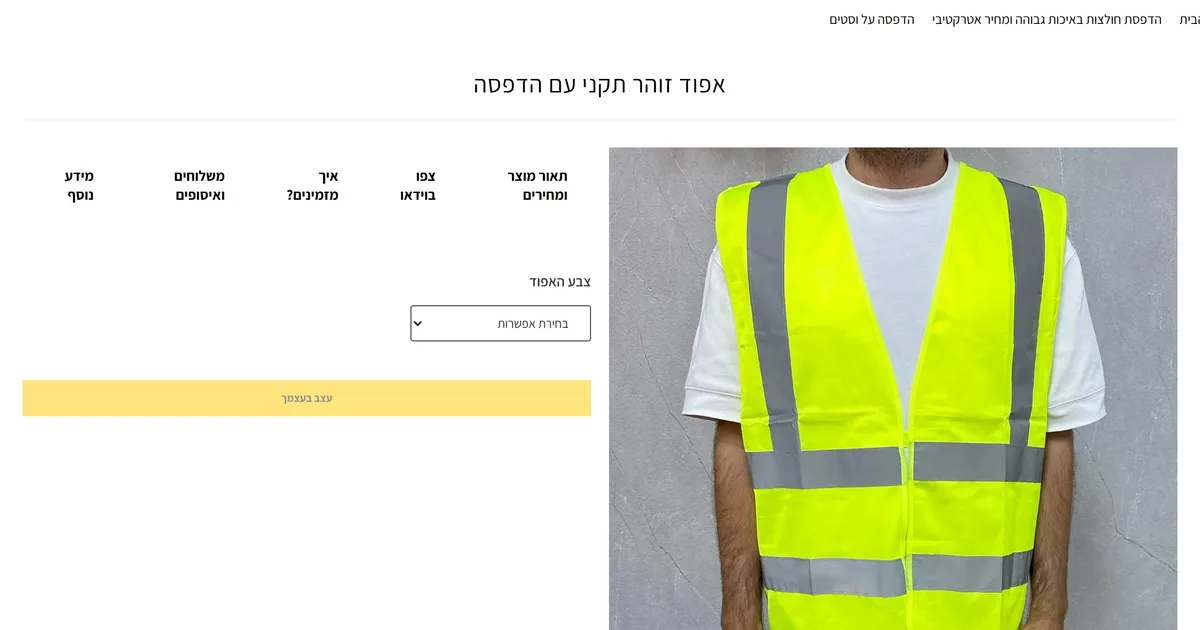
A product page offers garment colour, size and print side (front, back or both), then a choice: use the store's own design-it-yourself designer, or upload finished artwork. Printing methods named on the product page include flex, printed flex and DTF, with a print area of up to A3 per side, and linked tables for garment sizing and wash-care guidance.
- Client
- Migvan, Israel
- Status
- Delivered — live store, checked 2026-10-03
- Store
- migvan4u.co.il, Hebrew language, right to left
- Platform
- WordPress with WooCommerce and Elementor (visible in the public page source)
- Products
- T-shirts, polos, hoodies, sweatshirts, baby clothes, event and corporate garments, jerseys, bulk DTF orders
- Work by Netbase JSC
- Custom web-to-print project: a Hebrew online garment designer, built through eight numbered customisation releases
- Engagement period
- Project records from August 2021 to August 2025, about four years of dated, project-specific work
- Milestones
- Seventeen project-specific milestones, with no project-plan scaffold
How large is the market Migvan's designer has to reach?
Israel's population was about 9.85 million in 2023, and 87.0% of people used the internet, according to World Bank Open Data (sourced from the International Telecommunication Union). A store built for a market this size and this connected has little room to rely on buyers who already own design software; most of the catalogue, from a single event T-shirt to a corporate bulk order, has to be designable by a buyer using only a browser. The dossier behind this case study found no official Israeli figure specific to garment or textile e-commerce, so this section stops at the two figures that are independently verifiable rather than estimating further.
What is the business problem a garment designer in this market has to solve?
Two constraints run through Migvan's catalogue. The first is scale and variety: the same designer has to work across T-shirts, hoodies, baby clothes and jerseys, for a single buyer ordering one shirt and for a business or school ordering many, each with its own colour, size and print-side choice. A designer tuned only for a single product type cannot carry that range.
The second is language. Hebrew is written right to left, and a garment designer has to place text correctly in that direction, including the mixed-direction lines that appear when a Hebrew phrase contains a name, a number or a date written left to right. A designer that only handles left-to-right text produces a shirt with reversed or misplaced wording, which a buyer approves on screen before it reaches production. Underneath both constraints sits the production side: flex, printed flex and DTF each expect a different file per print side, so whatever the buyer designs or uploads has to resolve to the right file for the method the order will actually use.
What decisions and trade-offs shaped the project?
-
Eight numbered designer releases, not one large rebuild
The records show versions 1.2.0 through 5.0.0 shipped between mid-2022 and early 2023, each a scoped release rather than a single rewrite. The rejected option is a one-time build; the records show the designer instead grew in dated, numbered steps.
-
Dedicated Hebrew and right-to-left work, not left-to-right text treated as good enough
A 2025 task adds Hebrew-language support to the designer specifically, rather than assuming the generic plugin's text handling was already correct for a right-to-left store.
-
Mobile-specific fixes, not a desktop-only designer
An October 2024 record fixes designer errors on newer iPhone models. The rejected approach is treating mobile as a smaller version of the desktop designer; the fix was scoped to the mobile experience on its own.
-
Continued investment after four years, not a project closed at launch
The 2025 phase of work, including printing-option changes and font fixes, runs three to four years after the designer's first numbered release, on records that show acceptance and handover at the end of that phase rather than an early close.
How does an order move from the product page to a production file?
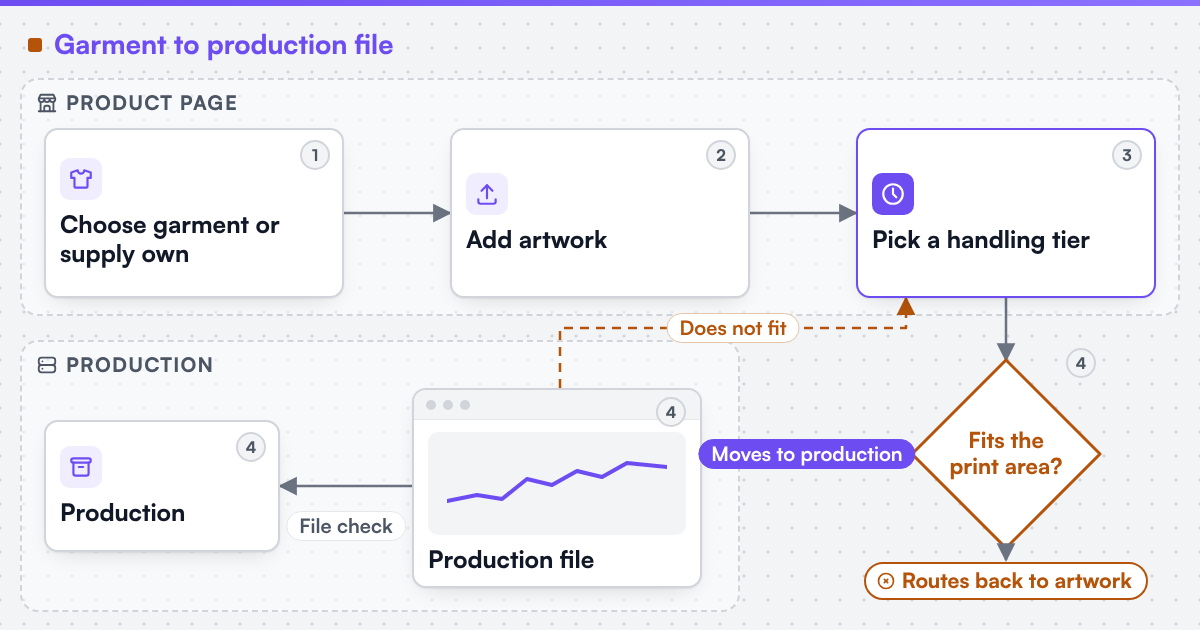
A garment product page where a buyer picks a colour, a print side and then either the store's own designer or a file upload.
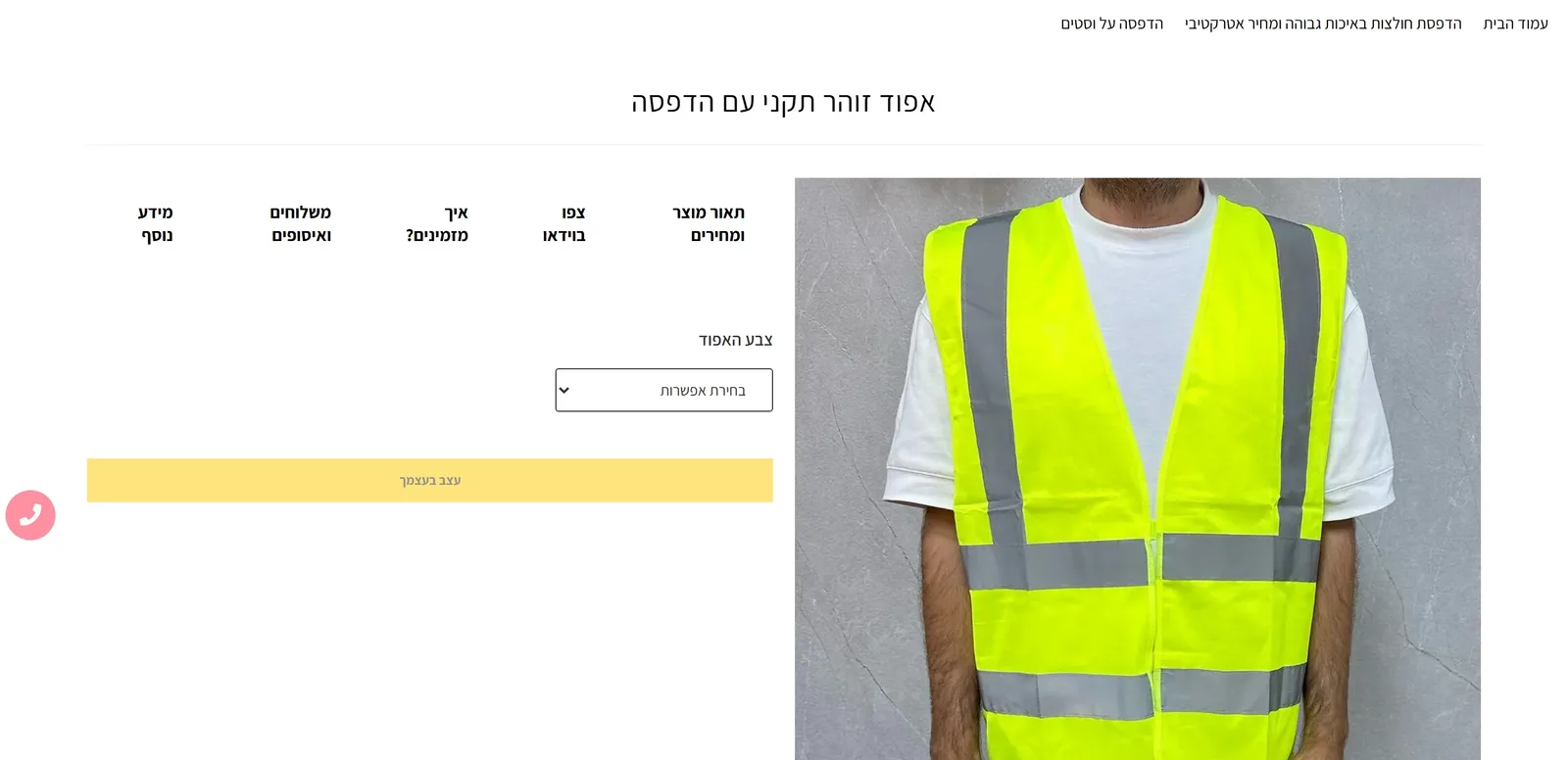
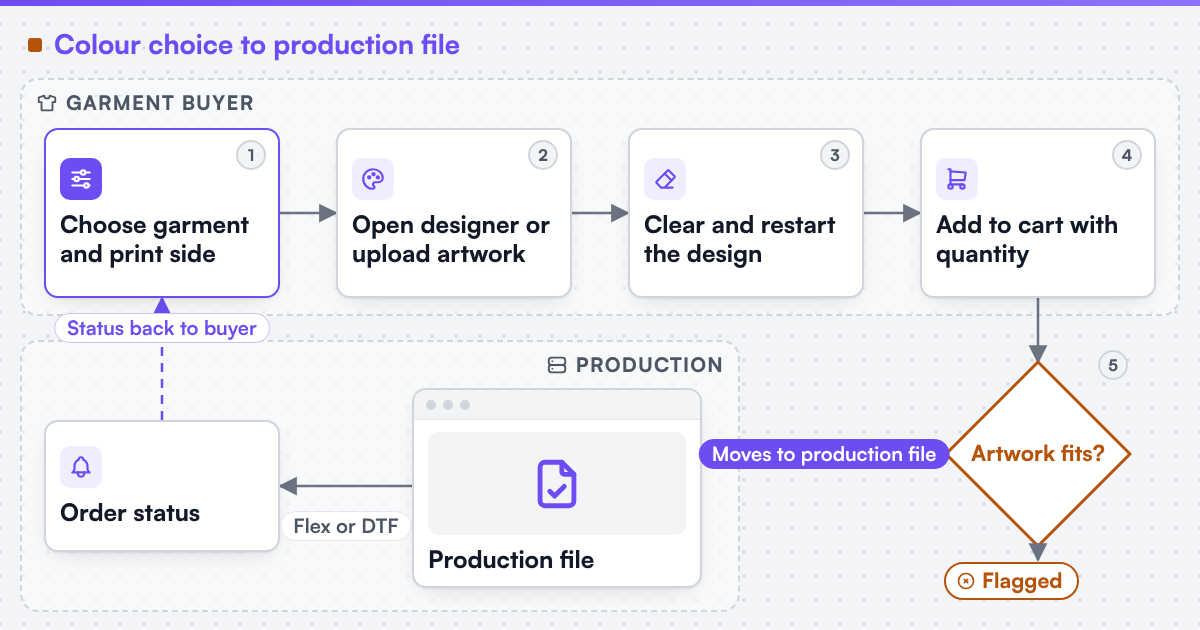
- Choose garment, colour and print side The buyer picks the garment, its colour, size and whether the print goes on the front, the back or both sides.
- Open the designer or upload artwork The buyer opens the design-it-yourself designer, or uploads finished artwork instead.
- Clear and redo if needed A clear button lets the buyer restart the design before it is finished.
- Add to cart with quantity The finished design or uploaded file is added to the order with a quantity.
- Check the artwork fits the print area Artwork that exceeds the print area for the chosen method is flagged before production; artwork that fits moves to a production file for flex, printed flex or DTF, and the buyer can later check the order's status.
-
Product options
Garment, colour, size, print side (front, back, both)
-
Price inputs
Garment, sides printed and quantity; no figures are published on this page
-
Artwork rules
Browser-based design, or an uploaded file, placed within a print area of up to A3 per side
-
File output
A production file per method: flex, printed flex or DTF, matched to the chosen side
-
Integrations
WooCommerce catalogue and checkout; an Israeli payment gateway; a web-to-print designer plugin with custom-design and upload containers
The failure modes the build guards against are the ones the dated records and the storefront both point to: Hebrew text placed as if it read left to right, a designer that breaks on current mobile devices, and artwork sent for production without a print-area check for the method the order will actually use. Each is a way a buyer-approved design could still reach production wrong.
Netbase JSC maintains reusable web-to-print components - a browser-based online designer, rule-based print pricing templates, print-ready PDF output with CMYK conversion, bleed and trim, storefront connectors for WooCommerce, Shopify, Wix and custom stores, and a garment designer with print-area placement - which an engagement may reuse under their own licence terms. The catalogue, pricing, production and customer relationships belong to Migvan.
 (opens the full-size diagram in a new tab)
What was delivered over time?
-
2021, Q3-Q4 (Aug-Oct)
A fix to the quantity option on products.
-
2022, Q2-Q3 (Jun-Sep)
Designer customisation releases 1.2.0, 2.5.0 and 2.6.0.
-
2022, Q4 (Oct-Dec)
A set of extra client requests, and releases 3.0.0, 3.1.0 and 4.0.0.
-
2023, Q1 (Jan-Mar)
Release 5.0.0; a button removed from the design page; a font-problem fix with an instructional video.
-
2023, Q4 (Oct-Nov)
Two rounds of payment-step fixes, and a FAQ customisation.
-
2024, Q4 (Oct)
Designer errors on newer iPhone models fixed.
-
2025, Q2-Q3 (May-Aug)
Hebrew-language support, a printing-options change, a default-on option, a font-error fix and a linked price-and-description button, with acceptance and handover recorded on 2025-08-31.
Migvan's project index carries no project-plan scaffold milestones, unlike some other engagements in this set; all seventeen project-specific milestones represent dated, scoped work.
What does this record show, and what does it not?
It shows an Israeli garment printer running a Hebrew, right-to-left online designer across T-shirts, workwear and bulk DTF orders, with four years of dated, numbered customisation work.
It does not show order volumes, conversion or any revenue figure; none is measured to a published method and none is claimed. It does not attribute every plugin or storefront feature visible today to Netbase JSC; the records describe the designer releases and fixes listed above. Web2Print Solutions is the web-to-print engineering service of Netbase JSC. Delivery records cited on this site belong to Netbase JSC; where no delivered example of a capability is published, the page says so rather than implying a record.
What should a print business in this niche take from it?
-
Treat right-to-left language support as a designer feature, not a translation task
Hebrew text inside a garment designer needs its own placement logic, including mixed-direction lines with numbers or dates.
-
Plan for mobile as its own surface
A designer that works on desktop can still fail on a current phone; test on real devices rather than assuming parity.
-
Match the file to the print method, not just the print area
Flex, printed flex and DTF each need their own production file per side; a single generic export will not serve all three.
-
Expect the designer to grow in numbered releases
Four years and multiple version releases is a realistic shape for a garment designer that keeps pace with a changing catalogue, not a sign of an unstable build.
-
Separate single-item and bulk ordering early
A buyer ordering one shirt and a business ordering a bulk DTF run need different quantity and review steps on the same designer.
Key takeaways
- Migvan is an Israeli garment and workwear printer whose Hebrew store was live on 2026-10-03.
- Buyers design online or upload artwork, choosing colour, size and print side before checkout.
- Netbase JSC's records hold a custom engagement from August 2021 to August 2025, with seventeen project-specific milestones across eight numbered designer releases.
- Hebrew right-to-left handling and mobile-device fixes were each treated as their own scoped work, not assumed to come free with the base designer.
- No order volume, conversion or revenue result is claimed for the store.
How could a similar project start?
If you print garments or workwear, or sell in a right-to-left language, send a project brief that names your platform, your busiest garment templates, and three examples of real customer text, including any mixed-direction lines. Garment placement rules are covered on the t-shirt and apparel designer page, and the routing logic behind decoration methods on apparel and promotional print. Option rules belong in a print product configurator, and store connections in WooCommerce web-to-print. A related Hebrew-language record on a different platform is the U-Print case study; more client-operated stores are on live web-to-print stores, and every case study is indexed on the evidence hub.
Frequently asked questions
No. U-Print is a separate client on Wix, selling general print such as business cards and stickers. Migvan is a garment and workwear printer on WordPress and WooCommerce, with its own designer for clothing.
The 2025 project records add Hebrew-language support to the designer as a dedicated task, which is what this page cites; the store's product pages are in Hebrew today.
The public store names flex, printed flex and DTF, with a print area of up to A3 per side, and separate pages for bulk DTF orders.
The dossier behind this page did not find an official Israeli statistic specific to garment or textile e-commerce; rather than estimate one, this page cites only the figures that are independently verifiable.
References (5)
- Netbase JSC project records for migvan4u.co.il (custom web-to-print project, seventeen project-specific milestones, August 2021 to August 2025), reviewed 2026-10-03.
- Migvan public store, migvan4u.co.il, read-only check from Hanoi, Vietnam, accessed 2026-10-03.
- World Bank Open Data, "Individuals using the Internet (% of population) - Israel," data.worldbank.org/indicator/IT.NET.USER.ZS, accessed 2026-10-03.
- World Bank Open Data, "Israel," population total, data.worldbank.org/country/israel, accessed 2026-10-03.
- WooCommerce documentation, woocommerce.com/documentation, accessed 2026-10-03.
The businesses named in these case studies are Netbase JSC clients; the web-to-print work described was delivered or designed by Netbase JSC, which operates Web2Print Solutions. Names, links and screenshots are shown with the operator's authorization and removed on request.
Related projects
MyTeeMyPrint is a Kuala Lumpur apparel printer whose WooCommerce store sells its own tees, polos, hoodies and bags with an online customise step. Netbase JSC delivered a custom web-to-print project for the store's apparel, running from 2021 to 2026, and the store offers seven decoration methods. The store was live on 2026-09-30.
Learn More
We Print All is a South African store selling apparel, business cards and signage from one catalogue. Netbase JSC's records hold a custom web-to-print engagement from October 2023 to June 2026, covering an online designer, pricing and PDF output. On 2026-10-07 the store returned a server error, so this record carries no live link today.
Learn More
T Shirts Australia is a Brisbane apparel printer whose WooCommerce store sells custom and blank T-shirts, graphic tees and hats with an online designer, two print methods and same-day, express and standard handling. Netbase JSC's records hold a custom engagement from August 2023 to November 2025, and the store was live on 2026-10-10.
Learn More