

Web-to-print for New Zealand print businesses
Web2Print Solutions has no New Zealand office, staff or entity; every engagement for a New Zealand print business is delivered remotely from Hanoi, Vietnam by Netbase JSC. It configures a storefront's GST tax invoices, an address field that preserves macrons in Māori place names, NZ Post dispatch and account-to-account payment.
Start a project brief Explore servicesReviewed by CEO, Netbase JSC · Published 1 Oct 2026 · Updated 1 Oct 2026

What is web-to-print for New Zealand print businesses?
Netbase JSC, which operates Web2Print Solutions, configures web-to-print storefronts for print businesses selling into New Zealand. All engineering and delivery for Web2Print Solutions is performed remote-first from Hanoi, Vietnam. Web2Print Solutions has no office, legal entity, employee base, representative or local support window in any other location. A New Zealand engagement configures a storefront's tax invoices, address handling, carriers and payment methods for that market.
New Zealand sits next to Australia on this site's market list, and the two are often treated as one build with a different GST rate swapped in. That shortcut misses what has nothing to do with the rate: a privacy law with its own text, a different parcel network, and an address field that must accept macrons rather than silently mangling them.
Key takeaways
- GST is 15%, against Australia's 10%, charged on most printed products and finishing add-ons and administered by Inland Revenue.
- New Zealand addresses often include Māori place names with macrons, such as Taupō or Whakatāne; a field that silently strips them can misaddress the parcel.
- NZ Post and CourierPost, not Australia Post or StarTrack, are the carrier integrations a New Zealand checkout needs (compare the Australian setup).
- Account-to-account payment, through services such as POLi or an open-banking provider, sits alongside card payment as an option buyers expect.
- The Privacy Act 2020, not Australia's Privacy Act 1988, governs a New Zealand storefront's data handling.
How does an order move from checkout to delivery in New Zealand?
The buyer sees a GST-inclusive price, and checkout issues a tax invoice carrying the seller's GST number and GST amount against an address field that stores macron characters rather than converting them to plain letters or rejecting them. The buyer pays by POLi, another account-to-account method, or card; the order becomes a production job handed to NZ Post or CourierPost.
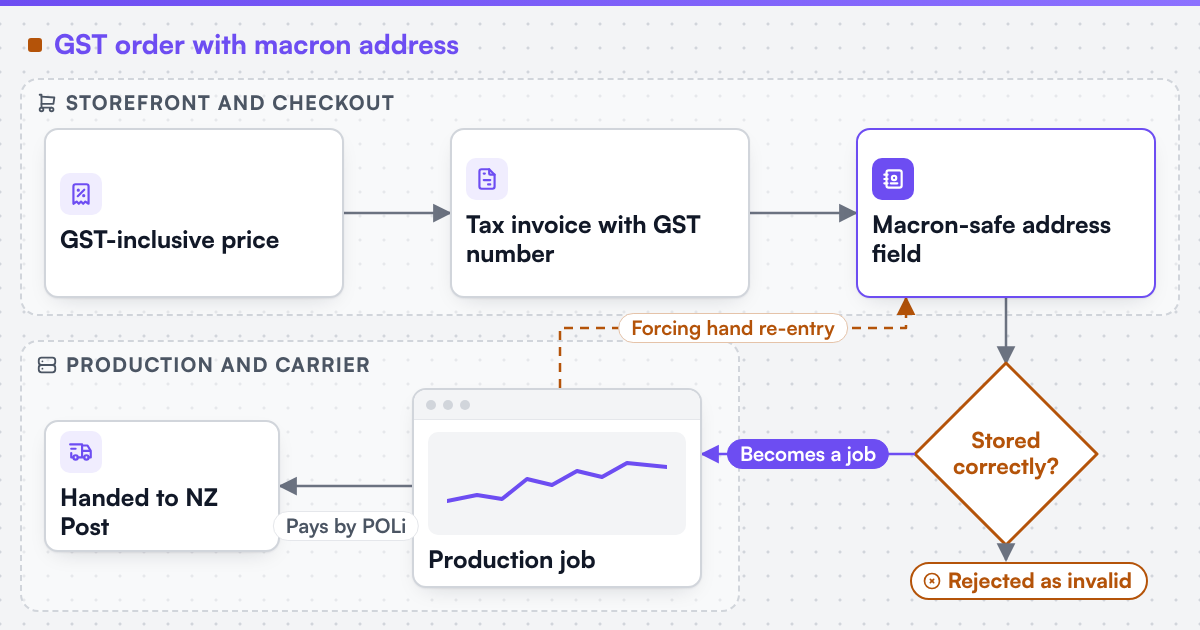 (opens the full-size diagram in a new tab)
What GST rules does a New Zealand storefront need to apply?
-
GST rate
15%, a single national rate, distinct from Australia's 10%
-
Tax invoice (over NZD 1,000)
Must show the seller's name and GST number, the buyer's details, a description of the goods, the GST amount and the total payable
-
Tax invoice (NZD 1,000 or under)
A simplified invoice is permitted, still showing the GST number and the GST-inclusive total
-
Record keeping
Inland Revenue requires invoice records to be retained in a form that can be produced on request
A storefront copied from an Australian build and re-rated at 15% usually keeps the Australian invoice layout, which is a cosmetic fix rather than a compliant one once Inland Revenue's invoice fields are checked.
What is the macron address problem, and why does it matter here specifically?
New Zealand's official place names standard treats macrons as correct spelling, not decoration: Taupo and Taupō are the same place, but only the macron form is the standard the New Zealand Geographic Board has adopted for hundreds of Māori place names. A storefront's address field, carrier label export and order-confirmation email must carry UTF-8 macron characters through the whole pipeline without stripping, double-encoding or rejecting them. The risk is not theoretical: Māori-owned businesses have reported a national carrier's own online shipping tool rejecting a correctly spelled macron address as invalid, forcing hand re-entry. A build inherited from a market without a macron convention, Australia included, will not handle this by default.
What units, address format and carriers does New Zealand use?
-
Paper sizes
A-series (A4, A5, A3), grams per square metre
-
Address format
Street number and name, suburb, town or city, four-digit postcode; macrons preserved in any Māori place name
-
Carriers
NZ Post, CourierPost
-
Payment
Cards, POLi or another account-to-account method, invoice or account terms for trade buyers
What privacy and accessibility law should a New Zealand engagement respect?
A New Zealand storefront that collects customer names, addresses and order history sits under the Privacy Act 2020, which replaced the 1993 Act and is administered by the Office of the Privacy Commissioner, a different statute and regulator from Australia's. New Zealand has no general private-sector web-accessibility law: the Web Accessibility Standard, set by the Government Chief Digital Officer, mandates WCAG conformance for public service websites only, while the Human Rights Act 1993 prohibits disability discrimination broadly without naming a web standard. Confirm both with the client's own counsel; neither is a certification Web2Print Solutions holds.
What does a New Zealand market engagement include, and what does it not?
Included
- GST-compliant tax invoice fields at both invoice thresholds
- Macron-safe address capture, storage and carrier label export
- NZ Post or CourierPost integration, POLi or account-to-account checkout
- A-series product templates
Not included
- Registering the client for GST
- Correcting a client's existing mis-stored macron addresses as a side effect
- A New Zealand office, staff, entity or local support window
- Advice that substitutes for the client's own accountant
What proof already exists for the New Zealand market?
Netbase JSC, which operates Web2Print Solutions, has delivered 50+ web-to-print platforms. No published live-store example or named client reference on this site is New Zealand-based today; where a record does not exist, this page says so rather than implying one.
What is the time-zone difference with a team based in Hanoi?
| Factor | Detail | Applies to |
|---|---|---|
| Hours difference from Hanoi | Five to six hours behind New Zealand, depending on daylight saving | New Zealand |
| Collaboration pattern | Asynchronous work against written change control, not a promised response window | New Zealand |
Send a project brief with your GST registration status, your current storefront platform, whether your address data already includes macron place names, and the carrier accounts you hold. See also web-to-print implementation.
Discuss your web-to-print project
Frequently asked questions
No. The tax invoice fields, carrier integration, payment methods and macron-safe address handling are each checked against New Zealand's own rules rather than copied from the Australia build.
No. Delivery is entirely remote from Hanoi, Vietnam; the client's own New Zealand entity holds the GST registration, bank account and carrier contracts.
The engagement can scope a one-off data-correction pass against the client's own records, but it is separate, explicitly agreed work, not something the storefront fixes automatically.
Yes, with the tax, address, carrier and payment logic each keyed to the buyer's country rather than assumed from a single shared template.
References (6)
- Inland Revenue, GST, accessed 2026-10-01.
- Office of the Privacy Commissioner, Privacy Act 2020, accessed 2026-10-01.
- Toitu Te Whenua LINZ, Standard for New Zealand place names NZGBS60002, accessed 2026-10-01.
- Department of Internal Affairs, Standards & guidance (Web Accessibility Standard), accessed 2026-10-01.
- New Zealand Legislation, Human Rights Act 1993, accessed 2026-10-01.
- NZ Post, Addressing guidelines, accessed 2026-10-01.